



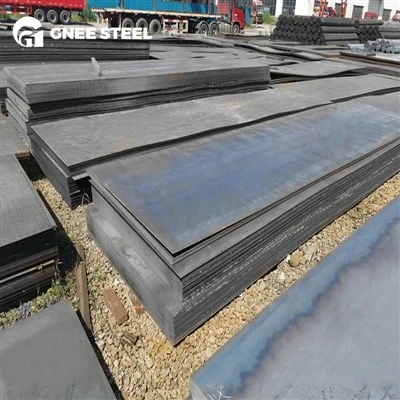
GB Low Alloy Steel Plate
Your Professional GB Low Alloy Steel Plate Supplier
Our goal is to become your true partner in the field of GB low alloy steel plate in China. Gnee Steel Group is committed to becoming the world's most internationally competitive supply chain group, meeting the different needs of different customers. We have a skilled engineering team dedicated to refining every stage, from product development and process improvement to production oversight, ensuring every product delivered meets rigorous quality and performance standards. The price is competitive and the product is quality-assured, which is a good choice for your long-term cooperation.




Why Choose Us
Our certification:
Our company has obtained SGS certification. We have also passed ISO9001 and ISO14001 environmental management system certification.
Quality control:
All our products are made of the highest quality materials and are subject to factory inspection, cargo inspection at any time.
Our capacity:
We have established long-term cooperative relationships with dozens of factories to ensure the production of our products, and our annual export volume exceeds 80,000 tons.
Our services:
In the pre-sales stage, our team of experts will recommend the most suitable products according to the needs of customers and provide detailed technical consultation. During the sales period, we ensure timely delivery and provide installation guidance.
Advantages of GB Low Alloy Steel Plate
Cost - effectiveness: One of the most significant perks of low carbon steel plate is its cost - effectiveness. Compared to other types of steel, like high - carbon or alloy steels, low carbon steel is way cheaper to produce.
Excellent formability: Low carbon steel plate is a dream when it comes to formability. It can be easily bent, rolled, stamped, and welded without cracking or losing its structural integrity. This makes it an ideal choice for a wide range of applications.
Weldability: Welding is a crucial process in many industries, and low carbon steel plate excels in this area. It has excellent weldability, which means that it can be joined together easily using different welding methods such as arc welding, mig welding, and tig welding.
Ductility: Ductility refers to a material's ability to deform under tensile stress without breaking. Low carbon steel plate is highly ductile, which means it can be stretched and drawn into wires or thin sheets without fracturing.
Good corrosion resistance (with proper treatment): While low carbon steel is not as corrosion - resistant as stainless steel, it can still offer decent protection against rust and corrosion when properly treated.
Availability: Another great advantage of low carbon steel plate is its wide availability. It is one of the most commonly produced types of steel in the world.
GB Low Alloy Steel Plate Specification
|
Grade |
Chemical Composition(%) |
||||
|
C |
Mn≥ |
Si |
P |
S |
|
|
GB/T1591 Q420D |
0.20 |
1.70 |
0.50 |
0.030 |
0.025 |
|
Grade |
Mechanical Property |
|
|||
|
Tensile Strength(MPa) |
Yield Strength(MPa) |
% Elongation in 2 in.(50mm) min |
Impacting Test Temperature(°C) |
|
|
|
GB/T1591 Q420D |
520-680 |
420 |
19 |
-20 |
|
Low alloy steel plate has good process performance and can be used for welding, bending, curling and other processing operations. At the same time, its corrosion resistance is also good. With appropriate anti-corrosion treatment, the service life of steel can be extended.
Low alloy steel plate has high strength, good fatigue resistance; high toughness and low brittle transition temperature; good cold forming performance and welding performance; good corrosion resistance and certain wear resistance.

Application of GB Low Alloy Steel Plate
Bridges: High strength low alloy steel plates are used for long-span bridges and structural support.
Shipbuilding: Commonly used for hulls and other structural components of large ships.
Railway and vehicles: Found in the manufacturing of railway cars, vehicles, and parts like truck frames.
Heavy equipment: Critical for the construction of heavy machinery used in mining and construction, such as bulldozers, excavators, loaders, and cranes.
Buildings: They are used in the construction of high-rise buildings, warehouses, and other large commercial structures.
Power plants: These plates are employed in the construction of power plant equipment, including high pressure boilers and other large welded structures.
Civil engineering: Used in various civil construction projects for structural components.
Customizable options of GB Low Alloy Steel Plate
Surface appearance:
Customers can specify the desired finish for the steel plate, such as a cold-rolled finish (CR), hot-rolled (HR), or a more polished look.
Thickness, width, and length:
A key customization is specifying the precise dimensions needed for a project, rather than relying on standard stock sizes. Manufacturers can provide a range of thicknesses, widths (from 1,500 to 4,500 mm), and lengths (up to 27,000 mm).
Coatings and treatments:
A layer of protective primer can be applied to prepare the plate for further finishing and enhance durability. A process of applying a protective zinc coating to prevent corrosion.
Packing and Shipping of GB Low Alloy Steel Plate
|
Packing |
Standard export packing (inside:water proof paper,outside:steel covered with strips and pallets) |
|
Shipping |
Shipped by road, sea, rail |
FAQ