



Power Transformer
Our goal is to become your true partner in the field of power transformer in China. Gnee Steel Group is committed to becoming the world's most internationally competitive supply chain group, meeting the different needs of different customers. We have a skilled engineering team dedicated to refining every stage, from product development and process improvement to production oversight, ensuring every product delivered meets rigorous quality and performance standards. The price is competitive and the product is quality-assured, which is a good choice for your long-term cooperation.


Our services:
In the pre-sales stage, our team of experts will recommend the most suitable products according to the needs of customers and provide detailed technical consultation. During the sales period, we ensure timely delivery and provide installation guidance. For after-sales, we provide long-term technical support, warranty services and spare parts to help customers maximize the use of products and get reliable maintenance during use.
Our certification:
Our company has obtained SGS certification. We have also passed ISO9001 and ISO14001 environmental management system certification.
Our capacity:
We have established long-term cooperative relationships with dozens of factories to ensure the production of our products, and our annual export volume exceeds 80,000 tons.
Quality control:
All our products are made of the highest quality materials and are subject to factory inspection, cargo inspection at any time.
Advantages of Power Transformer
Energy efficiency:
Transformers are designed to be power efficient, which helps reduce power losses and save energy.
01
Increased power quality:
Transformers help improve power quality by providing power at a safe and consistent voltage level.
02
Improved safety:
Transformers provide electrical isolation between power sources and power loads, which helps increase safety.
03
Increased power capacity:
Transformers can increase the power capacity of power systems, which helps power more loads.
04
Cost savings:
Transformers are cost-effective power solutions and can help reduce power costs in power distribution systems.
05
Power Transformer Specification
|
132kv Class Three-phase two winding OLTC power transformer |
|||||
|
Rated Power |
High Voltage |
Low Voltage |
No-load Loss(kw) |
On-load Loss(kw) |
No Load current(%) |
|
10MVA |
132 kV |
6.3 kV |
11.8 |
51.2 |
0.82 |
|
12MVA |
13.7 |
59.5 |
0.82 |
||
|
15MVA |
16.3 |
73.1 |
0.76 |
||
|
20MVA |
19.5 |
88.4 |
0.76 |
||
|
25MVA |
22.7 |
105 |
0.69 |
||
|
30MVA |
27.4 |
126 |
0.69 |
||
|
37.5MVA |
32.9 |
148 |
0.63 |
||
|
50MVA |
38.9 |
184 |
0.63 |
||
|
60MVA |
46.4 |
221 |
0.57 |
||
Components of Power Transformers
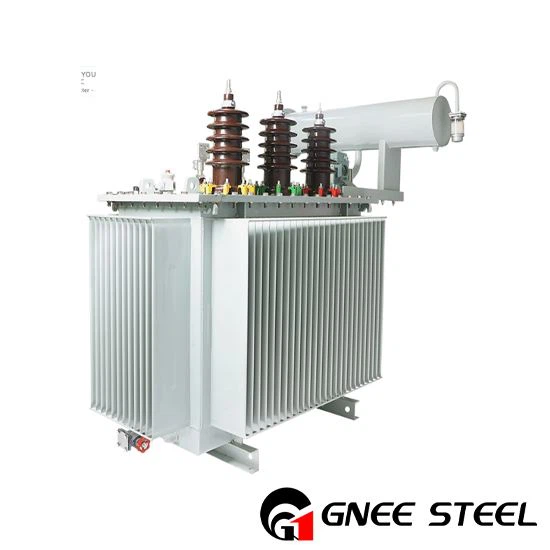
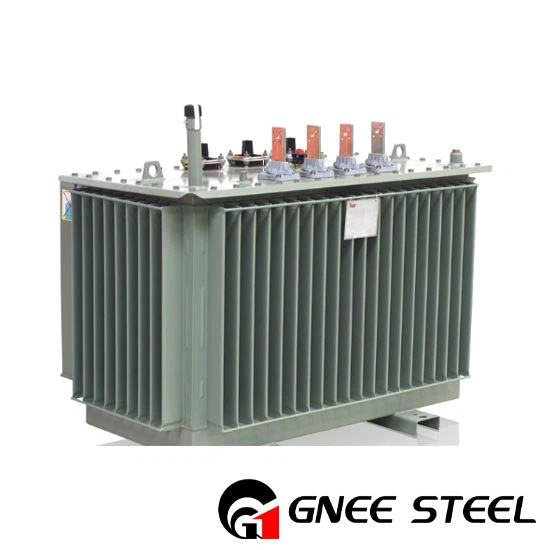

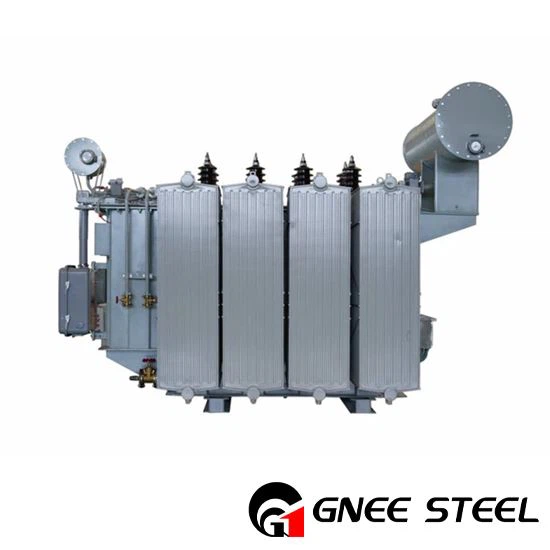
Core components: The core of a transformer supports the windings and provides a path of low reluctance for the magnetic flux. It is constructed by stacking and laminating thin steel sheets, which are insulated from one another by a coating.
Windings in power transformers: The windings of a transformer are composed of copper or aluminum coils with a specific number of turns.
Insulating materials: Insulating materials are essential for isolating the windings from the core, between the primary and secondary windings, and between each turn of the windings. These materials protect the transformer from potential damage.
Tap changer: Tap changers are devices used to regulate a transformer's output voltage by adjusting the number of turns in one winding.
Bushings in transformers: Bushings are insulating components that facilitate the connection between the current-carrying conductors of an electrical network and the ends of the transformer windings.
Transformer tank: The transformer tank (or the main tank) houses and protects the core, windings, and other components from the external environment.
Conservator component: The conservator is a tank positioned above the main tank and bushings, serving as a reservoir for transformer oil. It supplies oil to the main tank inside the transformer through a pipeline.
Breather component: The breather ensures that moisture-free air is supplied to the conservator by passing air through a bed of silica gel within a cylindrical container.
Cooling system: The cooling system is an essential component of transformers, regardless of the type of insulating material used. Power losses in transformers generate heat, which increases the temperature of the windings and core.
Explosion vent: The explosion vent is a metallic pipe with a diaphragm at its open end, situated just above the conservator tank.
Buchholz relay: The buchholz relay is installed in the pipeline connecting the conservator and the main tank of a transformer.
Types of Power Transformer
Berry type transformers: A berry-type transformer is shaped like an asterisk or like the spokes of a wheel. These transformers often have more than two independent magnetic circuits.
Core-type transformers: A core-type transformer is made from separate primary and secondary circuits that share a common core. In this type of transformer, the primary and secondary transformer windings surround the core.
Shell-type transformers: In a shell-type transformer, unlike core or berry-type transformers, the core surrounds the primary and secondary coils.
Isolation transformers: An isolation transformer is a power transformer that is used to couple two circuits together while electrically isolating them from each other.
Distribution transformers: A distribution transformer is a transformer that provides the last voltage transformation in power delivery to end users.
Step-down transformer: Step-down power transformers are designed to reduce the voltage and power of an input power source.
Step-up transformers: A step-up transformer is designed to increase the power and voltage of a power source.
Autotransformers: An autotransformer is a power transformer with only one winding. This power transformer operates by varying the voltage of the power supply to match it with the load.
Single-phase transformers: A single-phase transformer has only one power input and two power outputs.
Applications of Power Transformer
Power generation:
Power transformers are used to step up the voltage generated by power plants for transmission to substations.
Power transmission:
Power transformers are used to step up or step down the voltage at different points of the transmission network for efficient power delivery.
Power distribution:
Power transformers are used to step down the voltage for distribution to domestic or commercial users. It operates at variable loads depending on the demand and has good voltage regulation.

Power generation:
Power transformers are used to step up the voltage of the electricity generated by power plants before it is sent to the grid. This reduces the current and the line losses during transmission.
Power transmission:
Power transformers are used to step up or step down the voltage at different points of the transmission network for efficient power delivery. They also provide galvanic isolation and impedance matching between different circuits.
Power distribution:
Power transformers are used to step down the voltage for distribution to various consumers. They also provide multiple voltage levels for different applications, such as lighting, heating, cooling, communication, etc.
Lighting:
Power transformers are used to provide low voltage and high currents for lighting systems, such as fluorescent lamps, neon signs, etc.
Production Process of Power Transformer
Transformer core manufacturing process:
The transformer core manufacturing process involves raw materials like silicon steel, cold-rolled with grains orientated, or crgo.
Transformer tank manufacturing process:
Some transformer manufacturers like daelim only utilize high-quality steel in all their storage tanks. That is to pass the rigorous inspections necessitated by both international standards and the client.
customized service
After the core transformer assembly process is generally done, manufacturers can now put the core and coil together. Then the core assembly can be set up vertically with the footplate on the floor once the manufacturers remove the top yoke.
Transformer painting and finishing manufacturing process:
Transformer testingin this last stage of the power transformer manufacturing process, manufacturers seal the transformer tank.
Packing and Shipping of Power Transformer
|
Packing |
Standard export packing (inside:water proof paper,outside:steel covered with strips and pallets) |
|
Shipping |
Shipped by road, sea, rail |
Other Service of Power Transformer
|
Delivery time |
7 to 15 working days |
|
Payment terms |
30%TT for deposit, 70% balance before shipment or LC at sight |
|
Supply ablitity |
10000 Ton/ per Month |
FAQ