



Shipbuilding Steel Plate
Why Choose Us
We Are 100% Factory
We are a professional manufacturer with many years of experience, offering a one-stop packaging solution from design and production to shipping.
Professional Service
We accept factory and goods inspections at any time. We also offer technical discussions, research and development of new products, and comprehensive after-sales service.
Our Products
Our main products include shipbuilding steel plates, wear-resistant steel plates, corten steel plates, pressure vessel steel plates, alloy steel plates, and low alloy steel plates.
Quality Assurance
We utilize state-of-the-art equipment, experienced designers, and skilled workers. Our advanced production management experience and strict quality management standards ensure high quality. OEM and ODM services are available, and we can provide samples upon request.
What Is Shipbuilding Steel Plate?
Shipbuilding steel plate is a type of steel plate used in shipbuilding industry. It is typically made from hot rolled mild steel, although some shipbuilding steel plates may also be made from high-strength low-alloy (HSLA) steel or alloy steel. Shipbuilding steel plates come in a variety of grades, each with its own particular properties. They are typically used in the construction of the hull and other structural components of a ship, such as bulkheads, decks, and superstructures. These plates must meet certain requirements for strength, toughness, and corrosion resistance in order to withstand the harsh conditions of the marine environment.


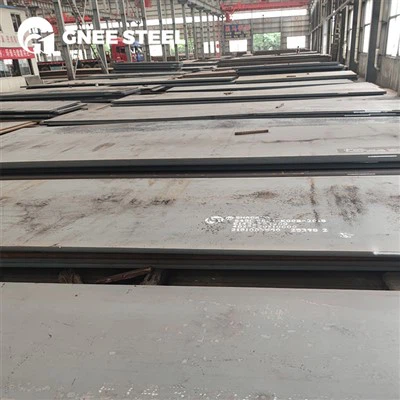


Grade A and B shipbuilding steel plates of general strength can meet the requirements of their process and mechanical properties through ordinary rolling, so the production process is relatively simple; while the production of Grade D, E and high-strength shipbuilding steel plates requires relatively complete equipment. Under the equipment, it is realized by means of controlled rolling and controlled cooling process or heat treatment process. At the same time, the internal steel purity of the supplied billet is relatively high, especially the content of S, P, N, O, H, etc. in the steel must be strictly controlled.
In order to reduce costs, it is the best strategy to produce shipbuilding steel plates by hot rolling or controlled rolling instead of normalizing. High-strength shipbuilding steel plates with a thickness of less than 35mm have been produced by two-stage controlled rolling; high-strength ship plates with a thickness of more than 35mm are mostly produced by hot rolling and normalizing.
In order to ensure the performance of high-strength shipbuilding steel plates, micro-alloying technology is used. By adding alloying elements such as Nb, V, and Ti to the steel, combined with the controlled rolling process, the grains are refined and the strength and toughness are improved.
Grade D, E series shipbuilding steel plates are required to have good low temperature toughness and good welding performance, which should be guaranteed first in terms of steel smelting process, and secondly, an effective controlled rolling and controlled cooling process should be implemented. In recent years, major domestic iron and steel enterprises have fully realized the importance of improving the internal quality of steel, and relying on the progress of smelting technology, improvements have been made in hot metal desulfurization and slag skimming, steelmaking hydrogen blowing, and vacuum refining outside the furnace, which has significantly reduced the harmful effects of steel.
Corrosion Resistance
Shipbuilding steel plates are typically made from specialized steel grades designed to withstand corrosion in marine environments. Such steels’ primary alloying elements and chemical composition must be carefully balanced to ensure resistance against the corrosive environment. For example, shipbuilding steels may contain higher amounts of chromium, nickel, and molybdenum than other low-alloy steels to offer greater protection against corrosion. Furthermore, plates may have their surfaces treated with special coatings or anodization processes which can help reduce exposure to seawater and moisture. Adopting a proper maintenance plan is also essential for ensuring consistent corrosion resistance, as any damage could lead to accelerated oxidation in the marine atmosphere.
High Tensile Strength
Shipbuilding Steel Plates are specifically designed for shipbuilding and offer the best combination of high tensile strength, abrasion resistance, toughness and weldability. The plates are made from alloy, carbon, and weathering steel to provide corrosion resistance and excellent mechanical properties even in extreme conditions. Shipbuilding Steel Plates have been tested to withstand temperatures up to 800 degrees Celsius while maintaining superior mechanical properties. Furthermore, these plates also feature good formability characteristics, making them ideal for welding applications and providing superior corrosion protection, making them especially suitable for marine applications.
Weldability
Shipbuilding steel plates are designed to be easily welded, providing flexibility in the ship’s construction process. The ease of welding saves time, reduces labour costs, and adds longevity to the ship’s lifecycle.
Completed Ship Testing
To avoid marine disasters, international organizations such as the International Maritime Organization have established safety standards for the construction of commercial ships. The compliance process includes rigorous testing of completed ships, including testing steel materials. Using shipbuilding steel plates that comply with safety standards ensures the vessel’s durability, safety, and seaworthiness.
Cost-Effective
Shipbuilding steel plates provide a cost-effective solution to ship construction due to their durability and longevity. Steel plates are also recyclable, making them environmentally friendly. Additionally, quick and easy replacement of individual plates during routine maintenance can help reduce the vessel’s downtime, ultimately leading to cost savings for the ship owner.
Characteristics Of Shipbuilding Steel Plates
High Tensile Strength: Shipbuilding steel plates have high tensile strength, allowing them to withstand the significant forces and loads experienced by ships during operation. This strength is achieved through controlled rolling or thermomechanical control processing (TMCP) techniques.
Good Toughness: Shipbuilding steel plates exhibit good toughness, which is crucial for withstanding impacts, heavy vibrations, and other dynamic loads encountered at sea. This property ensures the structural integrity and safety of the ship.
Corrosion Resistance: Ships operate in corrosive seawater environments, and shipbuilding steel plates are designed to resist corrosion effectively. Additional protective coatings may be applied to enhance the plates' resistance to rust and degradation caused by exposure to saltwater.
Weldability: Weldability is essential for shipbuilding steel plates as ship structures involve extensive welding during construction. These plates are engineered to have good weldability, allowing for efficient and reliable joining of sections while maintaining the desired properties in the welded joints.
Low Temperature Properties: Some ships operate in cold regions or encounter low-temperature conditions during their service life. Shipbuilding steel plates are designed to maintain their mechanical properties and toughness even at low temperatures, ensuring reliable performance in freezing environments.
Classification Society Rules: Shipbuilding steel plates are manufactured in compliance with the rules and regulations set by classification societies such as the International Association of Classification Societies (IACS). Commonly used grades include ABS (American Bureau of Shipping), DNV (Det Norske Veritas), LR (Lloyd's Register), and BV (Bureau Veritas), among others.
Quality Control: Shipbuilding steel plates undergo stringent quality control measures to ensure compliance with industry standards. This includes testing for mechanical properties, chemical composition, dimensional accuracy, and non-destructive testing (NDT) methods like ultrasonic or magnetic particle inspection.
Applications Of Shipbuilding Steel Plate
Shipbuilding
ASTM A131 Marine Steel Plate is extensively used in the construction of various types of ships, including bulk carriers, container ships, tankers, and offshore platforms. It provides the structural integrity and strength required for safe and reliable vessel operation.
Offshore Structures
These plates are employed in the fabrication of offshore drilling rigs, production platforms, and other offshore structures, where their high strength and corrosion resistance are crucial for withstanding challenging marine conditions.
Marine Equipment
ASTM A131 Marine Steel Plate finds application in various marine equipment such as cranes, winches, deck machinery, and hull components, contributing to the overall reliability and safety of these systems.

What types of steel plates are required in shipbuilding?
Structural Steel Plates: Structural steel plates form the backbone of the ship's main structural components such as the hull, bottom, bulkheads, and decks. These plates need to possess excellent strength and weldability characteristics to ensure the integrity of the vessel's structure.
High-Strength Steel Plates: High-strength steel plates are utilized to enhance the overall strength and rigidity of the ship, improving its resistance to compression and tension forces. Common high-strength steel plate varieties include TMCP (Thermo-Mechanical Controlled Process), QT (Quenched and Tempered), and TM (Thermo-Mechanical) processed plates.
Lightweight Steel Plates: Lightweight steel plates are used for interior partitions, ceilings, and flooring within the ship. These plates help reduce the overall weight of the vessel while enhancing comfort and maneuverability.
Stainless Steel Plates: Stainless steel plates are employed to protect the ship's exterior decks, railings, and equipment from corrosive environments. They provide excellent corrosion resistance, ensuring longevity and durability in maritime conditions.
High-Temperature Pressure Vessel Steel Plates: These plates are engineered to withstand high temperatures and pressures, making them suitable for ship boilers, pressure vessels, and piping systems operating in extreme heat and pressure environments.
Mold Steel Plates: Mold steel plates are essential for shipbuilding and repair processes. These plates are used in the production of molds, such as ship compartment dock boards and templates, which aid in accurately shaping various ship components.
Quality
The quality of the shipbuilding steel plate is one of the most important factors to consider. Make sure to select high-quality materials that meet or exceed industry standards, such as those specified by classification societies like ABS, DNV GL, BV, LR, CCS, etc.
Composition
Different grades of shipbuilding steel plate have different chemical compositions, with varying levels of carbon, manganese, silicon, sulfur, phosphorus, and other elements. Ensure that the composition of the steel you select is appropriate for your specific application.
Strength
Shipbuilding steel plates come in various grades with different strength levels. Consider the strength required for your application and select a steel grade that meets your needs.
Thickness
The thickness of the shipbuilding steel plate is also an important consideration. Ensure that the thickness selected provides adequate strength and durability for the application.
Weldability
Some shipbuilding steel plates may have low weldability due to their chemical composition or manufacturing process. If welding is required, make sure to select a steel grade that has good weldability.
Surface condition
Check the surface condition of the shipbuilding steel plate before purchasing to ensure that it is free from defects, such as cracks, pitting, or roughness.
Price
Price is always a factor to consider when selecting ship plate steel. However, do not compromise on quality or performance for the sake of saving costs. Select a reputable supplier that provides high-quality materials at competitive prices.
What Is The Production Process Of Shipbuilding Steel Plate
Grade A and B shipbuilding steel plates with general strength can meet their technical and mechanical performance requirements through ordinary rolling, so the production process is relatively simple; while the production of D, E and high-strength grade shipbuilding steel plates requires relatively complete equipment.
At the same time, there is a high requirement for the purity of the internal steel quality of the supplied billet, especially the content of S, P, N, O, H, etc. in the steel must be strictly controlled.
In order to reduce costs, it is the best policy to produce shipbuilding steel plates by hot rolling or controlled rolling instead of normalizing. For high-strength ship plates with a thickness less than 35mm, two-stage controlled rolling has been adopted for production; high-strength ship plates with a thickness greater than 35mm are mostly produced by hot rolling and normalizing.
In order to ensure the performance of high-strength shipbuilding steel plates, micro-alloying technology is adopted. By adding Nb, V, Ti and other alloying elements to the steel, combined with the controlled rolling process, the grains are refined and the strength and toughness are improved. Due to the limitation of billet shape and billet weight, many manufacturers cannot produce extra-thick ship plates. The thick plate plants of Puyang Iron and Steel Co., Ltd. and Wuyang Iron and Steel Co., Ltd. can use large slabs or large ingots to roll ship plates with a thickness greater than 50mm.
D and E grade shipbuilding steel plates require good low-temperature toughness and good welding performance, which must first be guaranteed in the steel smelting process, and secondly, effective controlled rolling and controlled cooling processes must be implemented. In recent years, major domestic iron and steel enterprises have fully realized the importance of improving the internal quality of steel.
Our Factory

We have established long-term cooperative relationships with dozens of factories in China to ensure that our products are manufactured using high-quality materials and in sync with various international standards, with an annual export volume of more than 80,000 tons. Gnee Group is committed to becoming the world's most internationally competitive supply chain group, meeting the different needs of different customers, and truly realizing: one-stop service, making choice easier.
FAQ