

ASTM A645/A645M-10 Standard Specification for Pressure Vessel Plates, Five Percent Nickel Alloy Steel, Specially Heat Treated
ASTM A645/A645M-10,This specification covers specially heat treated 5 % and5 1/2 % nickel alloy steel plates intended primarily for weldedpressure vessels for service at low or cryogenic temperatures.
SA645 GrB complies with ASME specifications for pressure vessel steel plates. Under the SA645/SA645M standard, which covers SA645 GrA and SA645 GrB, this grade is a specially heat-treated 5% and 5.5% nickel-alloyed steel plate intended for welded pressure vessels in cryogenic service. Delivered as killed steel in a quenched or quenched and tempered condition, Wusteel's American-standard SA645 GrB steel plate is equivalent to the domestic 5Ni steel plate and features a minimum impact test temperature of -195°C.
Grade: A645 Grade B / X12Ni5
Standard: ASME SA-645 / SA-645M
Material type: Quenched and tempered 5Ni alloy steel plate
Nickel content: Approximately 5% Ni
Applications: LPG tanks, LEG tanks, VLEC cargo tanks, cryogenic pressure vessels
Key performance: Low-temperature toughness, weld-zone stability, fracture resistance
Inspection: Impact test, UT, heat treatment records, EN 10204 3.1 / 3.2 MTC
Related material: 9Ni steel for ultra-low-temperature LNG service
Kazakhstan 850 Tons A645 Gr. B Steel Plates For Cryogenic Reservoir Project
Project Overview
Application: Cryogenic Reservoir (Preliminary design phase)
Steel Grade: ASME SA645 Grade B (5.5% Nickel-alloyed steel)
Thickness Range: 14 mm to 36 mm
Project Volume: Approximately 850 Tons
Delivery Terms: Budget price per ton, RMB EXW, including professional packing for truck delivery.
Technical Inquiry & Confirmation
- Customer's Requirement:
The steel must pass a Charpy V-notch impact test at -104°C, with an impact value of at least 27 J/cm².
- Our Technical Confirmation:
Fully Confirmed. ASME SA645 Gr. B is specifically intended for cryogenic service down to -195°C (-320°F). At -104°C, this grade easily and consistently exceeds the required 27 J/cm² with a substantial safety margin. The plate is delivered as killed steel in a quenched or quenched and tempered (Q&T) condition to ensure optimal grain structure and low-temperature toughness.
We can fully provide and document all these technical requirements. For your procurement and technical documents, we will clearly specify the material as ASME SA-645 / SA-645M Grade B, along with the exact plate thickness, delivery condition, impact test temperature, test direction, UT (Ultrasonic Testing) requirements, and the requested MTC (Mill Test Certificate) type.
A645 Grade B is commonly associated with LPG tanks, LEG storage systems, VLEC cargo tanks, cryogenic pressure vessels, and other welded structures where brittle fracture control is a main acceptance concern.
A645 Grade B is normally supplied in the quenched and tempered condition. For project acceptance, engineers usually review the plate's chemistry, tensile properties, Charpy impact results, heat-treatment records, UT results, and material traceability documents.
| Specification | Material Description | Common Designation | Typical Applications |
| ASME SA-645 | 5% nickel alloy steel plate for low-temperature pressure vessel service | A645 Grade B 5Ni Steel |
LPG tanks LEG tanks Cryogenic process vessels |
| ASME SA-645M | Metric version of the same low-temperature nickel steel specification | X12Ni5 5.5Ni Steel |
VLEC cargo tanks Marine fuel containment systems Low-temperature storage modules |
Why 5Ni Steel Is Used in LPG and LEG Projects
In low-temperature storage projects, the main risk is not only static strength. If the plate does not maintain stable low-temperature toughness, brittle fracture risk increases around welded joints, nozzles, shell intersections, and heavy attachments.
A645 Grade B steel provides a practical balance between nickel alloy cost, low-temperature toughness, weldability, and fabrication reliability. This is why 5Ni steel is often considered for LPG, LEG, and VLEC containment systems where ultra-low-temperature LNG-grade 9Ni steel may not be required.
Chemical Composition & Metallurgical Control
ASME SA-645 / SA-645M regulates composition balance, heat treatment, mechanical properties, and low-temperature impact toughness for welded pressure vessel service, rather than just nominal nickel content.
To ensure stable low-temperature toughness, A645 Grade B controls nickel around 5%, while keeping phosphorus and sulfur at ultra-low levels to minimize weld crack sensitivity and ensure consistent through-thickness impact properties.
Consequently, production of 5Ni steel plates focuses on stable nickel distribution, controlled carbon equivalent, and uniform alloying across all thickness ranges. For cryogenic welded structures, chemical consistency and metallurgical uniformity are critical, as weld-zone toughness stability relies on these factors rather than isolated high-strength values.

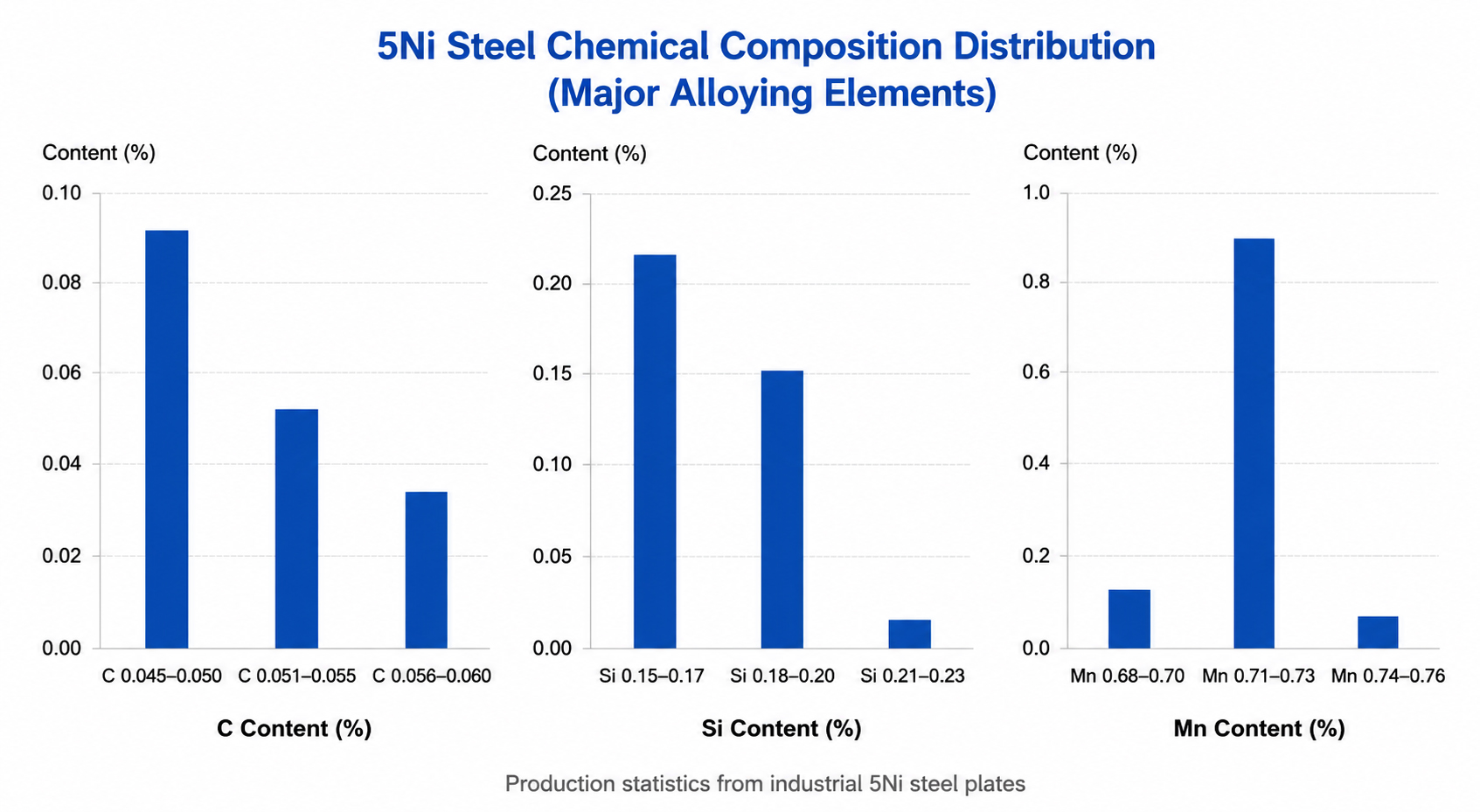
The statistical distribution of C, Si, and Mn shows controlled alloying stability in industrial 5Ni steel production.
For low-temperature pressure vessel fabrication, phosphorus and sulfur control directly influence weld crack sensitivity and brittle fracture resistance.
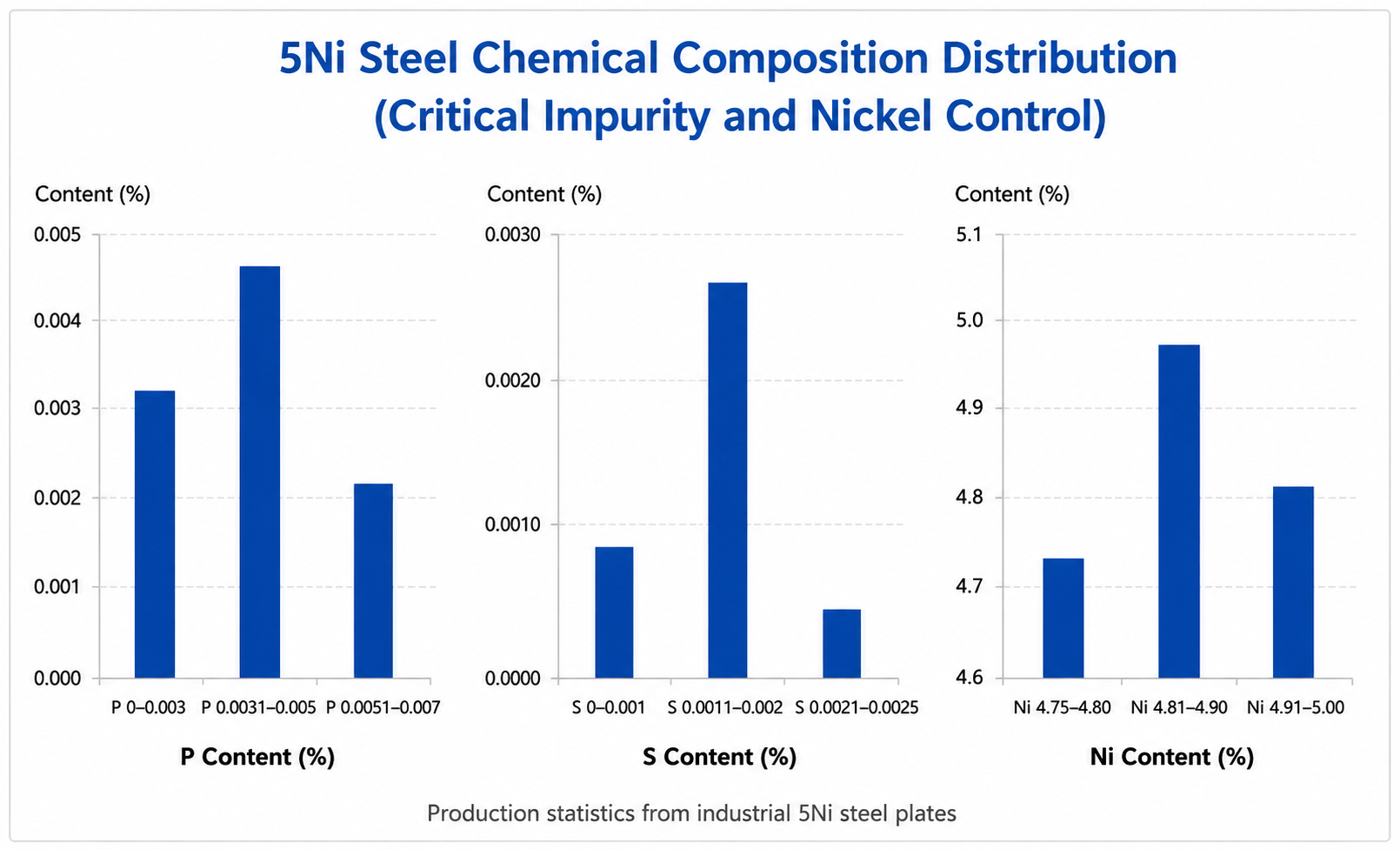
| Control Area | Engineering Purpose | Importance in Fabrication | Typical Concern |
| Nickel Control | Maintain low-temperature toughness | Improve fracture resistance | Cryogenic brittleness |
| Low P/S Control | Reduce crack sensitivity | Improve weld-zone stability | HAZ cracking |
| Heat Treatment Consistency | Stabilize mechanical properties | Improve plate uniformity | Strength variation |
| Inclusion Control | Improve through-thickness properties | Reduce lamellar tearing risk | Restraint-induced cracking |
Mechanical Properties in Low-Temperature Service
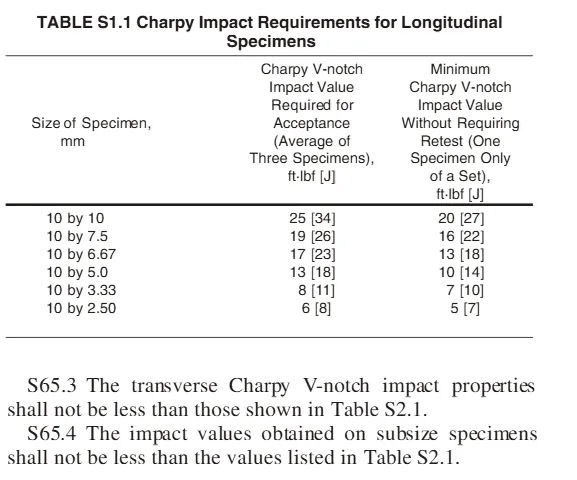
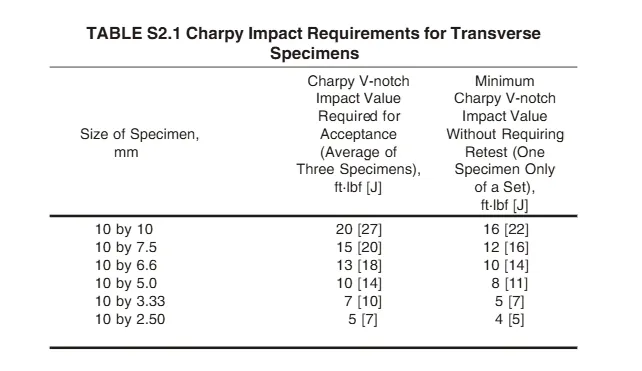
ASME SA-645 Grade B steel is evaluated by its yield strength, tensile strength, elongation, Charpy impact toughness, and heat-treatment consistency. For cryogenic vessel fabrication, the priority is not merely meeting minimum specified values, but maintaining stable test results across various plate thicknesses and heats.
In practical cryogenic fabrication, yield consistency and impact energy stability are more critical than isolated tensile strength peaks. Large welded LNG and LEG structures require highly uniform through-thickness mechanical properties to mitigate brittle fracture risks during transportation, cooldown, startup, and thermal cycling.
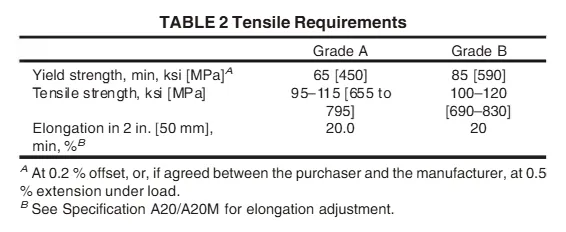
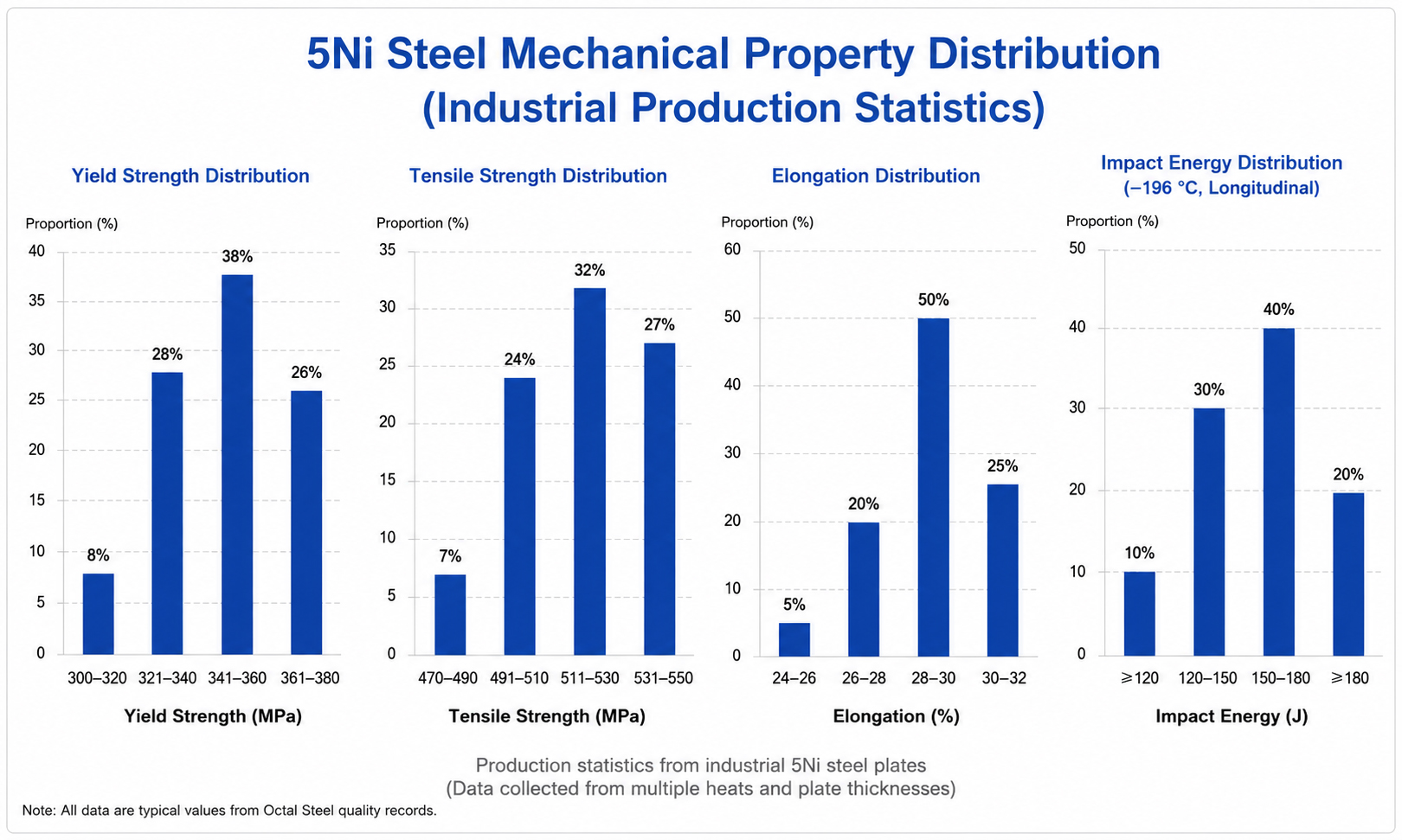
Low-Temperature Impact Performance of A645 Grade B Steel
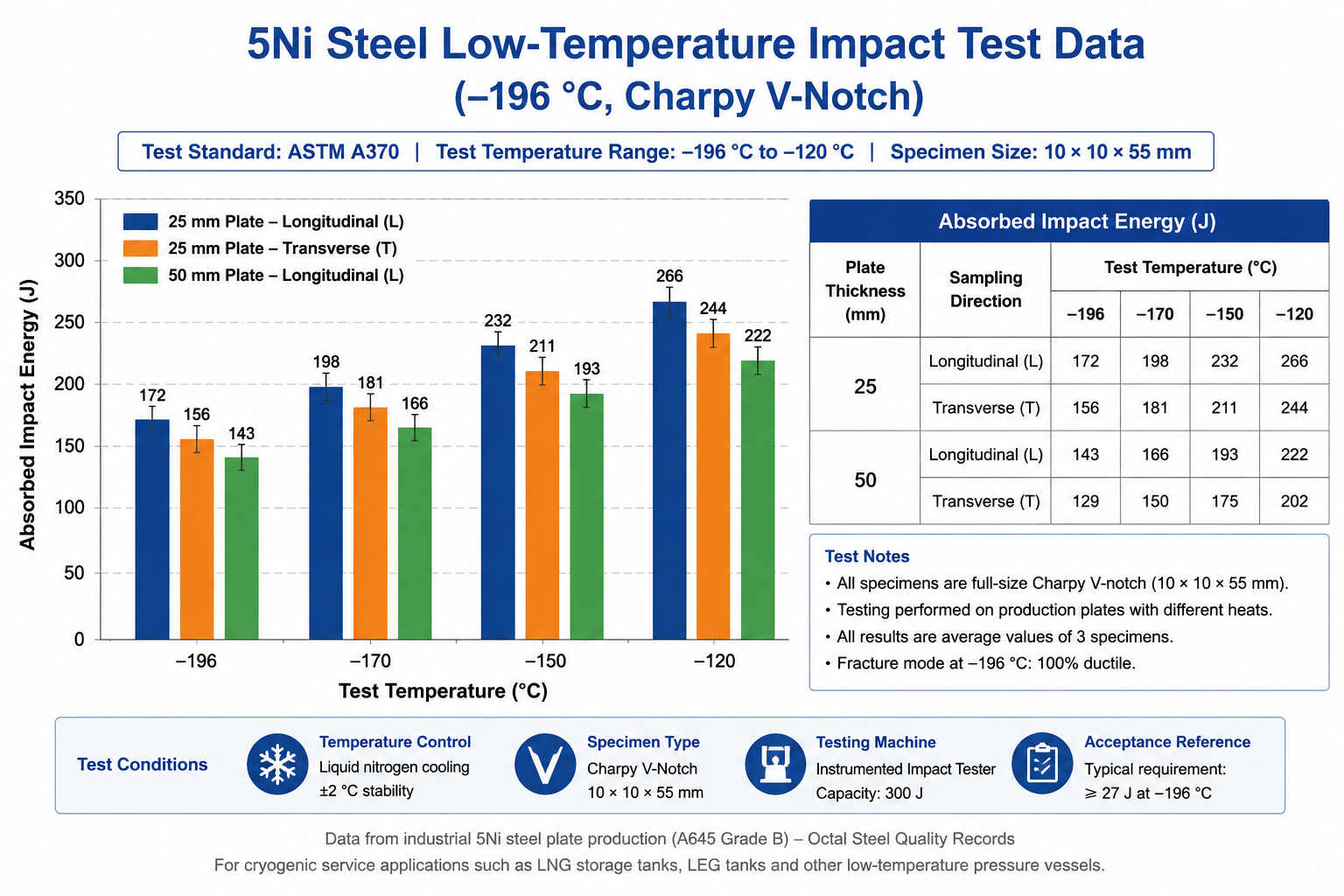
Production testing of 25 mm and 50 mm 5Ni steel plates shows stable absorbed impact energy performance from -120°C to -196°C under different sampling directions and plate thickness conditions.
Welding Performance of A645 Grade B Steel
CTOD evaluation is therefore commonly included in welding qualification procedures for cryogenic pressure vessel fabrication involving restrained thick-section welded joints.
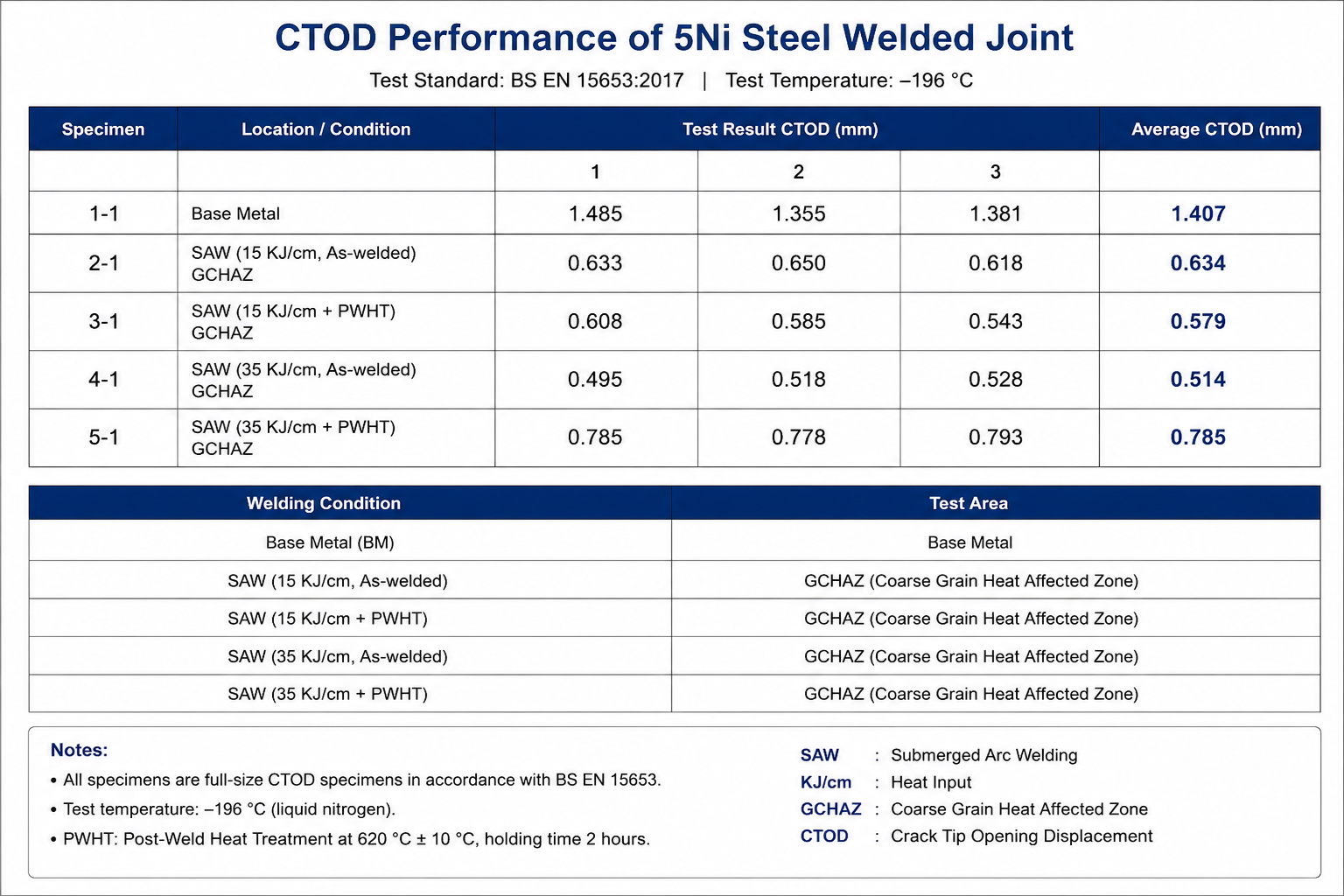
CTOD testing results indicate stable crack-arrest behavior under different submerged arc welding heat-input and post-weld heat-treatment conditions.
Industrial welding qualification programs for 5Ni steel commonly include hardness mapping under different submerged arc welding heat-input conditions such as 15 KJ/cm and 35 KJ/cm procedures.
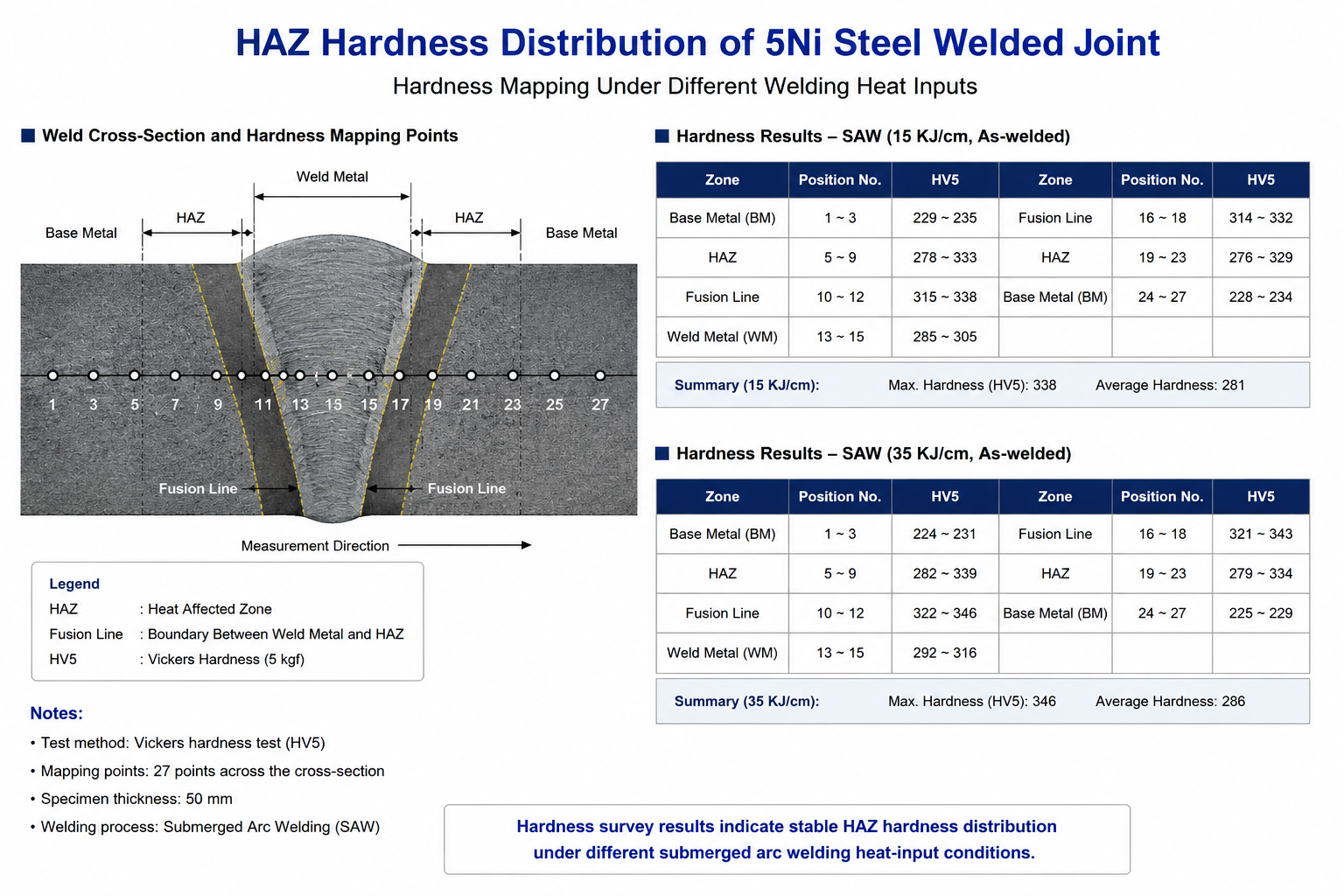
Measured hardness values remained within stable engineering control ranges across weld metal, fusion-line, and heat-affected-zone regions under different submerged arc welding heat-input conditions.
Restraint cracking evaluation is commonly performed for thick cryogenic plate welding procedures where hydrogen-assisted cracking risk must be controlled during restrained fabrication conditions. Industrial testing of 5Ni steel welded joints has included Y-groove crack evaluation under different post-weld heat-treatment conditions and controlled heat-input parameters.
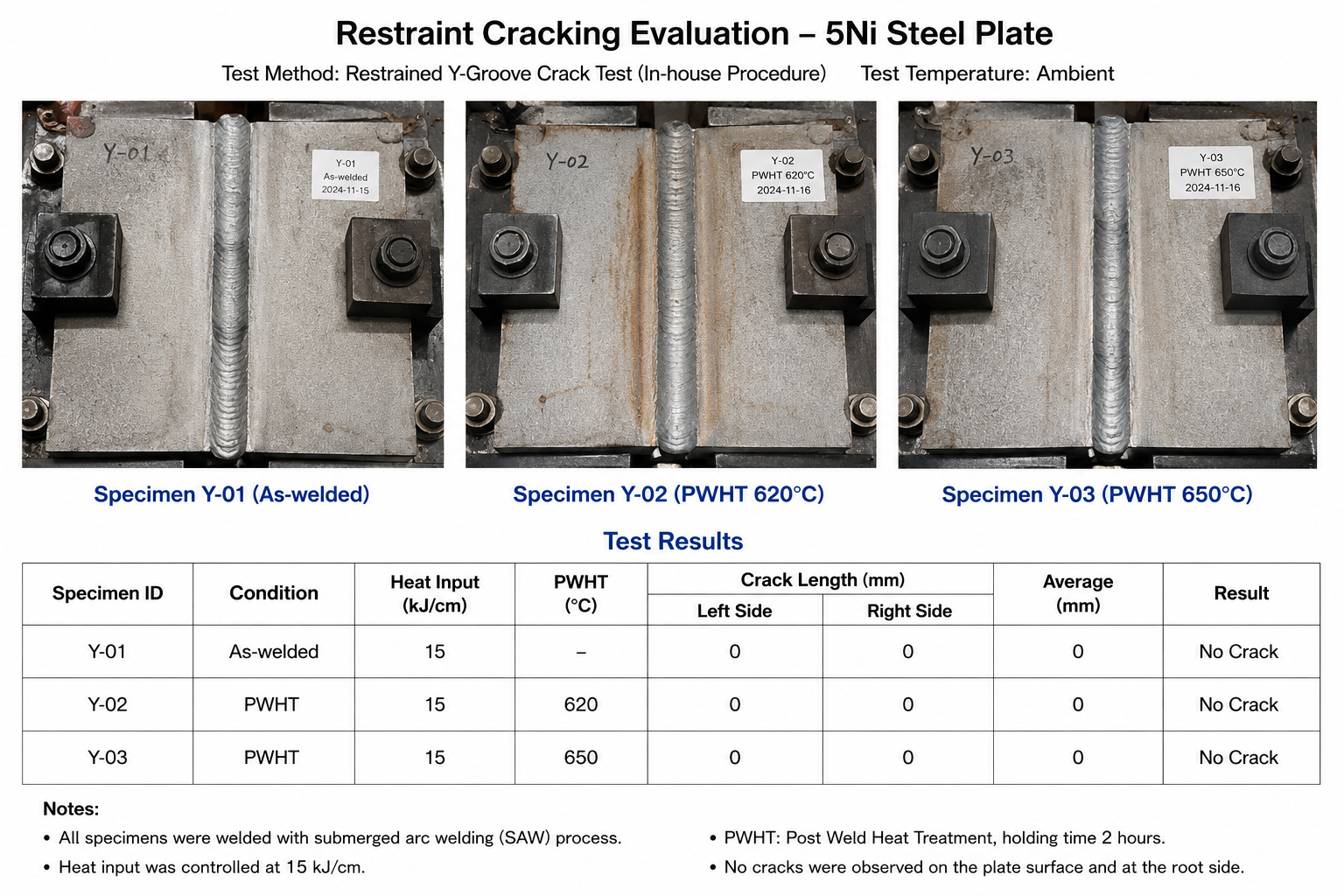
No visible surface cracking or root cracking was observed during restrained Y-groove welding evaluation under the tested conditions.
Residual magnetism control is another fabrication concern for cryogenic nickel steel plates because excessive magnetic attraction during handling or welding may affect weld stability, arc behavior, and field assembly efficiency during large-tank construction.
For cryogenic storage projects, fabrication specifications may require residual magnetic levels below 50 GS before welding. Production control measures for industrial 5Ni steel plates may include vacuum lifting, non-magnetic handling separation, and residual magnetic inspection before shipment.
Residual Magnetism Control During Fabrication
Residual magnetism control is another fabrication concern for cryogenic nickel steel plates because excessive magnetic attraction during handling or welding may affect weld stability, arc behavior, and field assembly efficiency during large-tank construction.
For cryogenic storage projects, fabrication specifications may require residual magnetic levels below 50 GS before welding. Production control measures for industrial 5Ni steel plates may include vacuum lifting, non-magnetic handling separation, and residual magnetic inspection before shipment.
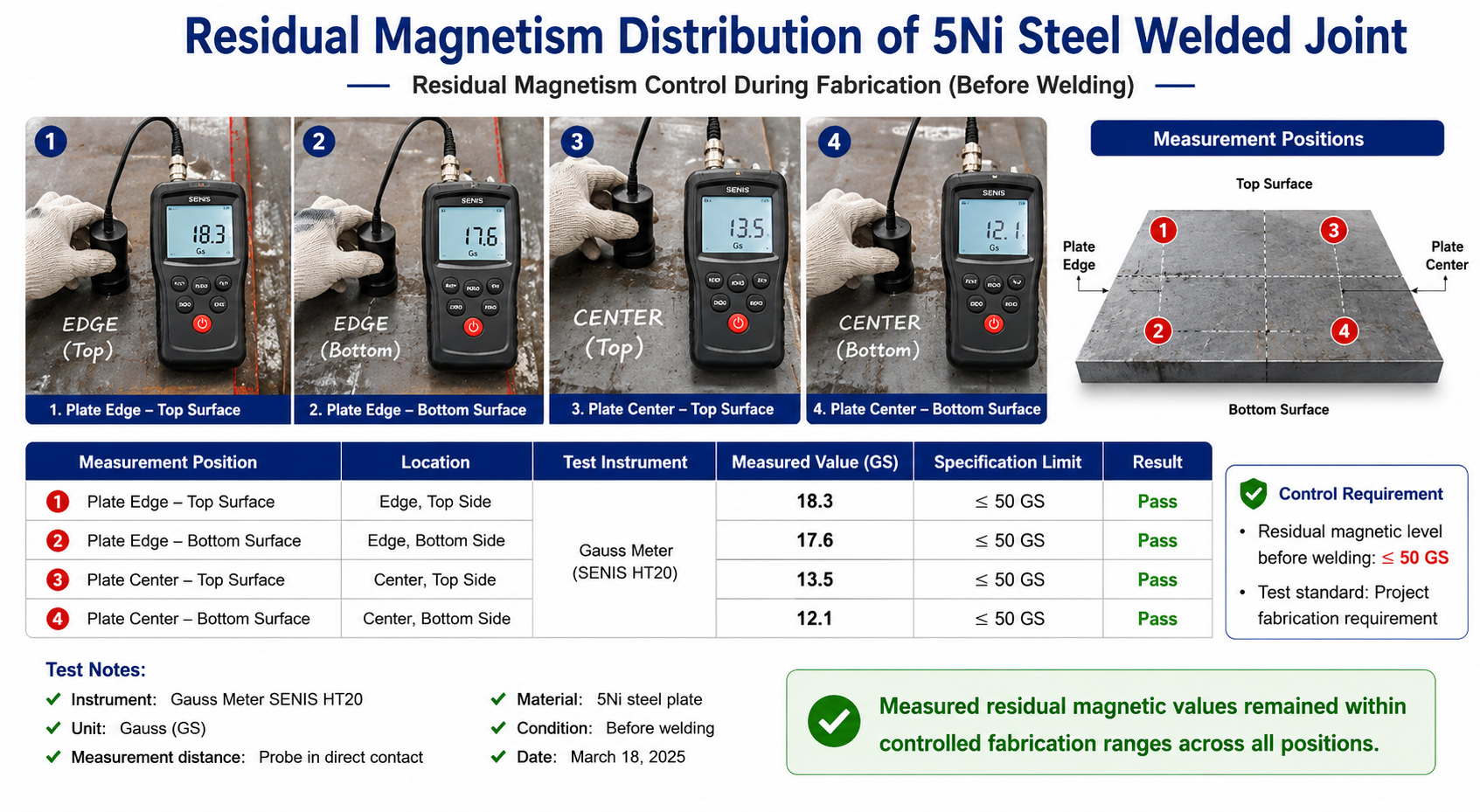
Measured residual magnetic values remained within controlled fabrication ranges across plate-edge and center measurement positions.
Typical Engineering Applications
A645 Grade B steel is mainly used in welded low-temperature pressure vessel and storage systems where toughness, heat-treatment consistency, and weld-zone reliability are required by project specifications.
Typical applications include LPG storage tanks, LEG storage systems, VLEC cargo tanks, marine fuel containment structures, and low-temperature process vessels.
FAQ
Q1: What is A645 Grade B steel mainly used for?
A1: A645 Grade B steel is mainly used for LPG tanks, LEG storage systems, low-temperature pressure vessels, and cryogenic cargo containment structures.
Q2: Is A645 Grade B suitable for LNG service?
A2: It can be used in certain low-temperature applications, but ultra-low-temperature LNG storage systems more commonly use 9Ni steel.
Q3: What is X12Ni5?
A3: X12Ni5 is a designation commonly associated with 5Ni low-temperature steel used in cryogenic storage and transportation projects.
Q4: Why is weld-zone toughness important for 5Ni steel?
A4: Cryogenic fracture risks often initiate near welded joints, especially in restrained thick-wall structures exposed to thermal cycling.


