

Understanding the differences between AR500 vs AR600 steel in terms of composition and properties is critical when selecting materials for extreme abrasion environments.
As a professional wear resistant steel plate manufacturer, GNEE Steel provides clear, application-driven guidance to help global customers choose between AR500 steel plates and AR600 steel plates.
In the first stage of material selection, engineers often compare AR500 vs AR600 steel to balance hardness, wear life, impact resistance, and fabrication feasibility. This article explains the key differences directly from the manufacturer's perspective.
Who We Are – AR500 & AR600 Steel Manufacturer GNEE Steel
GNEE Steel is a direct manufacturer and exporter of wear resistant steel plates, established in 2008. We specialize in AR400, AR450, AR500, AR600, and NM series steel plates, serving mining, cement, quarry, and heavy machinery industries worldwide.
Why Choose GNEE Steel
Direct factory supply with stable quality
Full hardness grades from AR400 to AR600
Thickness range: 6–120 mm
Custom cutting and fabrication support
Third-party inspection available (SGS, BV, TUV)
Our engineering team helps customers select the right grade-not just the hardest one.
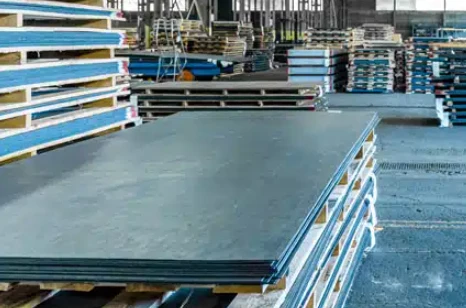
AR500 and AR600 steel plates at GNEE Steel warehouse
AR500 and ar600 Steel Composition and Properties
AR500 steel is a high-hardness wear resistant steel plate designed for severe abrasion conditions with a good balance between wear life and toughness.
-
Typical Composition of AR500 Steel
AR500 steel generally contains:
Carbon (C) for hardness
Manganese (Mn) for strength and toughness
Chromium (Cr) for wear resistance
Small additions of alloying elements
-
Typical Composition of AR600 Steel
Compared with AR500, AR600 steel has:
Higher carbon content
Optimized alloy design
Advanced heat treatment (quenching & tempering)
-
Typical mechanical numbers - AR500 vs AR600
Below are the commonly reported ranges for commercially supplied plates. These figures are mill-typical ranges - always rely on the vendor MTR for project acceptance.
| Property | AR500 (typical) | AR600 (typical) | Notes / Relevance |
|---|---|---|---|
| Surface hardness (Brinell HBW) | ~470 – 540 HBW (often 477–534 HBW). | ~570 – 650 HBW (often 580–670 HBW). | AR600 is notably harder - better abrasion/ballistic resistance but can be more brittle. |
| Typical tensile strength | ~1650 MPa (240 ksi) reported by many producers. | ~1825–1830 MPa (≈265 ksi) reported for some AR600 products. | Higher tensile often accompanies higher hardness. |
| Typical yield strength | ~1480 MPa (215 ksi) (mill-typical). | ~1516–1518 MPa (≈220 ksi) reported in some datasheets. | Yield numbers vary with heat treat and measuring method. |
| Elongation (%) | Often ~6–12% depending on thickness and mill. | Usually lower than AR500; may be in the single digits at high hardness. | |
| Toughness / Charpy | Mill-supplied Charpy values vary; low-temperature impact energy tends to decrease with increasing hardness. | AR600 typically requires validated Charpy values for ballistic or low-temp applications. |

Heat treatment process of AR600 steel plates
AR500 vs AR600 Steel – Key Differences in Properties
When comparing AR500 vs AR600 steel, the most important differences lie in hardness, wear life, and fabrication behavior.
AR500 vs AR600 Steel Comparison Highlights
- Hardness: AR600 > AR500
- Wear Resistance: AR600 offers longer service life
- Impact Toughness: AR500 performs better
- Fabrication: AR500 is easier to cut and weld
- Cost: AR600 is generally higher
Selecting AR600 simply for higher hardness may increase fabrication risk if impact loading is present.

AR500 vs AR600 steel comparison
How to Choose Between AR500 and AR600 Steel
Choosing between AR500 vs AR600 steel should be based on actual operating conditions rather than hardness alone.
Consider:
- Type of wear (sliding abrasion vs impact)
- Operating temperature
- Required service life
- Fabrication and maintenance capability
- Total lifecycle cost
In many applications, AR500 provides the best balance. AR600 is recommended only for extreme abrasion with minimal impact. GNEE Steel offers application-based recommendations to reduce risk and cost.
👉 Learn more solutions:
Wear Resistant Steel Plates from GNEE Steel Manufacturer
Frequently Asked Questions
What is the main difference between AR500 and AR600?
AR600 delivers higher Brinell hardness (roughly 570–650 HBW) than AR500 (roughly 470–540 HBW), giving superior wear and ballistic resistance at the expense of easier forming and sometimes ductility.
Can AR600 be welded like AR500?
Yes, but AR600 often requires more careful welding procedures (preheat, controlled interpass temperatures, selection of suitable filler metal) because of its higher hardenability and greater risk of local embrittlement. Qualification is recommended.
Is AR600 always a better choice for armor?
Not always. AR600 may provide higher ballistic performance by weight, but the final armor qualification depends on system design, backing, spall control, and certified ballistic testing. For many civilian use cases AR500 is adequate.
How much more expensive is AR600 than AR500?
Prices fluctuate by market and country. AR600 typically commands a premium per kg; however, thinner AR600 plates can sometimes substitute for thicker AR500, partially offsetting the price difference. Ask suppliers for side-by-side quotes with equivalent wear life calculations.
Can AR500 or AR600 be cold-formed?
AR500 can be formed more readily than AR600. When forming AR600, use larger bend radii and consult the mill for approved forming limits.
Are there recognized standards for AR plate?
AR grades are performance classes; there's no single universal ASTM spec that defines AR500/AR600 chemistry. However, mills and buyers frequently use EN/BS dimensional standards (e.g., BS EN 10051 for plate tolerances) and ASTM tests (E10 for Brinell hardness, A370 for mechanicals). Specify required tests and acceptance criteria in purchase orders.
Is AR600 more likely to crack in service?
Without proper design, welding practice, and inspection, higher hardness steels can be more susceptible to cracking under impact or cyclic loads. That risk is manageable with correct material selection, appropriate toughness criteria, and qualified fabrication.
Which industries use AR600 most?
Heavy mining, aggregate handling, high-abrasion processing equipment, and some ballistic systems where weight is critical.
How should I specify plate hardness on an order?
Specify a numeric Brinell acceptance range, required test standard (ASTM E10), required Charpy energy and temperature if toughness is critical, and request MTRs. Example: "AR600, 580–640 HBW surface hardness; Charpy V-notch ≥ XX J @ -20°C; provide MTRs."
Can GNEE Steel supply AR500 and AR600 with export documentation and fast shipping?
Yes. GNEE Steel works with approved Chinese mills, supplies MTRs, and offers stocked items at factory pricing with rapid dispatch for standard thicknesses. For bespoke orders we coordinate mill scheduling and testing.
Conclusion: AR500 vs AR600 Steel – Composition and Properties Explained
Understanding AR500 vs AR600 steel composition and properties helps engineers select the most cost-effective and reliable wear resistant material. As an experienced manufacturer, GNEE Steel supplies stable-quality AR500 and AR600 steel plates with full technical support.
If you are evaluating AR500 vs AR600 steel for mining, cement, or heavy-duty equipment, contact GNEE Steel today for expert advice, fast quotation, and dependable global delivery.
👉 Send your inquiry now and work directly with a professional AR steel plate manufacturer.


