

ASME SA 387 GRADE 12 Class 2
Engineered for use in elevated temperature service, ASME SA387 Grade 12 is a chrome molybdenum carbon alloy steel for use in weldable pressure vessels and industrial boilers.
The material benefits from added chromium which provides excellent corrosion and oxidation resistance making it ideal for sour service applications in the oil and gas industry.

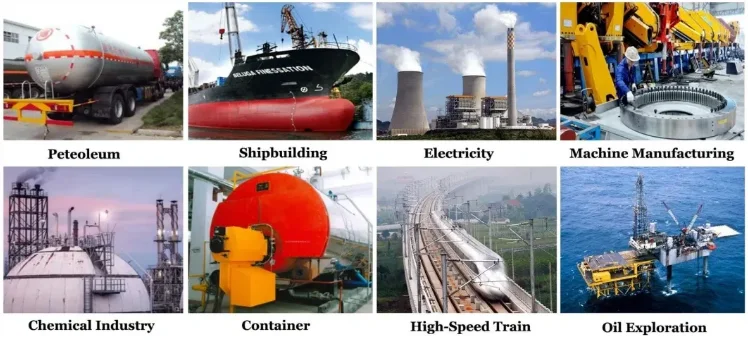
ASME SA387 Grade 12 Steel Plate is a chrome molybdenum carbon alloy steel for use in weldable pressure vessels and industrial boilers. The material benefits from added chromium which provides excellent corrosion and oxidation resistance making it ideal for sour service applications in the oil and gas industry. Excellent corrosion resistance and high temperature resistance respectively. ASME SA387 standard plates are used by the world's leading fabricators who in turn, supply primarily to the oil and petrochemical industry. Applications for ASME SA387 include pressurized vessels, industrial boilers, heat exchangers and Pipe work.
ASME SA 387 Grade 12 Class 2 is a chromium-molybdenum alloy steel plate for high-temperature, weldable pressure vessels, offering superior strength and corrosion resistance, with Class 2 specifying higher mechanical properties (tensile/yield strength) than Class 1, typically heat-treated to normalized and tempered conditions for enhanced durability in demanding oil/gas or boiler applications.
Standard Specification
Standard
ASTM A387 / ASME SA387
Width
1000mm-4500mm
Thickness
5mm-150mm
Length
3000mm -18000mm
Impact tested
-52° C
Process
Hot-Rolled (HR)
Key Characteristics:
Material: Chrome Moly (Cr-Mo) Alloy Steel.
Application: Elevated temperature service, pressure vessels, boilers, piping, especially in sour service (oil & gas).
Composition: Contains Chromium (Cr) for oxidation resistance and Molybdenum (Mo) for high-temperature strength.
Class 2: Indicates higher minimum tensile strength (e.g., 75-100 ksi / 515-690 MPa) and yield strength (e.g., 43 ksi / 310 MPa) compared to Class 1.
Heat Treatment: Typically supplied normalized and tempered (N+T) to achieve its specified mechanical properties.
Equivalents
| BS | EN | ASTM/ASME | DIN |
| 620 B | 13 CRMO 45 | SA387-12-2 | 13 CRMO 44 |
Chromium & Molybdenum content (according to the ASME specification)
| Designation | Nominal Chromium Content (%) |
Nominal Molybdenum Content (%) |
| SA387 Grade 12 | 1.00% | 0.50% |
Tensile Requirements for ASME SA387 Grade 12 Alloy Steel Plates Class 2 Plates
| Designation: | Requirement: | Grade 12 |
| SA387 Grade 12 | Tensile strength, ksi [MPA] | 65 to 85 [450 to 585] |
| Yield strength, min, ksi [MPa]/(0.2% offset) | 40 [275] | |
| Elongation in 8 in. [200mm], min % | 19 | |
| Elongation in 2 in. [50mm], min, % | 22 | |
| Reduction of area, min % | ––– |
Chemical Composition of ASME SA387 Grade 12 Class 2
| Carbon (C) | % |
| Heat Analysis: Product Analysis: |
0.05 - 0.17 0.04 - 0.17 |
| Manganese (Mn) | % |
| Heat Analysis: Product Analysis: |
0.40 - 0.65 0.35 - 0.73 |
| Phosphorus (P) | % |
| Heat Analysis: Product Analysis: |
0.035 0.035 |
| Sulphur (S) (Max) | % |
| Heat Analysis: Product Analysis: |
0.035 0.035 |
| Silicon (Si) | % |
| Heat Analysis: Product Analysis: |
0.15 - 0.40 0.13 - 0.45 |
| Chromium (Cr) | % |
| Heat Analysis: Product Analysis: |
0.80 - 1.15 0.74 - 1.21 |
| Molybdenum (Mo) | % |
| Heat Analysis: Product Analysis: |
0.45 - 0.60 |
1What is ASME SA387 Grade 12 Class 2?
ASME SA387 Grade 12 Class 2 is a chromium-molybdenum alloy steel plate designed for high-temperature pressure vessels and boilers, offering excellent corrosion resistance from its chromium content and enhanced strength from molybdenum, with "Class 2" indicating higher tensile and yield strength compared to Class 1, making it suitable for demanding oil & gas, power generation, and chemical processing applications
2 what is theASME SA387 Grade 12 Class 2 equivalent?
ASME SA387 Grade 12 Class 2 is a Cr-Mo alloy steel for pressure vessels, with key international equivalents being EN 13CrMo4-5, BS 620B, and DIN 13CrMo44, all offering similar strength and corrosion resistance for high-temp applications, with Class 2 indicating higher tensile strength than Class 1.
3Is ASME SA 387 GRADE 12 Class 2 hard to drill?
ASME SA 387 Grade 12 Class 2 is a chromium-molybdenum alloy steel, making it tougher and harder to drill than plain carbon steel, requiring slower speeds, sharp carbide or HSS bits, good lubrication, and potential preheating to prevent cracking, though its Class 2 treatment (quenched & tempered) enhances strength and machinability compared to Class 1, it's still considered a challenging material requiring proper tooling and techniques, not inherently "easy" but manageable with care.
4What are the primary advantages of ASME SA 387 GRADE 12 Class 2 ?
ASME SA 387 Grade 12 Class 2 offers significant advantages for high-temperature, high-pressure applications like boilers and pressure vessels, primarily due to its superior high-temperature strength, excellent corrosion/oxidation resistance (from Cr-Mo content), and good weldability, ensuring durability and safety in demanding environments like oil & gas, providing higher mechanical properties than Class 1.
5What are common testing requirements for ASME SA 387 GRADE 12 Class 2 ?
For ASME SA 387 Grade 12 Class 2, common testing includes Tensile Tests (strength 65-85 ksi, yield min 40 ksi, elongation specs), Chemical Analysis, and Impact Tests (Charpy V-Notch often at 0°F/-18°C or lower for Class 2), alongside Non-Destructive Testing (UT, dye penetrant), and Post-Weld Heat Treatment (PWHT) verification, ensuring it meets mechanical properties for high-temperature pressure vessels.
For more details about GNEE's steel products, contact us at info@gneesteels.com We look forward to working with you.


