

Can wear-resistant steel plates be bent?
Wear-resistant steel plates can be bent, yet the inner bending radius and bending angle must be strictly controlled.
During cold bending, the higher the tensile strength of the plate, the greater the bending force required, along with larger springback force and springback angle. Accordingly, matching punch radius and die opening width shall be adopted.
What Is Bending of Wear Resistant Steel Plate?
Cold Bending:Cold Bending denotes a fabrication process in which steel plates undergo plastic deformation under mechanical force using bending machines, presses and other equipment at ambient temperature, without heating the plates, to achieve the required angles and shapes.
Hot Bending:Hot Bending refers to the bending operation performed after heating steel plates to a specified temperature. High temperature improves the plasticity of the material, which reduces bending force and facilitates easier forming of steel plates.
Taking mainstream NM400 wear-resistant steel plates as an example, the full original mill test certificate (MTC) is attached below. All physical, chemical and bend test data can serve as references for bending process design.
Contact us now for the latest price quote for NM400.

| Comparison Item | Cold Bending | Hot Bending |
|---|---|---|
| Processing Temperature | Ambient temperature | Processed after heating |
| Original Hardness Retention | Yes | May decrease |
| Wear Resistance | Basically retained | May be impaired |
| Processing Difficulty | Relatively high | Relatively low |
| Dimensional Accuracy | High | Relatively low |
| Energy Consumption | Low | High |
| Applicable Scenarios | Standard wear-resistant parts, dump truck bodies, hoppers, buckets, etc. | Extra-thick plates, large-radius or complex formed components |

Real Shot Images of Press Brake & Steel Plate Bending Process
Which Method Is More Suitable for NM400, NM450 and NM500?
Cold bending is the preferred forming process for most applications. Provided the bend radius, die dimensions, rolling direction and processing parameters are properly controlled, NM400, NM450 and even certain NM500 wear plates can achieve excellent cold forming performance while retaining their original wear resistance.
Hot bending is only applicable to special scenarios, such as extra-thick plates, complex geometries or cases with limited machine capacity. Heating temperature and post-bending treatment must be strictly controlled in accordance with the process guidelines issued by steel mills or material suppliers to prevent significant degradation of material properties.
Bending Process of NM400 / NM450 / NM500 Wear Plates
| Grade | Plate Thickness, mm | Min. Inner Bending Radius | Min. Lower Die Opening Distance | Springback Angle (°) |
|---|---|---|---|---|
| NM400 | t < 8 | 5t | 9t | 9–13 |
| NM400 | 8 ≤ t < 12 | 6t | 10t | 9–13 |
| NM450 | t < 8 | 7t | 10t | 11–18 |
| NM450 | 8 ≤ t < 12 | 8t | 10t | 11–18 |
| NM500 | t < 8 | 8t | 12t | 11–18 |
| NM500 | 8 ≤ t < 16 | 8t | 12t | 11–18 |

To prevent bending cracks at plate edges caused by work hardening during processing, you may use a grinder to remove burrs appropriately.
The longitudinal cold bending performance of wear-resistant steel plates is slightly better than transverse cold bending performance. Therefore, when bending to the same angle, a slightly larger inner bending radius shall be adopted for transverse bending. Longitudinal direction refers to the rolling direction of the steel plate being perpendicular to the length direction of the press brake punch.
Quick Reference Bending Parameters for NM450:
| Plate Thickness t (mm) | 6 | 8 | 10 |
|---|---|---|---|
| Minimum Inner Bending Radius (mm) | ≥36 | ≥64 | ≥80 |
| Minimum Lower Die Opening Width W (mm) | ≥60 | ≥80 | ≥100 |
| Punch Force Calculation Conditions | W=75, Rm=1350 | W=90, Rm=1350 | W=100, Rm=1350 |
| Bending Punch Pressure P per Meter (ton) | 104 | 154 | 196 |
The bending force can be calculated with reference to the formula below:

- P = Bending punch force (ton, t).
- b = Workpiece width (mm).
- t = Plate thickness (mm).
- Rm = Tensile strength (MPa).
- W = Lower die opening width (mm).
Take 10 mm thick NM450 wear plate with 1-meter width for single-edge bending as an example
The known parameters are derived from the standard reference values in the above table:
- Workpiece width b = 1000 mm (1-meter plate)
- Plate thickness t = 10 mm
- Tensile strength Rm of NM450 = 1350 MPa
- Die opening width W = 100 mm
Substitute into the bending force calculation formula:

Result Explanation
The calculated theoretical bending tonnage is 216 tons. The table reference value of 196 tons is a simplified value for engineering safety. A 10%~15% tonnage margin of the press equipment is recommended for actual processing to prevent bending cracking and excessive springback.
If switching to 6 mm or 8 mm thick NM450 plates, simply substitute the corresponding t (plate thickness) and W (die opening width) parameters to quickly calculate the matching bending tonnage.
Note: For other wear-resistant steel grades such as NM400 and NM500, only replace the corresponding ultimate tensile strength Rm value and apply the identical formula to compute the required bending tonnage.
Key Factors Affecting Wear Resistant Steel Plate Bending Quality
-
Thickness
Thicker plates bring higher bending difficulty:
- 6–10 mm:Easy to bend
- 10–20 mm:Moderate difficulty
- 20 mm:Difficulty rises significantly
-
Hardness Grade
The higher the hardness:
- The lower the elongation.
- The higher the risk of cracking.
-
Surface Condition
- Whether cracks exist on cutting edges
- Work hardening caused by flame cutting
- Presence of notches or gouges.
-
Temperature (Cold Bending vs Warm Bending)
- Cold bending: Suitable for NM360 / NM400
- Hot bending: Commonly used for NM500 or thick plates.
Wear Resistant Steel Plate Common Bending Problems and Solutions
| Defect | Root Cause | Solution |
|---|---|---|
| Cracking (cracks) | Bending radius too small; material hardness too high; bending line parallel to rolling direction; burrs or defects on edges | Increase inner radius; preheat or hot bend; make bending line perpendicular or angled to rolling direction; grind edges to remove burrs |
| Excessive springback (angle deviation) | High yield strength of material; relatively constant elastic modulus | Compensate by over‑bending based on trial results; use multi‑step forming |
| Die wear / surface scratches | High hardness of wear plate; damaged or insufficiently hard die surface | Replace or repair die; use dedicated high‑strength tool steel; apply lubricant during bending |
| Insufficient bending force / machine overload | Large plate thickness and high strength – required force exceeds machine capacity | Select larger tonnage machine; increase lower die V‑opening width appropriately |
| Edge cracking (at cut edges) | Work‑hardened layer or burrs from flame/plasma/shear cutting cause stress concentration | Grind cut edges and remove burrs before bending; smoothly round the outer tensile‑stress edge |
| Dimensional deviation / slipping | Insufficient clamping force; inaccurate blank development due to springback | Increase clamping force (20‑30% higher than for mild steel); verify by trial bending before production |
What Processing Services Can GNEE STEEL Provide?
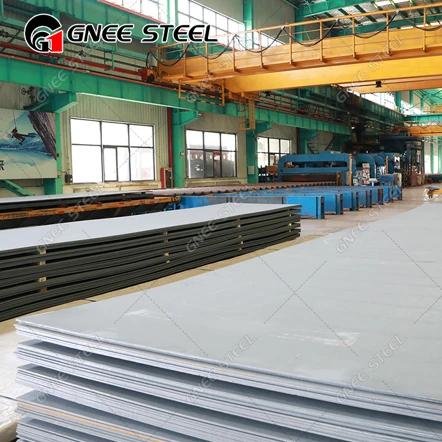
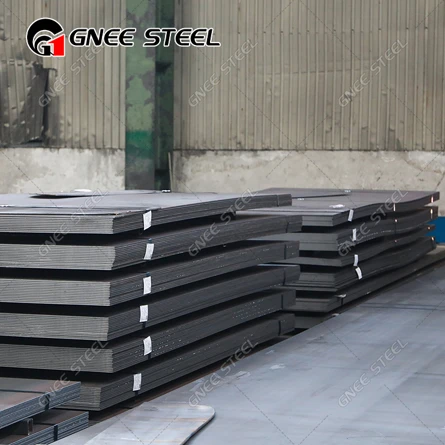
GNEE STEEL supplies NM400, NM450, and NM500 wear-resistant steel plates with stable inventory, competitive pricing, and fast global delivery. We also provide one-stop processing services, including cutting, bending, welding, and custom fabrication, helping customers reduce lead times and overall project costs.
✔ Laser Cutting
✔ CNC Bending
✔ Welding
✔ Fabrication
✔ Drilling
✔ Beveling
✔ OEM
✔ Drawing Design
✔ Ready-to-install Parts

Contact us now for the latest quotes and processing services.



FAQ:
What is wear resistant steel?
Wear resistant steel generally has a higher carbon content and also contains manganese, chromium, nickel, vanadium and boron. These alloying elements increase not only the hardness but also the ductility. To a limited degree, these elements also have a positive effect on corrosion resistance.
What is the process of bending?
A bending process is a metal forming operation used to permanently deform ductile materials (like sheet metal) into V-shapes, U-shapes, or channels along a straight axis. It relies on applying force via a press brake or specialized die to exceed the material's yield point, compressing the inner radius and stretching the outer radius.
Can 3mm-thick NM450 be bent into a right angle of 90 degrees?
Yes. 3mm NM450 can be cold-bent to 90° at ambient temperature with a minimum bending radius of no less than 9mm (3 times the plate thickness). The best forming performance can be achieved when bending perpendicular to the rolling direction. Preheating is unnecessary under normal circumstances.
What is the bending direction relative to rolling for NM400?
Whenever possible, bend along the rolling direction of the steel plate, as this direction offers more stable mechanical properties and lower cracking risk.
When bending perpendicular to the rolling direction, increase the bending radius accordingly.
What is the difference between NM500, NM550 and NM600?
NM500, NM550 and NM600 are high-hardness wear resistant steel plates. NM550 and NM600 offer higher wear resistance, but they are also more difficult to cut, weld and process.


