

SA516 Gr.70 and SA612 are ASME pressure vessel steels, with SA612 providing higher strength (570–725 MPa tensile) for thinner-wall, high-pressure, low-temperature, and weight-sensitive applications, while SA516 Gr. 70 is a, often more cost-effective, versatile, and notch-tough steel commonly used for moderate-temperature, conventional vessel, and boiler fabrication.
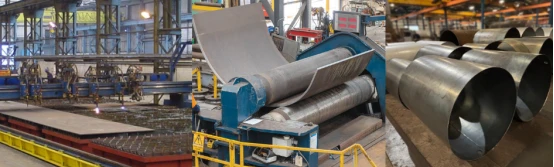
Click to learn more about SA612 steel.
Key Differences and Usage Examples
Strength & Thickness: SA612 is a high-strength manganese-silicon steel (Yield≥ 345MPa ) ideal for thicker, higher-pressure applications where minimizing weight is crucial. SA516 Gr.70 is standard carbon steel (Yield≥ 260MPa) widely used in moderate-pressure, thinner-walled, and more conventional, and sometimes lower-temperature scenarios, though its strength is lower than SA612.
Low-Temperature Performance: SA612 offers superior low-temperature performance, certified for service down to -40°C . SA516 Gr. 70 is designed for moderate to lower temperatures but may not match SA612 in extremely low-temperature toughness.
Fabrication & Usage: SA612 is often chosen to reduce vessel weight by up to 16%, lowering fabrication costs. It is common in LPG tanks, high-pressure vessels, and, sometimes, in smaller, more specialized reactors. SA516 Gr.70, often in the normalized conditio, is the go-to for pressure vessels, boilers, and storage tanks due to its high cost-effectiveness and broad suitability.
SA516 Gr.70 and SA612 steel plate MTC
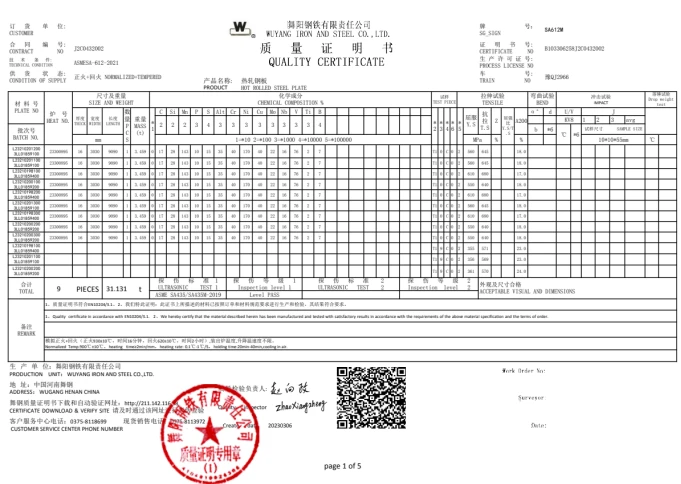
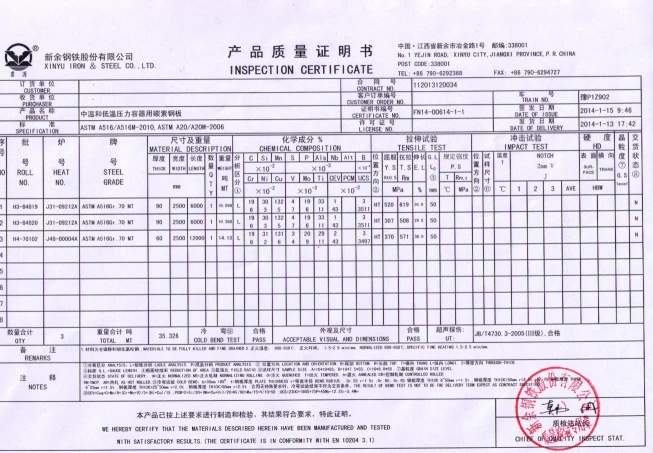
Chemical Composition Comparison of SA516 Gr.70 and SA612
The chemical composition of a steel plate directly determines its weldability, strength, toughness, and overall performance in service. Below is a detailed comparison:
| Element | SA516 Gr.70 | SA612 |
|---|---|---|
| Carbon (C) | ≤ 0.27–0.31 (thickness-dependent) | ≤ 0.25 |
| Manganese (Mn) | 0.85–1.20 | 1.00–1.50 |
| Silicon (Si) | 0.15–0.40 | 0.15–0.50 |
| Phosphorus (P) | ≤ 0.035 | ≤ 0.025 |
| Sulfur (S) | ≤ 0.035 | ≤ 0.025 |
| Grain Refining Elements | Not specifically required | Al ≥ 0.020%, Nb ≤ 0.02% (Aluminum-killed fine-grain practice) |
Key Insight:
SA612 features lower carbon content (≤ 0.25%) compared to SA516 Gr.70 (≤ 0.27–0.31%), resulting in a reduced carbon equivalent that significantly improves weldability and crack resistance in the heat-affected zone (HAZ).
Meanwhile, SA612's higher manganese content (1.00–1.50%) compensates for the lower carbon by ensuring adequate strength while maintaining excellent toughness.
The strict control of phosphorus and sulfur in SA612 (≤ 0.025% each) further enhances its suitability for critical welded structures where impurities could compromise joint integrity.
Mechanical Properties of SA516 Gr.70 and SA612 Compared
The mechanical properties comparison reveals the fundamental design difference between these two materials:
| Property | SA516 Gr.70 | SA612 |
|---|---|---|
| Yield Strength (min.) | ≥ 260 MPa (38 ksi) | ≥ 345 MPa (50 ksi) |
| Tensile Strength | 485–620 MPa (70–90 ksi) | 570–725 MPa (83–105 ksi) |
| Elongation (min.) | ≥ 17% (200mm) / ≥ 21% (50mm) | ≥ 16% (200mm) |
| Charpy Impact Toughness | Optional (typically ≥ 27 J) | ≥ 27 J average at –40°C (standard) |
| Modulus of Elasticity | ~200 GPa | ~200 GPa |
| Hardness | Varies by thickness | ≤ 207 HB |
Key Insight:
SA612 offers approximately 33% higher minimum yield strength (345 MPa vs. 260 MPa) and 17–18% higher tensile strength compared to SA516 Gr.70.
This strength advantage allows designers to reduce wall thickness while maintaining the same design pressure rating, translating directly into material weight savings and reduced fabrication costs.
Why SA612 Mechanical Properties Enable Lighter Vessel Designs
The higher strength profile of SA612 - with yield ≥ 345 MPa and tensile strength reaching up to 725 MPa - enables thinner wall designs without compromising safety margins. In practical terms, this means that under identical design pressure conditions, an SA612 vessel wall can be up to 16% thinner than its SA516 Gr.70 equivalent. This weight reduction delivers cascading benefits: lower material procurement costs (despite a slightly higher per-ton price), reduced welding volume (fewer passes, shorter fabrication time), lighter lifting and transportation requirements, and improved payload capacity for mobile pressure vessels such as LPG tank trucks

SA516 Gr.70 vs SA612: Thickness Range and Heavy Plate Options
| Parameter | SA516 Gr.70 | SA612 |
|---|---|---|
| Standard Thickness Range | Up to 200 mm | ≤ 25 mm (ASTM/ASME standard maximum) |
| Industrial Availability | Excellent (widely stocked) | 6–150 mm (extended through technical agreement) |
| Heavy Plate Suitability | Excellent | Limited |
| Typical Thickness Usage | Thick-wall vessels, large shells | Medium-thickness, optimized designs |
Typical Industry Applications of SA516 Gr.70 and SA612
| Industry Sector | SA516 Gr.70 Applications | SA612 Applications |
|---|---|---|
| Oil & Gas | Large storage tanks (crude oil, refined products), thick-wall separators, columns | LPG storage spheres, fractionation towers, mobile tankers |
| Petrochemical | Reactors, absorbers, general process vessels | Medium-pressure reactors, chemical process columns |
| Power Generation | Boiler shells, steam drums, tube sheets | Boiler components, steam generators, high-pressure water pipes |
| Chemical Processing | Thick-wall vessels with lining/coating, heat exchangers | Heat exchanger shells, process vessels for low-temperature service |
| Industrial Gas | Fixed storage tanks, gas cylinders | Spherical gas storage vessels, compressed gas receivers |
Heavy Plate Availability for SA516 Gr.70 Applications
One of SA516 Gr.70's greatest advantages is its widespread availability in heavy sections. As one of the most commonly specified pressure vessel steels globally, SA516 Gr.70 plates are routinely produced and stocked in thicknesses from 6mm to over 200mm by mills worldwide. This extensive availability reduces procurement lead times, simplifies supply chain management, and ensures competitive pricing even for large-volume orders. For projects involving large-diameter thick-wall vessels, boiler drums, and heavy industrial columns, SA516 Gr.70 remains the practical and economical choice.
SA612 Medium-Thickness Optimization for Pressure Vessel Fabrication
SA612 is specifically engineered for medium-thickness pressure vessel designs where high strength and low-temperature toughness are prioritized. In industrial practice, the most common thicknesses for SA612 applications range from 8mm to 50mm, covering the sweet spot for optimized pressure vessel designs in the petrochemical, oil and gas, and power generation industries. When project requirements demand weight reduction, structural efficiency, and guaranteed low-temperature performance, SA612's strength advantage allows engineers to specify thinner plates while maintaining full ASME code compliance.

Welding and Forming Characteristics of SA516 Gr.70 and SA612
| Fabrication Aspect | SA516 Gr.70 | SA612 |
|---|---|---|
| Carbon Content | Lower to moderate (≤ 0.27–0.31%) | Controlled, lower (≤ 0.25%) |
| Carbon Equivalent | Moderate | Lower (improved weldability) |
| Preheating Requirements | Usually not required | May be required for thicker sections |
| Weldability Rating | Excellent | Good to Excellent (with qualified WPS) |
| Formability | Very good | Good |
How to Select Between SA516 Gr.70 and SA612: A Practical Decision Guide
Making the right material selection requires evaluating your project against several key criteria:
Choose SA516 Gr.70 when:
- Your vessel requires thick plates (above 50mm) that exceed SA612's standard thickness range
- The design prioritizes proven performance, wide availability, and fabrication simplicity over weight optimization
- Operating conditions involve general pressure and moderate temperature without extreme low-temperature requirements
- Cost control, supply chain reliability, and ease of procurement are primary project drivers
- The vessel will be fabricated by shops with standard welding capabilities and procedures
Choose SA612 when:
- The design benefits from higher strength to reduce wall thickness and overall vessel weight
- The equipment will operate in moderate to low-temperature environments (down to –40°C) requiring guaranteed impact toughness
- Weight reduction is critical - such as in LPG tank trucks, spherical storage tanks, or offshore modules
- The project aims for optimized design with reduced welding volume and shorter fabrication time
- Your fabrication team has qualified WPS for higher-strength C-Mn-Si steels
Guide Your Pressure Vessel Steel Selection
Not sure which grade is right for your project? Contact GNEE Steel today to discuss your specifications with our technical team. We provide expert material selection guidance, competitive pricing, fast delivery from our extensive inventory, and full mill test certification. Request your free quote now and let us help you choose the optimal pressure vessel steel for your next project.
What is the difference between ASTM A612 steel plate and ASME SA612 pressure vessel steel?
ASTM A612 and ASME SA612 refer to essentially the same material, but SA612 is listed in the ASME Boiler and Pressure Vessel Code, making it suitable for code-certified pressure vessel applications.
What are the mechanical properties of ASTM A612 carbon steel plate?
ASTM A612 carbon steel plate typically offers a yield strength of at least 345 MPa, tensile strength of 570–725 MPa, and elongation of no less than 16%, ensuring strong and ductile performance.
Is ASTM A612 steel plate good for welding in pressure vessel fabrication?
Yes, ASTM A612 steel plate has low carbon content and controlled composition, providing excellent weldability, although preheating may be required for thicker plates.
What heat treatment is required for ASTM A612 normalized steel plate?
ASTM A612 steel plate is usually supplied in normalized condition to ensure uniform mechanical properties and reliable performance in pressure vessel use.
What certifications are available for ASTM A612 pressure vessel steel plate?
ASTM A612 plates can be supplied with Mill Test Certificates (EN 10204 3.1) and third-party inspection reports such as SGS, BV, or TUV.


