

Choose the Right Material for 30 Years of Safe Tank Operation
In pressure vessel manufacturing, material selection is the first and most critical step. With the right material, equipment can operate safely for decades; with the wrong one, it may lead to constant repairs at best, or accidents at worst.
Today, we will talk about the most commonly used steel plate materials for pressure vessels and storage tanks, helping you clarify your material selection logic.
I. Basic Requirements for Steel Used in Pressure Vessels Steel plates for pressure vessels are not ordinary steel plates.
According to the national standard GB/T 713, steel plates for pressure vessels must possess the following characteristics
- Good mechanical properties: Sufficient strength and toughness to safely withstand internal pressure
- Excellent weldability: Easy to process and manufacture, with strong and reliable welds
- Good ductility and toughness: Must not become brittle, especially in low-temperature environments
- Corrosion resistance: Selection of appropriate corrosion-resistant materials based on the characteristics of the medium
In short, steel for pressure vessels must be "strong enough, easy to weld, adaptable, and cost-effective."

II. Three Most Commonly Used "Mainstream" Materials
In the manufacture of pressure vessels and storage tanks, three materials stand out as the main force, covering the vast majority of conventional application scenarios.
| Material Grade | General Description | Yield Strength | Applicable Temperature | Key Features | Common Applications |
|---|---|---|---|---|---|
| Q245R | Economical basic grade | ≥245 MPa | -20℃ ~ 400℃ | Excellent plasticity and weldability, low cost | Medium and low-pressure vessels, ordinary water storage tanks |
| Q345R | All‑around mainstream grade | ≥345 MPa | -20℃ ~ 475℃ | High strength, excellent comprehensive performance, most widely used | Petrochemical storage tanks, reactors, heat exchangers |
| 16MnDR | Professional low‑temperature grade | ≥315 MPa | -40℃ | Excellent low-temperature impact toughness | LNG storage tanks, liquid ammonia storage tanks, outdoor equipment in northern regions |
Q345R: The Most Widely Used "All‑Round Performer"
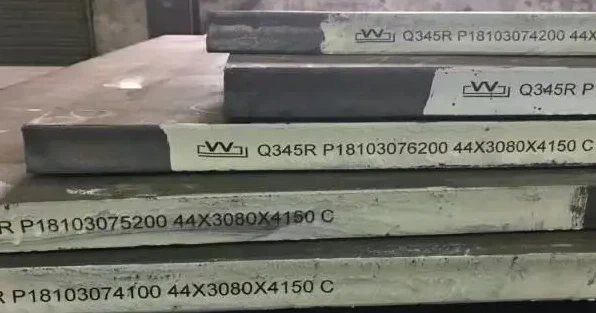
Q345R is currently the most widely consumed and applied steel plate material in China's pressure vessel industry.With a yield strength of 345 MPa, approximately 40% higher than Q245R, it allows for thinner wall thickness design under the same pressure requirements, thus reducing equipment weight.In terms of chemical composition, Q345R has a manganese content ranging from 1.20% to 1.60% and a carbon content controlled at ≤0.20%, ensuring outstanding weldability.
Q345R products from major steel mills such as Nanjing Iron and Steel and Angang have been widely used in large‑scale projects including Sichuan Petrochemical and Turkmenistan storage tanks, with cumulative supply reaching tens of thousands of tons.
Q245R: The Cost-Effective "Basic Grade"
If your storage tank operates under low pressure and normal temperature, Q245R is the optimal cost-effective choice. With a yield strength of 245 MPa, it is lower than that of Q345R, yet sufficient for many medium- and low-pressure vessels.The biggest advantages of Q245R are its lower cost and superior weldability.
For equipment with modest strength requirements, such as ordinary water storage tanks and small gas storage tanks, Q245R is fully capable and avoids over-engineering.

16MnDR: The "Guardian" for Low-Temperature Environments
The letter "D" stands for "low" and "R" for "pressure vessel" - 16MnDR is a pressure vessel steel specially designed for low-temperature environments.It maintains excellent impact toughness at -40℃ without becoming brittle or fracturing.
If your storage tank is to be installed in frigid northern regions or used to store low-temperature media such as liquid ammonia, 16MnDR is an essential option.16MnDR products from Nanjing Iron and Steel have been successfully applied in the PetroChina Tangshan LNG Project, with a supply volume of 1,247 tons.

III. High-End Material Selection for Special Working Conditions
In addition to the three conventional materials mentioned above, more advanced materials are required for certain special working conditions:
Large Crude Oil Storage Tanks: 12MnNiVR
For large crude oil storage tanks above 100,000 cubic meters, ordinary materials are no longer sufficient. High-strength steel plates such as 12MnNiVR, with a yield strength of over 490 MPa, are required.Nanjing Iron and Steel is a leading domestic supplier in this field, having supplied materials for 265 storage tanks in major projects of CNPC, Sinopec, CNOOC and others, with a total volume of more than 180,000 tons.This type of steel not only features high strength, but also requires excellent weldability and resistance to brittle fracture.

Cryogenic Storage Tanks: 9% Nickel Steel (06Ni9DR)
When the temperature drops to -196℃ (the storage temperature of liquefied natural gas), ordinary steel will fracture brittlely like glass. In this case, 9% nickel steel (grade 06Ni9DR) is required.Full-specification nickel-based steels developed by Shandong Iron and Steel Rizhao Company have been successfully applied in the world's largest 270,000 cubic meters LNG storage tank at the Zhuhai LNG Terminal.This type of steel was long monopolized by foreign countries, but has now achieved a domestic breakthrough, with a premium of over 1,000 yuan per ton.

Ultra-Low Temperature Liquid Hydrogen Tanks: Austenitic Stainless Steel
The storage temperature of liquid hydrogen is as low as -253℃, and liquid helium reaches -269℃. Even 9% nickel steel is inadequate for such extreme environments, so austenitic stainless steel must be used.S31603 (JLH) austenitic stainless steel independently developed by Jiuquan Iron and Steel Group has passed the technical evaluation of the China Special Equipment Inspection and Research Institute.It has an applicable temperature range of -269℃ to 100℃ and can be widely used in ultra-low temperature liquid hydrogen / liquid helium storage equipment.

High-Temperature Hydrogen Service: Chromium-Molybdenum Steel
For severe high-temperature, high-pressure and hydrogen-containing conditions (such as hydrogenation reactors), chromium-molybdenum steel series must be selected, such as 15CrMoR, 14Cr1MoR, 12Cr2Mo1R, etc.This type of steel exhibits excellent hydrogen corrosion resistance at high temperatures, and can resist hydrogen embrittlement and high-temperature creep.
IV. The "Temperature Red Line" for Material Selection
The most easily overlooked factor in material selection is the minimum operating temperature. Different materials have their own safe temperature ranges. The table below shows the temperature limits for common materials:
| Material | Delivery Condition | Minimum Applicable Temperature |
|---|---|---|
| Q245R (6–12mm thick) | Hot rolled / Controlled rolling / Normalized | -20℃ |
| Q345R (6–20mm thick) | Hot rolled / Controlled rolling / Normalized | -20℃ |
| 16MnDR | Normalized | -40℃ |
| 09MnNiDR | Normalized | -70℃ |
| 08Ni3DR | Normalized / Quenched and tempered | -100℃ |
| 06Ni9DR | Quenched and tempered | -196℃ |
⚠️ Important Note:When the design temperature is below -20℃, low-temperature steel must be used; ordinary Q345R is not acceptable as a substitute. This is a safety red line that cannot be violated.
V. Delivery Conditions: Normalized, Controlled Rolled, or Quenched & Tempered?
Many purchasers overlook the parameter of delivery condition, yet it directly affects the properties of steel plates:
- Hot Rolled (AR): The most basic condition, suitable for low‑requirement applications
- Controlled Rolling (CR): Produces finer grains and better performance through controlled rolling processes
- Normalized (N): Air‑cooled after heating to a specified temperature; recommended for stable and uniform performance
- Quenched and Tempered (QT): Quenching + tempering, used for high‑strength requirements such as steel for large storage tanks
- Purchasing Suggestions:For pressure vessel steel plates, normalized delivery is recommended - it is the standard preferred option with the most stable performance.For thicker steel plates (e.g., Q345R with thickness > 36mm), the standard mandates delivery in the normalized condition.


VI. Material Selection Decision Flowchart
To help you quickly identify the right material, I have created a decision-making process:
Step 1: Determine operating temperature
Below -40℃ → Low-temperature steel series (16MnDR / 09MnNiDR / 9Ni steel)
-20℃ ~ 400℃ → Proceed to next step
Step 2: Determine design pressure
Medium and low pressure, general service → Q245R (economical and practical)
High pressure, high strength requirement → Q345R (all‑around mainstream grade)
Step 3: Check special requirements
Large storage tanks (>100,000 m³) → High‑strength steel such as 12MnNiVR
High‑temperature hydrogen service → Chromium‑molybdenum steel series
Ultra‑low temperature (LNG/LH₂) → 9Ni steel / Austenitic stainless steel
VII. Practical Suggestions for Purchasers
Comply with standards
When purchasing, make sure the steel plates conform to GB/T 713 (Steel plates for pressure vessels) - this is the most basic requirement.
Inspect quality certificates
Products from qualified steel mills come with a quality certificate that includes key information such as grade, specification, chemical composition and mechanical properties. Always obtain and verify it.
Select materials based on actual needs; do not blindly pursue high prices
More expensive materials are not necessarily better. Using Q345R for normal‑temperature, low‑pressure vessels is wasteful, while using 16MnDR at -50℃ creates a safety hazard. Suitability is the best choice.
Consider processability
Thick plates (thickness > 36mm) must be delivered in the normalized condition to ensure a dense internal structure. Specify this requirement clearly to the steel mill when purchasing.
Follow the latest technological trends
The domestic production of high‑end materials such as 9Ni steel and austenitic stainless steel is accelerating, with prices becoming more affordable. For projects under special working conditions, explore domestic alternatives.
Final Notes
Material selection for pressure vessels and storage tanks is a professional discipline. However, by mastering the basic principles and characteristics of commonly used materials, you can make the right decisions.
Choose the right material, and your equipment can operate safely for 30 years. Choose the wrong one, and even the most expensive material will be useless.
If you are selecting materials for a specific project, feel free to leave a comment for discussion. Our professional team can help analyze your working conditions and recommend the most suitable material solution.
What is Q345R material?
Q345R is common low alloy steel, it is the boiler pressure vessel commonly used steel type, the delivery state: hot rolled or normalization.
What is Q345R steel equivalent to?
The Q345R equivalent ASTM material is A516 Grade 70 in specification of ASTM A516/A516M.
What is Q345 equivalent to ASTM?
A572 Grade 50
Q345 can also be replaced with equivalent materials, including A572 Grade 50 USA ASTM, Q355 China GB/T, and SPFC 590 Vietnam/Japanese JIS. The yield strength of Q345 is where the material begins to deform plastically. Before hitting deformation, it will return to its original shape when stress is removed.
What is the ASTM material equivalent to Q245R?
ASTM A516 Grade 60
The equivalent ASTM material for Q245R, a Chinese low-alloy steel grade used for pressure vessels, is ASTM A516 Grade 60.
What is the difference between Q345B and Q345R?
1. Q345B material: It is a low carbon alloy steel (c <0.2%), with good comprehensive performance, good low temperature performance, cold stamping performance, welding performance and machinability. 2. Q345R material: It is a special plate for pressure vessels with a yield strength of 345MPa.
What is the difference between Q245R and Q345R?
Q245R has better weldability (Ceq < 0.45%) due to lower manganese, reducing crack formation during welding. Q345R's higher Ceq (~0.47%) increases hardening tendency and crack risk, requiring careful welding precautions (e.g., preheating, low-hydrogen electrodes).
What type of steel is used in pressure vessels?
While there are multiple grades of PVQ steel, ASTM A516 and ASTM A537 are most commonly used for pressure vessel applications due to their balance of strength and ductility.


