

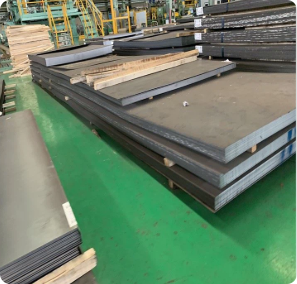
Q295GNH is a high-performance weathering steel designed for extreme industrial environments, adhering to GB/T 4171-2008 and GB/T 10125-2012 standards . Engineered with a unique alloy system, this steel offers superior corrosion resistance, high tensile strength, and thermal stability, making it ideal for chemical plants, power generation facilities, and mining infrastructure exposed to acidic gases, high temperatures, and cyclic loading.
Core Engineering Properties
Alloy Composition: Contains Cu (0.25-0.45%), Cr (0.30-0.65%), and Ni (0.25-0.50%) , forming a dense α-FeOOH oxide layer that reduces corrosion rates by 2-8 times compared to conventional carbon steel . Phosphorus (0.07-0.12%) enhances resistance to acidic environments, while controlled carbon (≤0.12%) ensures weldability and ductility .
Mechanical Performance:
Yield strength ≥295 MPa (thickness ≤16mm), tensile strength 360-510 MPa, and elongation ≥24% , ensuring load-bearing capacity under dynamic industrial loads.
Impact resistance: ≥34J at -20℃ (Grade D) to ≥60J (negotiable for critical applications) , critical for low-temperature and high-seismic zones.
Industrial Corrosion Resilience
Acid & Alkali Resistance: Withstands 70°C 50% H₂SO₄ environments with corrosion rates ≤14 mg/cm²·h , making it suitable for chemical storage tanks and wastewater treatment equipment. Its phosphorus-enriched microstructure resists chloride ingress in coastal refineries, passing 1000-hour salt spray testing with minimal pitting .
High-Temperature Stability: Maintains ≥80% of its yield strength at 600°C , ideal for furnace linings, chimney structures, and power plant boilers.
Abrasion Resistance: Exhibits HB 230-280 hardness in wear-prone applications like mining conveyor belts and agricultural plows.
FAQ
1. What is Q295GNH high-performance weathering steel designed for?
Answer: It is designed for extreme industrial environments, such as chemical plants, power generation facilities, and mining infrastructure, exposed to acidic gases, high temperatures, cyclic loading, and harsh conditions.
2. Which standards does Q295GNH comply with?
Answer: It complies with GB/T 4171-2008 and GB/T 10125-2012.
3. What key alloy elements enhance Q295GNH's corrosion resistance, and how?
Answer:
Copper (Cu 0.25–0.45%), chromium (Cr 0.30–0.65%), nickel (Ni 0.25–0.50%): Form a dense α-FeOOH oxide layer, reducing corrosion rates by 2–8 times compared to conventional carbon steel.
Phosphorus (P 0.07–0.12%): Enhances resistance to acidic environments and chloride ingress.
Controlled carbon (C ≤0.12%): Ensures weldability and ductility.
4. What are the mechanical properties of Q295GNH?
Answer:
Yield strength: ≥295 MPa (for thickness ≤16mm).
Tensile strength: 360–510 MPa.
Elongation: ≥24% (suitable for dynamic industrial loads).
Impact resistance: ≥34 J at -20°C (Grade D), with up to ≥60 J negotiable for critical applications.
5. What industrial corrosion resilience and special properties does Q295GNH offer?
Answer:
Acid & alkali resistance: Withstands 70°C 50% H₂SO₄ environments (corrosion rate ≤14 mg/cm²·h) and passes 1000-hour salt spray testing for coastal refineries.
High-temperature stability: Maintains ≥80% of yield strength at 600°C for furnace linings and boilers.
Abrasion resistance: Exhibits HB 230–280 hardness for mining conveyor belts and agricultural equipment.
Thermal & mechanical durability: Suits cyclic loading and high-seismic zones with robust impact resistance.


