

Products Description
HP265 is a low-carbon manganese-based hot-rolled steel plate specifically designed for manufacturing welded gas cylinders. Its core purpose is to meet the manufacturing requirements of steel welded gas cylinders for liquefied petroleum gas (LPG) and industrial gases.
This material needs to be used for extended periods in ambient temperatures ranging from -40℃ to 60℃ and withstand test pressures up to 3.2MPa. Therefore, it has strict requirements for weldability, stamping performance, and low-temperature toughness.
HP: Derived from the first letters of the Chinese pinyin for "welding cylinder," clearly indicating the material's intended use in the manufacture of welded gas cylinders.
265: Indicates that the lower limit of the material's yield strength is 265 MPa, meeting the strength requirements for steel used in welded gas cylinders as specified in GB/T 6653-2017.
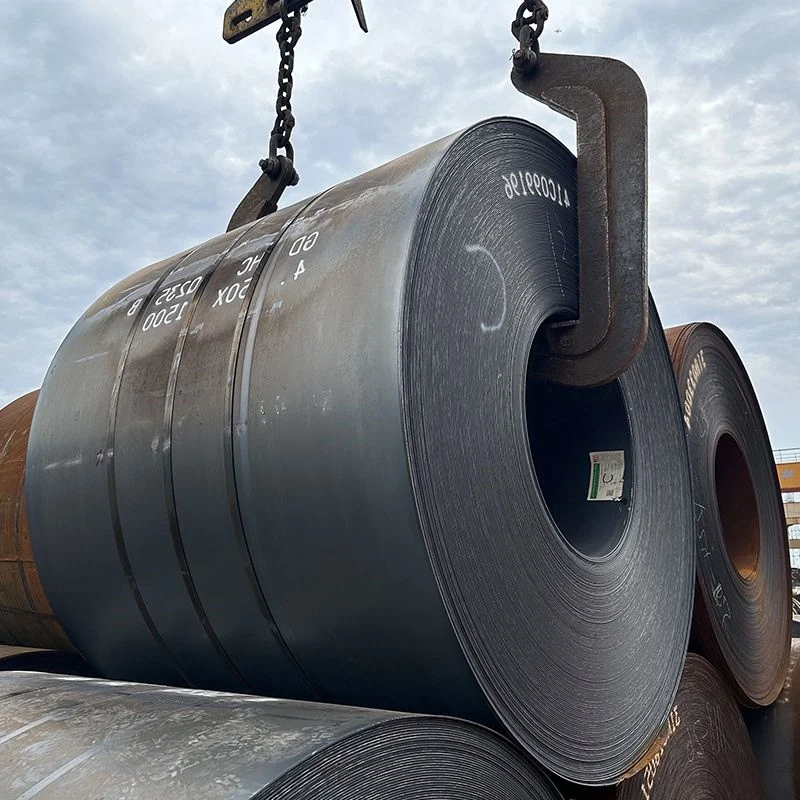
Hot Rolled HP265 Carbon Steel Coil for Welding Gas Cylinder
As a global leading steel supply chain group with 18+ years of experience, GNEE (Tianjin) Supply Chain Group Co., Ltd. has been dedicated to providing high-quality hot-rolled steel plates for welded gas cylinders since 2008. With over 600 companies across 100+ countries, we specialize in producing and supplying HP265 steel plates-two core grades compliant with GB/T 6653 standard.
Products Description
HP265 Chemical Composition
| Element | Max. Value |
|---|---|
| C | 0.19 |
| Si | 0.10 |
| Mn | 0.80 |
| P | 0.035 |
| S | 0.035 |
| Als (acid-soluble Al) | ≥ 0.015 |
- Low carbon content (C≤0.19%): Ensures minimal cracking during welding; low carbon equivalent adapts to various processes such as submerged arc welding and plasma welding.
- Manganese alloying (Mn≤0.80%): Improves hardenability, compensates for insufficient strength due to low carbon content, and refines grain size, improving toughness.
- Strict sulfur and phosphorus control (P≤0.035%, S≤0.035%): Reduces hot brittleness, improves material purity, and prevents cracking during stamping.
- Aluminum deoxidation (Als≥0.015%): Refines grain size through aluminum deoxidation, improving overall material performance.
HP265 Mechanical Properties
| Property | Value |
|---|---|
| Yield Strength (ReL) | ≥ 265 MPa |
| Tensile Strength (Rm) | 410–520 MPa |
| Elongation (A) | ≥ 27% (t ≥ 3 mm) |
| Elongation (A) | ≥ 21% (t < 3 mm) |
| Cold Bending (180°) | D = 2a, no cracks |
- Yield strength ≥ 265 MPa, tensile strength 410-520 MPa: Ensuring strength while avoiding excessive strength that could lead to stamping cracks.
- Elongation ≥ 27% (for thickness ≤ 16 mm): Ensuring sufficient plastic deformation capacity of the material during stamping.
- Impact toughness ≥ 27 J at -20℃: Meeting the requirements for use in low-temperature environments and preventing brittle fracture.
Technical Advantages of HP265 Cylinders
Excellent Welding Performance
Low carbon content and appropriate manganese content reduce the likelihood of cracking during welding, resulting in stable weld quality.
Suitable for various welding processes such as automatic submerged arc welding and plasma welding, improving production efficiency.
Good Stamping Forming Performance
Low yield strength ratio (≤0.80), indistinct yield plateau, small differences in longitudinal and transverse properties, uniform deformation during cold stamping, and less prone to cracking.
High elongation, meeting the stamping requirements of complex-shaped gas cylinder components.
High Material Utilization
The steel plate is straight with minimal thickness variation, reducing machining allowances and increasing material utilization to over 95%.
Lowering production costs and enhancing enterprise competitiveness.

Core Application Scenarios
Liquefied petroleum gas cylinders
Liquefied Petroleum Gas Cylinders: Used for storing and transporting liquefied petroleum gas (LPG), requiring high pressure and low temperature environments.
HP265's excellent weldability and stamping performance ensure that the cylinders are not prone to cracking during manufacturing and can be used safely for a long time.
Industrial Gas Cylinders
Suitable for storing industrial gases such as acetylene, nitrogen, and hydrogen, requiring compliance with the pressure and corrosiveness requirements of different gases.
HP265's corrosion resistance can be improved by adjusting its chemical composition or surface treatment processes to adapt to special environmental requirements.
Gas Cylinders for Special Environments
In extremely cold regions or corrosive media environments, HP265 can meet the requirements for use under extreme conditions by adding alloying elements or using special coatings.

Standards and Certification
Domestic Standards
HP265 strictly adheres to GB/T 6653-2017 "Steel Plates and Strips for Welded Gas Cylinders" standard, ensuring that material properties meet domestic gas cylinder manufacturing requirements.
International Certification
HP265 has performance similarities to the SG255 grade in the Japanese JIS G3116-2005 standard, making it a viable alternative to imported materials and reducing procurement costs.
Mandatory Standard Harmonization
With GB/T 6653 becoming a mandatory national standard, the production and testing of HP265 will be more stringent, ensuring the safety performance of gas cylinders.
HP265 gas welded cylinder steels
Why choose GNEE Steel as the manufacturer?
Reliable Quality Assurance
Strict compliance with GB/T 6653
Full traceability and inspection reports
Third-party certification available
Strong Supply and Customization
Wide range of grades: HP265, HP295, HP345
Custom sizes and specifications
Stable inventory and fast delivery
Global Export Experience
We have supplied gas cylinder steel to clients in Asia, the Middle East, Africa, and South America, supporting both OEM manufacturers and large-scale distributors.

What is the heat treatment process for HP265?
HP265 is typically delivered in hot-rolled or controlled-rolled condition, and heat treatment can also be performed as needed. For cold-spun gas cylinders, the manufacturing process often employs a "cold spinning + overall stress-relief annealing" route, under which HP265 maintains good performance stability.
What temperature environments is HP265 suitable for?
According to standards, HP265 is suitable for welded gas cylinders used in normal ambient temperatures (-40℃ ~ 60℃). Its guaranteed room-temperature impact toughness is 27J, which meets the requirements of most conventional applications. For special applications in extremely cold regions, it is recommended to confirm the low-temperature impact performance with the supplier.
Is HP265 steel easy to weld?
Yes, HP265 steel has good weldability due to its low carbon content and controlled alloy composition, resulting in low cracking risk and stable weld seam quality.
What is the equivalent grade of HP265 steel?
HP265 is commonly equivalent to EN standard P265NB and ISO BW265, which are widely used in pressure vessel and cylinder manufacturing in international markets.
Can HP265 steel be used for high-pressure applications?
HP265 is suitable for medium-pressure environments, but for high-pressure gas cylinders, higher strength grades like HP325 or HP365 are recommended.


