

What Is The Maximum Thickness Typically Available For P460QL1?
The maximum thickness for P460QL1 steel plate typically reaches around 400mm, though availability can vary by supplier, with common ranges often cited from 6mm up to 350-400mm, used for quenched and tempered pressure vessel applications.

P460QL1 is a weldable, heat-sensitive alloy steel. It is recognized for its ability to be joined into complex shapes provided that strict thermal management protocols are followed. Because its strength is derived from its specific heat-treated state (+QT), the welding process must be carefully controlled to ensure the Heat Affected Zone (HAZ) does not lose the properties granted by the mill's tempering process.
Key Characteristics
Weldability: Compatible with SAW (Submerged Arc), GMAW, and SMAW welding processes.
Low Carbon Equivalent: Designed to minimize the risk of cold cracking during the joining process.
Z-Direction Quality: Often available with Z-test options (Z25/Z35) to prevent lamellar tearing in complex joints.
Cold Formability: Can be rolled into cylindrical shells, though it requires higher-capacity rolling machines than standard carbon steel.
Decoding the Name
P: Informs the welder that the material must follow Pressure Vessel Welding Procedures.
460: Determines the required Tensile Strength of filler metals (electrodes/wire).
Q: A reminder that Post-Weld Heat Treatment (PWHT) temperatures must not exceed the original tempering point.
L1: Indicates the material's suitability for service in freezing climates.
Comparison
Vs. Standard Carbon Steel: P460QL1 requires mandatory preheating (100°C–150°C) and low-hydrogen consumables, whereas standard steel is more forgiving.
Vs. S460Q: Structural S460Q lacks the rigorous testing for pressure-bearing reliability and high-purity chemistry found in P460QL1.
Common Application
Boiler Steam Drums: Thick-walled drums subjected to intense thermal and pressure cycles.
Refinery Heat Exchangers: Complex units with numerous welded nozzles and tube sheets.
Pressure Manifolds: High-strength piping headers in oil and gas processing plants.
What is the maximum thickness available for P460QL1?
P460QL1 is supplied 6-150 mm thick, with custom options up to 200 mm. 460 MPa yield strength is maintained ≤100 mm; thicker plates (100-150 mm) have slight yield reductions but remain high-strength. Precise quenching/tempering ensures uniform properties-thickness selection depends on load, welding, and service conditions.
Is P460QL1 corrosion-resistant?
No, P460QL1 (carbon-manganese steel) has limited corrosion resistance. Protect with painting, galvanizing, epoxy/polyurethane coatings, or sacrificial anodes (offshore). Mild environments need regular cleaning/repainting; harsh settings (coastal/chemical plants) require coatings + cathodic protection. Weld HAZ needs post-weld cleaning/coating.
Can P460QL1 be welded to other steel grades?
Yes, but ensure compatibility. Weld to low-strength steels (A36, S235) with matching lower-strength filler; to high-strength steels (P500QL1, S690QL) use filler matching P460QL1 or higher grade. Preheat/PWHT prevents cracking; clean base metals to remove contaminants. Qualify welding procedures via tensile/impact/bend tests.
Chemical composition % of steel P460QL1 (1.8872): EN 10028-6-2009
| C | Si | Mn | Ni | P | S | Cr | Mo | V | N | Nb | Ti | Cu | Zr | B |
| max 0.18 | max 0.5 | max 1.7 | max 1 | max 0.02 | max 0.008 | max 0.5 | max 0.5 | max 0.08 | max 0.015 | max 0.05 | max 0.03 | max 0.3 | max 0.05 | max 0.005 |
Mechanical properties of steel P460QL1 (1.8872)
| Nominal thickness (mm): | to 100 | 100 - 150 |
| Rm - Tensile strength (MPa) (+QT) | 550-720 | 500-670 |
| Nominal thickness (mm): | to 50 | 50 - 100 | 100 - 150 |
| ReH - Minimum yield strength (MPa) (+QT) | 460 | 440 | 400 |
| KV - Impact energy (J) transverse, (+QT) | -40° 27 |
-20° 40 |
0° 60 |
| A - Min. elongation at fracture (%) (+QT) | 19 |
What is the chemical composition of P460QL1?
Typical composition (weight%): C ≤0.18, Si ≤0.60, Mn ≤1.70, P ≤0.025, S ≤0.025, Cr ≤0.30, Ni ≤0.50, Mo ≤0.15, V ≤0.12, Ti ≤0.05. Carbon/Mn boost strength, Si improves weldability, low P/S reduces brittleness, and V/Ti refine grain structure. Variations exist but meet EN 10025-6 limits.
2What is the hardness of P460QL1?
P460QL1 (EN 1.8872) is a normalized steel with a Brinell hardness typically around 217 HBW, reflecting its high strength and good toughness, with values often in the 217-250 HBW range, though specific hardness depends on heat treatment and product form.
3Which standard governs P460QL1?
P460QL1 is governed by EN 10025-6:2004, covering hot-rolled high-yield quenched/tempered structural steels. It specifies chemical composition, mechanical properties, heat treatment, test methods, and delivery conditions, ensuring consistent quality across manufacturers for engineers and buyers.
4What are the typical applications of P460QL1?
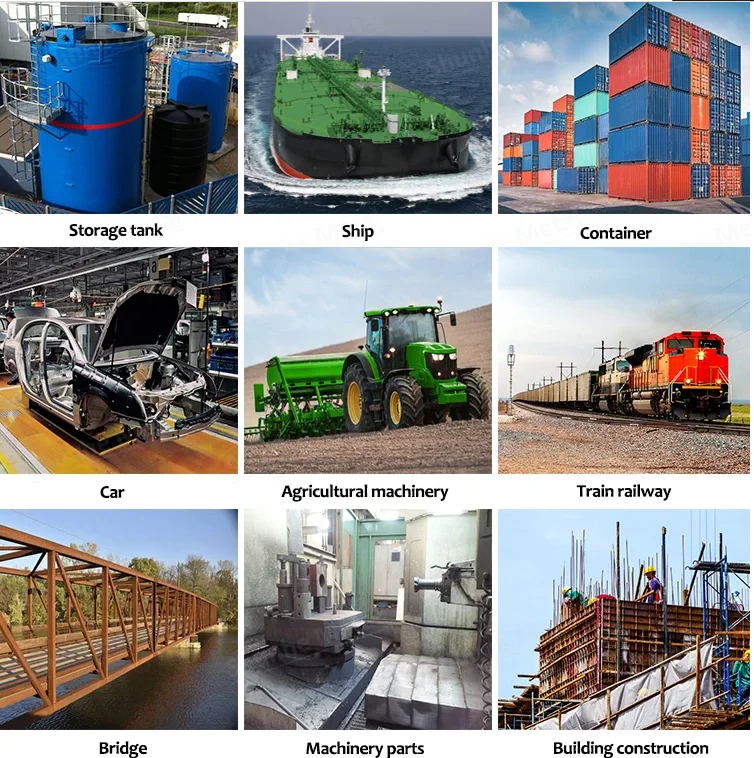
P460QL1 is used in heavy-duty engineering: construction machinery (crane booms, excavator arms), long-span/offshore bridges, offshore platforms, medium-high pressure vessels/boilers, wind turbine towers, and ship/locomotive structural parts. Suitable for dynamic loads, low temperatures, or corrosive environments (with coating).
5Can P460QL1 be used in low-temperature environments?
Yes, P460QL1 excels in low temperatures with 60 J impact energy at -40°C (EN 10025-6), resisting brittle fracture. Ideal for harsh winters, offshore, or arctic projects. For 0°C, verify toughness via testing or upgrade to P460QL2. Proper fabrication/welding/coating maintains performance.
If you have project requirements for P460QL1, we welcome your inquiry. GNEE maintains a large inventory of commonly used high strength steel grades for your selection.For detailed mechanical properties, chemical composition, and technical data, as well as free samples, please contact our factory immediately. We offer competitive prices, stable quality, and professional service. Email: info@gneesteels.com


