

Applicable Standard: ASTM A36/A36M, with dimensional tolerance governed by ASTM A6/A6M. Developed for North American construction specifications, it is the designated general structural steel under the AISC Steel Construction Specification and IBC International Building Code.
Grade Definition:
The figure "36" denotes the minimum yield strength of 36ksi (≈250MPa) for thin plates. Only tensile test and chemical composition inspection are mandatory under this standard; Charpy impact toughness is not a compulsory factory inspection item, and impact tests must be explicitly specified in purchase contracts if toughness performance is required.
Target Application Markets: the United States, Canada, Mexico, US-funded projects in the Middle East, Latin American infrastructure; compatible with AWS American standard welding specifications.

S235JR Hot Rolled Steel Plate (European Standard System)
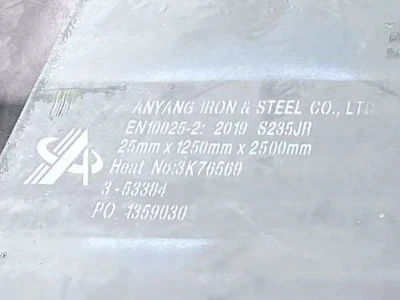
Applicable Standard: EN 10025-2, general structural steel per European standards, material designation No. 1.0038, fully compliant with Eurocode structural design codes.
Grade Code Breakdown:
S = Structural steel; 235 = Minimum yield strength of 235MPa for plates ≤16mm in thickness;
JR = Charpy V-notch impact energy ≥27J at 20°C, Charpy impact toughness is a mandatory factory inspection item.
Target Application Markets: All EU member states, Africa, Southeast Asian European-standard projects, construction works requiring CE structural certification.
Quick Overview Comparison: ASTM A36 vs EN 10025 S235JR Hot Rolled Plate
| Comparison Item | ASTM A36 Hot Rolled Plate | S235JR Hot Rolled Plate (EN 10025-2) |
|---|---|---|
| Governing Standard | ASTM A36/A36M | EN 10025-2 (Material No. 1.0038) |
| Yield Strength (Thickness ≤16mm) | ≥250MPa | ≥235MPa |
| Tensile Strength Range | 400–550MPa | 360–510MPa |
| Elongation after Fracture | ≥20% (Gauge Length: 200mm) | ≥26% (Gauge Length: 5.65√S₀) |
| Charpy Impact Toughness at 20°C | No mandatory requirement, test on demand only | Mandatory requirement: ≥27J for V-notch |
| Maximum Carbon Content | 0.26% | 0.17% (t≤40mm) |
| Maximum Allowable S & P Impurities | S≤0.05%, P≤0.04% | S≤0.035%, P≤0.035% |
| Standard Factory Inspection Items | Tensile Test + Chemical Composition Analysis | Tensile Test + Chemical Composition + Charpy Impact Test |
| Typical Brinell Hardness (HB) | 119–159 | 120–170 |
ASTM A36, S235JR Hot Rolled Structural Steel Plate Specification
| Item | ASTM A36 Steel Plate |
|---|---|
| Product Name | ASTM A36, S235JR Hot Rolled Structural Steel Plate |
| Standard | ASTM A36/A36M; EN 10025-2 |
| Manufacturing Process | Hot Rolled |
| Supply Thickness | 6–300 mm |
| Supply Width | 1,000–4,500 mm |
| Supply Length | 3,000–18,000 mm |
| Surface Finish | As Rolled, Shot Blasted & Painted |
| Edge Condition | Mill Edge (ME), Trimmed Edge (TE) |
| Heat Treatment | As Rolled (Optional Normalized) |
Chemical Composition: ASTM A36 vs EN 10025 S235JR hot rolled structural steel plate
|
Element |
ASTM A36 (% by weight) |
EN 10025-2 S235JR (% by weight) |
|---|---|---|
|
Carbon (C) |
0.26 max |
0.17 max |
|
Manganese (Mn) |
1.03 max (varies by thickness) |
1.40 max |
|
Phosphorus (P) |
0.040 max |
0.035 max |
|
Sulfur (S) |
0.050 max |
0.035 max |
|
Silicon (Si) |
0.40 max |
0.55 max |
|
Copper (Cu) |
0.20 min (if specified) |
0.55 max |
|
Iron (Fe) |
Balance |
Balance |
Mechanical Property: ASTM A36 vs EN 10025 S235JR hot rolled structural steel plate
| Property | ASTM A36 | EN S235JR |
|---|---|---|
| Yield Strength (min) | 250 MPa (36 ksi) | 235 MPa |
| Tensile Strength | 400–550 MPa | 360–510 MPa |
| Elongation (200mm) | 20% min | 26% min (longitudinal) |
| Elongation (50mm) | 23% min | 24% min (transverse) |
| Charpy Impact | Not required | 27J at +20°C (JR grade) |
Analysis of Weldability: ASTM A36 vs EN 10025 S235JR carbon structural steel plate
Welding Characteristics of ASTM A36 carbon structural steel plate
Carbon Equivalent ranges from 0.36 to 0.44. Preheating at 100–150°C is recommended for plates thicker than 25mm or welding at ambient temperature below 5°C to prevent hardness cracking in weld joints.
01
Higher allowable sulfur content calls for strict interpass temperature control for high heat input welding.
02
Perfectly matched with mainstream structural welding electrode E7018 under American standards, highly compatible with welders and construction procedures in North American projects.
03
Conventional welding for thin plates (6–20mm) requires no special technical treatment for outstanding cost performance.
04
Welding Characteristics of S235JR carbon structural steel plate
Carbon Equivalent (CE) <0.35, no preheating required for ambient-temperature welding of plates ≤30mm. Compatible with all mainstream welding processes including SMAW, GMAW and SAW.
01
Strict control of sulfur and phosphorus minimizes hot cracking and lamellar tearing during multi-pass welding for thick plates and high-altitude field assembly.
02
Matched with European standard E60 series welding electrodes for excellent process compatibility at European construction sites.
03
Low-temperature welding for thick plates only requires mild preheating at 50–80°C to cut construction costs.
04
GNEE can provide targeted welding procedure proposals for A36/S235JR according to your welding drawings and service ambient temperature, including technical guidance for groove fabrication and preheating parameters. Steel plates can be delivered after CNC cutting per welding dimensions for direct assembly.
Cold Formability & Machinability Comparison: ASTM A36 vs EN 10025 S235JR steel plate


1. Cold Forming (Bending, Plate Rolling, Stamping, Flanging)
- S235JR presents prominent advantages: higher elongation after fracture and purer steel composition deliver smaller springback for large-angle bending, cylinder rolling and special-shaped component stamping with drastically reduced edge tearing risk.
- ASTM A36 satisfies conventional 90° right-angle bending and plate shearing; extra bending allowance is required for forming with large curvature.
2. Mechanical Cutting & Machining (Drilling, Milling, Turning, Tapping)
Brinell Hardness of both grades is concentrated at 120–160HB, delivering nearly equivalent machining efficiency for ordinary lathes, drilling machines and CNC milling machines.
- ASTM A36 features thicker hot mill scale on the surface, so shot blasting rust removal is recommended prior to finish machining;
- S235JR offers superior surface flatness after hot rolling, suitable for exposed decorative structural components requiring finish machining.
3. Hot Working (Hot Bending, Forging, Hot Straightening)
- Low sulfur and phosphorus content of S235JR avoids intergranular brittle fracture during high-temperature hot straightening;
- A36 requires strict control of finish forging temperature to prevent failure induced by sulfide segregation.
4. Anti-Corrosion Surface Treatment
Both are plain carbon steel with no inherent corrosion resistance, so paint coating, hot-dip galvanizing or epoxy zinc-rich coating is compulsory for outdoor service.
- Custom high-copper A36 achieves marginal atmospheric weathering resistance by adjusting copper content;
- S235JR delivers uniform adhesion of galvanized coating, widely adopted for galvanized steel components for export.
Typical Application Segmentation: ASTM A36 vs EN 10025 S235JR structural steel plate

- Primary beam & column steel structures, floor bearing plates and anchor base plates for North American and US-funded overseas projects.
- American-style bridges, highway guardrails and heavy bolt-connected steel components.
- Conventional equipment base plates and platform brackets without low-temperature exposure or impact loads.
- Construction machinery for the Americas, container base frames and main steel for American-standard factory buildings.
- Overseas projects requiring AISC structural certification and AWS welding acceptance criteria.

- Factory buildings, steel structure curtain walls and main bridge structures complying with Eurocode specifications for the EU.
- Construction machinery frames, forklift base frames and vibration-resistant equipment frames for components under dynamic loads.
- Modular steel structures and box girders requiring massive field welding & assembly.
- Agricultural machinery frames for exports to Central Europe and Africa.
- Outdoor equipment foundations operated at ambient temperature requiring CE structural certification and anti-impact performance.
Key Reminder for Prohibited Grade Substitution
Structures exposed to ambient temperature below 0°C or lifting-impact base frames: Direct substitution of S235JR with A36 is forbidden.
Projects specified with American standard certification: S235JR shall not replace A36 directly.
European projects requiring CE certification: A36 cannot be used as a direct substitute for S235JR.
Product Supply Service from GNEE Steel
Founded in 2008, GNEE Steel boasts over 18 years of professional experience in hot rolled steel plate export. We maintain long-term cooperative relations with top domestic steel mills including Wuyang Iron & Steel and Anshan Iron & Steel. We are authorized to issue full traceability mill test certificates including EN 10204 3.2 and ASTM MTR.
Full Compliance Documentation Support
Original mill test certificates (MTC) provided as standard delivery. Third-party inspection by SGS/BV, CE certificate of conformity and notarization of American-standard material documents can be arranged on demand to satisfy mandatory documentation requirements for overseas customs clearance and project acceptance inspection.


One-Stop Logistics Packaging Service
Centralized warehousing at domestic ports, rust-proof packaging, container fixing and integrated sea freight door-to-door logistics coordination for FCL and LCL export orders.

Submit your drawing plate thickness, service location and governing standard now to receive a free material selection proposal + latest spot quotation for A36/S235JR. Trial pieces are available for physical inspection prior to mass order confirmation, with price locking and supply guarantee for bulk orders.
Click to get a free selection proposal and quote
FAQ
Are A36 and S235JR officially equivalent steel grades for unrestricted interchangeable use?
No, ASTM A36 and EN S235JR are not officially equivalent for unrestricted, automatic interchangeability. While they are close functional counterparts widely used as commercial substitutes for general mild steel fabrication, they belong to entirely different governing standard bodies (ASTM in the US and EN in Europe) with distinct compliance rules.
Is preheating mandatory for welding thick A36 steel plates?
Whether preheating is mandatory for thick ASTM A36 steel depends on structural codes, joint restraint, and plate thickness. Under structural standards like AWS D1.1, preheating is strictly required for A36 plates over 1.5 inches thick-ranging from 150°F to 300°F or higher-whereas thinner sections or ambient shop conditions may only recommend it to drive out moisture or prevent rapid cooling.
Is the yield strength of A36 always higher than S235JR?
No, the yield strength of ASTM A36 is not always higher than S235JR. While A36 generally has a higher nominal minimum yield strength (250 MPa vs. 235 MPa), the actual required yield strength for both grades changes depending on the thickness of the steel piece.
Can A36 steel plates pass CE certification for projects exported to Europe?
ASTM A36 steel plates cannot directly receive a CE mark under European harmonised standards because A36 is an American ASTM standard, not a European EN standard. To use steel legally in structural European projects requiring CE compliance, the material must be certified and ordered directly under the relevant European standard, such as EN 10025-2 (typically grade S235JR or S275JR).


