

A553 Type 1 - also designated as ASTM A553 Type I, UNS K81340, and commonly referred to as 9% nickel steel - is a high-strength low-carbon alloy steel containing nominally 9% nickel, balanced by iron and controlled additions of manganese, silicon, phosphorus, and sulfur. The ASTM A553/A553M specification covers three nickel levels (Type I: 9%, Type II: 8%, and Type III: 7%), but Type I is the most widely specified variant for the most demanding cryogenic applications because of its superior impact toughness at −196 °C and its decades-long proven track record in LNG storage infrastructure.
When quenched and tempered, A553 Type 1 develops a unique fine-grained martensitic microstructure containing stable retained austenite - a metallurgical feature critical to resisting crack propagation at extreme sub-zero temperatures. Unlike conventional martensitic steels, A553 Type 1 is not brittle or hard; rather, it combines high strength with remarkable toughness and excellent weldability, making it ideally suited for complex pressure vessel fabrication
A553 Type 1 Chemical Composition
The tightly controlled chemical composition is fundamental to the material's cryogenic performance. The nickel content - strictly maintained between 8.50% and 9.50% - is what distinguishes this steel from all other pressure vessel grades.
| Element | Heat Analysis (wt.%) | Product Analysis (wt.%) |
|---|---|---|
| Carbon (C), max | 0.13 | 0.13 |
| Manganese (Mn), max | 0.90 | 0.98 |
| Phosphorus (P), max | 0.035 | 0.035 |
| Sulfur (S), max | 0.040 | 0.040 |
| Silicon (Si) | 0.15 – 0.40 | 0.13 – 0.45 |
| Nickel (Ni) | 8.50 – 9.50 | 8.40 – 9.60 |
| Iron (Fe) | Balance | Balance |
A553 Type 1 Mechanical Properties
| Mechanical Property | Requirement | Unit |
|---|---|---|
| Tensile Strength, Ultimate | 690 – 825 | MPa |
| Tensile Strength (equivalent) | 100,000 – 120,000 | psi |
| Yield Strength (0.2% offset), min | 585 | MPa |
| Yield Strength (equivalent), min | 84,800 | psi |
| Elongation at Break (in 50 mm), min | 20 | % |
| Charpy V-Notch Impact Test Temperature (Type I) | −195 (−320) | °C (°F) |
| Minimum Impact Energy at −195 °C (Transverse) | ≥ 27 (≥ 34 Longitudinal) | Joules |
| Minimum Lateral Expansion at −195 °C | ≥ 0.381 | mm |
| Elastic Modulus (typical) | 190 – 210 | GPa |
| Density (typical) | 7.70 – 8.03 × 1000 | kg/m³ |
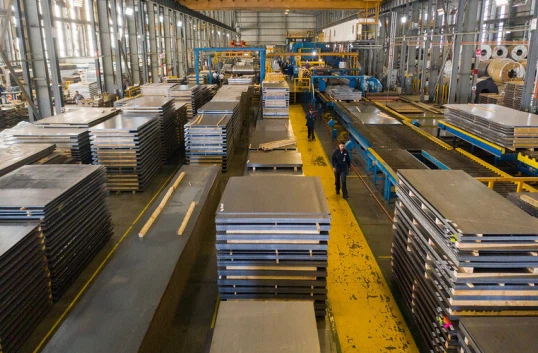
High-Strength Nickel-Alloy Steel A553 Type 1 plates stored in GNEE's warehouse
Why Choose High-Strength Nickel-Alloy Steel A553 Type 1 for Cryogenic Applications
Engineers and project managers evaluating materials for cryogenic pressure vessels consistently choose High-Strength Nickel-Alloy Steel A553 Type 1 over alternatives - including AISI 304L stainless steel, 7% nickel steel, and aluminum - for several technically compelling and economically significant reasons. These advantages have been validated through more than five decades of safe operational service across thousands of LNG storage installations worldwide.
Exceptional Cryogenic Toughness of A553 Type 1
At temperatures approaching −196 °C, most ferritic carbon and low-alloy steels undergo a well-documented ductile-to-brittle transition, becoming dangerously susceptible to catastrophic brittle fracture. A553 Type 1 overcomes this fundamental limitation through its carefully balanced 9% nickel metallurgy and specialized quenching-and-tempering heat treatment.
Proven Weldability for Fabrication Efficiency
The controlled low carbon content of A553 Type 1 (0.13% maximum) substantially reduces the risk of hydrogen-induced cold cracking in the heat-affected zone during fusion welding. This enables the use of conventional arc welding processes - shielded metal arc welding (SMAW), submerged arc welding (SAW), gas metal arc welding (GMAW), and gas tungsten arc welding (GTAW) - with appropriately matched nickel-based filler metals. The material is widely used in both shop fabrication and field erection environments.
Superior High-Strength Performance of A553 Type 1
The high tensile strength of A553 Type 1 - 690–825 MPa (100–120 ksi) - is approximately twice that of conventional AISI 304L stainless steel, which is commonly considered for the same cryogenic applications. This strength advantage allows pressure vessel designers to reduce shell plate thickness substantially while maintaining identical design pressure ratings and corrosion allowances. The cascading economic benefits include lower steel purchase weight, reduced welding consumable consumption, shorter fabrication time, lighter vessel erection lifts, and simplified foundation engineering. In large LNG projects where thousands of tonnes of steel are consumed, even modest thickness reductions translate into millions of dollars in total installed cost savings.
A553 Type 1 vs. A553 Type 2
| Parameter | A553 Type 1 (9% Ni) | A553 Type 2 (8% Ni) |
|---|---|---|
| Nickel Content | 8.50 – 9.50% | 7.50 – 8.50% |
| Impact Test Temperature | −195 °C (−320 °F) | −170 °C (−275 °F) |
| Tensile Strength | 690 – 825 MPa | 690 – 825 MPa |
| Yield Strength (min) | 585 MPa | 585 MPa |
| Density | ~7.85 g/cm³ | ~7.85 g/cm³ |
| Material Cost Index | Moderate | Lower Moderate |
| Primary Cryogenic Applications | LNG, LOX, LIN, LAR, ethylene | Moderate cryogenic storage |
Key Applications of High-Strength Nickel-Alloy Steel A553 Type 1
The unique combination of cryogenic toughness, high strength, and fabrication friendliness makes High-Strength Nickel-Alloy Steel A553 Type 1 the material of choice for numerous mission-critical cryogenic installations worldwide.
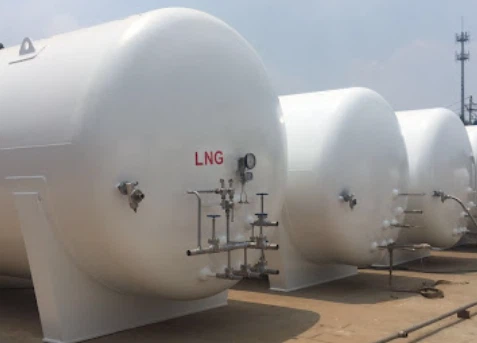
LNG Storage Tanks and Receiving Terminals
A553 Type 1 - specified in API 620 Appendix Q as ASTM A553 Type 1 - is the reference material for the inner shell of large double-walled LNG flat-bottom above-ground storage tanks operating at −163 °C (−260 °F). The industry has accumulated over 50 years of successful operational experience with this alloy in LNG storage, making it the benchmark against which all alternative cryogenic containment materials are measured.
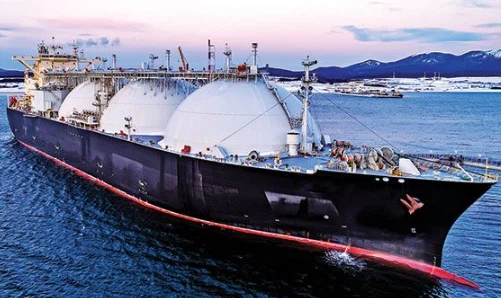
LNG-Fueled Ship Cryogenic Fuel Tanks
With the International Maritime Organization's increasingly stringent sulfur emission regulations, global demand for LNG-fueled vessels has surged dramatically. The International Maritime Organization (IMO) limits cryogenic tank materials for LNG-fueled ships to only four approved types under the IGC Code, and most recently ordered LNG-fueled ship tanks are adopting ASTM A553-1 material due to its high tensile strength, excellent impact toughness at cryogenic temperatures, and economic advantages compared to alternative materials.
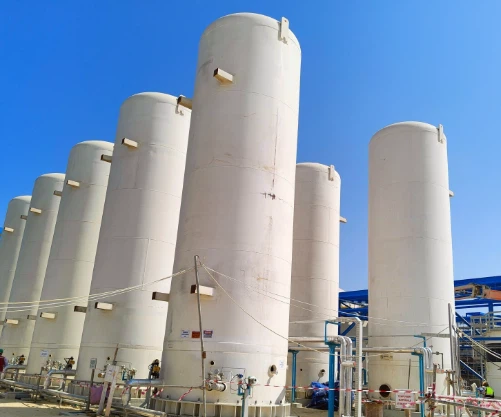
Industrial Gas Storage and Air Separation Units
Liquid oxygen, liquid nitrogen, and liquid argon - the primary products of cryogenic air separation - must be stored at temperatures ranging from −183 °C to −196 °C. A553 Type 1 9% nickel steel plates are ideal for constructing these double-walled, vacuum-insulated cryogenic storage vessels, providing the necessary combination of structural integrity and long-term corrosion resistance. The material's high nickel content also provides resistance to pitting and crevice corrosion in industrial gas storage environments.
Ethylene and Petrochemical Cryogenic Storage
Ethylene - a fundamental petrochemical building block - is stored at approximately −104 °C, well within the certified operating range of A553 Type 1. Petrochemical complexes worldwide depend on this nickel-alloy steel grade for ethylene storage spheres, bullet tanks, and cryogenic transport vessels because of its documented reliability under sustained low-temperature static loading conditions.
Conclusion: Why High-Strength Nickel-Alloy Steel A553 Type 1 from GNEE Is the Right Choice
When you specify and procure High-Strength Nickel-Alloy Steel A553 Type 1 for your cryogenic pressure vessel project, you are making more than a material purchase - you are investing in the long-term safety, structural integrity, and regulatory compliance of mission-critical assets that must perform flawlessly at −196 °C for decades of continuous service.
With over 18 years of metallurgical and export expertise, deep relationships with China's premier steel mills, a fully equipped 35,000 m² manufacturing and processing facility, and a documented track record of supplying certified cryogenic steel plates to satisfied customers in over 200 countries, GNEE Steel is uniquely positioned to serve as your long-term supply partner for High-Strength Nickel-Alloy Steel A553 Type 1.
Partner with GNEE today and secure your supply of fully certified A553 Type 1 9% nickel steel plates - backed by expert technical consultation, competitive factory-direct pricing, reliable global logistics, and unwavering commitment to quality. Your cryogenic project deserves nothing less.
FAQ
Q1: Are A553 Type 1 and SA553 Type 1 the same material?
Yes. ASTM A553 Type I and ASME SA-553 Type I are identical in chemical composition, mechanical property requirements, and impact testing criteria. The "SA" prefix designates the ASME Boiler and Pressure Vessel Code adoption of the ASTM standard. Both refer to the same 9% nickel alloy pressure vessel steel plate.
Q2: What is the maximum thickness available for A553 Type 1 plates?
The ASTM A553 specification places no absolute maximum thickness - the practical limit is determined by the manufacturer's ability to meet all mechanical property and impact test requirements through the full plate thickness. Current mill practice normally supplies plates up to 50 mm (2 inches), though recent developments have demonstrated successful production of ultra-thick 9% Ni plates up to 100 mm (4 inches) for pressurized cryogenic equipment applications.
Q3: Is A553 Type 1 suitable for hydrogen service?
Emerging research indicates that 9% nickel steels show promise for certain cryogenic hydrogen containment applications within the −196 °C to −253 °C range, particularly for liquid hydrogen storage in the context of the Global Energy Transition. However, project-specific material qualification testing and code compliance verification are strongly recommended, as liquid hydrogen storage at −253 °C presents unique material challenges beyond the traditional −196 °C certification of A553 Type 1.
Q4: Does GNEE provide free samples of A553 Type 1?
Yes. GNEE offers complimentary A4-sized sample plates of High-Strength Nickel-Alloy Steel A553 Type 1 for customer evaluation, laboratory testing, and weld procedure qualification. Contact our sales team with your sample request and delivery details, and we will arrange prompt shipment.
Q5: What welding consumables are recommended for A553 Type 1?
Nickel-based filler metals - typically AWS A5.11 ENiCrMo-3 (Alloy 625 type) or ENiCrFe-2/3 - are the industry-standard choice for welding A553 Type 1, as they produce weld deposits with excellent cryogenic toughness matching that of the base metal. The specific filler metal selection depends on the welding process employed and the applicable fabrication code requirements.


