

Products Description
HP295 steel plate is a low-alloy, high-strength steel specifically designed for the manufacture of welded gas cylinders, and is widely utilized in the fields of liquefied petroleum gas (LPG), industrial gases, and pressure vessels. As the gas cylinder industry faces increasingly stringent requirements regarding safety, lightweight design, and cost control, HP295 has emerged as one of the leading materials for the production of medium-pressure gas cylinders, distinguished by its stable mechanical properties and excellent processing characteristics.
"HP" stands for the initial letters of the Pinyin transcription of the Chinese words hanping ("welding cylinder"), representing "steel for welded gas cylinders";
"295" indicates that the nominal yield strength of the material is 295 MPa.

HP295 Steel Plate for Gas Cylinders
Looking for a reliable supplier of HP295 Steel Plate gas cylinder steel? Contact GNEE today for expert advice, competitive pricing, and fast delivery-let us help you choose the best solution for your project.
Chemical Composition of HP295 Steel Plate
| Element | Content (%) |
|---|---|
| C (Carbon) | ≤ 0.20 |
| Si (Silicon) | ≤ 0.55 |
| Mn (Manganese) | 1.20 – 1.60 |
| P (Phosphorus) | ≤ 0.025 |
| S (Sulfur) | ≤ 0.015 |
| Nb/V/Ti | Trace |
Low-carbon design is one of the most distinctive features of HP295. The carbon content is controlled to remain below 0.20%, ensuring that the material possesses excellent weldability-specifically, the heat-affected zone does not undergo excessive hardening during welding, thereby minimizing the susceptibility to cold cracking.
The addition of manganese serves as a crucial guarantee for the strength of HP295. As a solid-solution strengthening element, manganese enhances strength without significantly compromising ductility. Furthermore, manganese combines with sulfur to form MnS inclusions, thereby preventing sulfur-induced hot brittleness.
The deoxidizing and grain-refining effects of aluminum: The addition of acid-soluble aluminum (Als) serves a dual purpose: on one hand, it acts as a deoxidizer; on the other, it combines with nitrogen to form AlN precipitates. These precipitates pin the grain boundaries and refine the austenite grain structure, thereby improving the material's toughness and formability.
Mechanical Properties of HP295 Steel Plate
| Item | Value |
|---|---|
| Yield Strength | ≥ 295 MPa |
| Tensile Strength | 440 – 560 MPa |
| Elongation | ≥ 24% |
| Impact Energy (20℃) | ≥ 27 J |
- High Elongation (≥24%) → Suitable for deep drawing and roll forming
- Stable Strength Range → Meets design requirements for medium-pressure gas cylinders
- Good Impact Properties → Enhances safety
Applicable Standards and Specifications
The national standard applicable to HP295 steel plates is GB/T 6653, Steel Plates and Strips for Welded Gas Cylinders. This standard encompasses a total of six strength grades ranging from HP235 to HP365; HP295 is positioned in the upper-middle range and stands as the most widely utilized grade.
| Standard Name | Description |
|---|---|
| GB/T 6653 | Steel Plates and Strips for Welded Gas Cylinders |
| GB/T 1804 | Linear and Angular Dimensions Tolerances |
| NB/T 47013 | Non-Destructive Testing Standard for Pressure Equipment |
Key Standard Requirements:
- Strict control of chemical composition
- Mandatory impact testing
- High requirements for surface quality (absence of cracks and inclusions)
Production Process Of HP295 Steel Plate
- Hot Metal Pre-treatment: Desulfurization and dephosphorization
- Converter Smelting: Precise control of chemical composition
- Ladle Refining (LF/VD): Removal of inclusions and harmful gases
- Continuous Casting: Full-process protective casting to prevent secondary oxidation
- Heating: Slab heated to the appropriate temperature
- Hot Continuous Rolling: Controlled Rolling and Controlled Cooling (TMCP) process
- Coiling/Leveling: Hot-rolled into coils or leveled into steel plates

Production Process Of HP295 Steel Plate
Quality Control Standards
As a steel grade designated for pressure vessels, HP295 is subject to extremely rigorous quality inspection:
- Chemical Composition: Every heat of molten steel undergoes testing.
- Mechanical Properties: Tensile, bend, and impact tests are conducted on every batch.
- Surface Quality: 100% visual inspection is performed.
- Non-destructive Testing: Ultrasonic flaw detection is conducted when necessary.
- Metallographic Examination: Inspected for inclusions and grain size.
Main Applications of HP295 Steel Plate
HP295 steel plate is mainly used in the manufacture of the following pressure vessels and gas cylinders:
- Household LPG cylinders:YSP35.5 type liquefied petroleum gas cylinders (35.5L) for household cooking and daily energy supply.
- Commercial LPG cylinders:15kg to 50kg LPG cylinders widely applied in restaurants, catering businesses, industrial canteens and commercial gas supply stations.
- Industrial gas cylinders:Acetylene cylinders, oxygen cylinders and other standard industrial gas storage vessels, relying on stable formability and reliable safety performance.
- Chemical storage & transportation containers:Liquid chlorine cylinders and similar pressure vessels for the safe storage and transportation of hazardous chemical media.
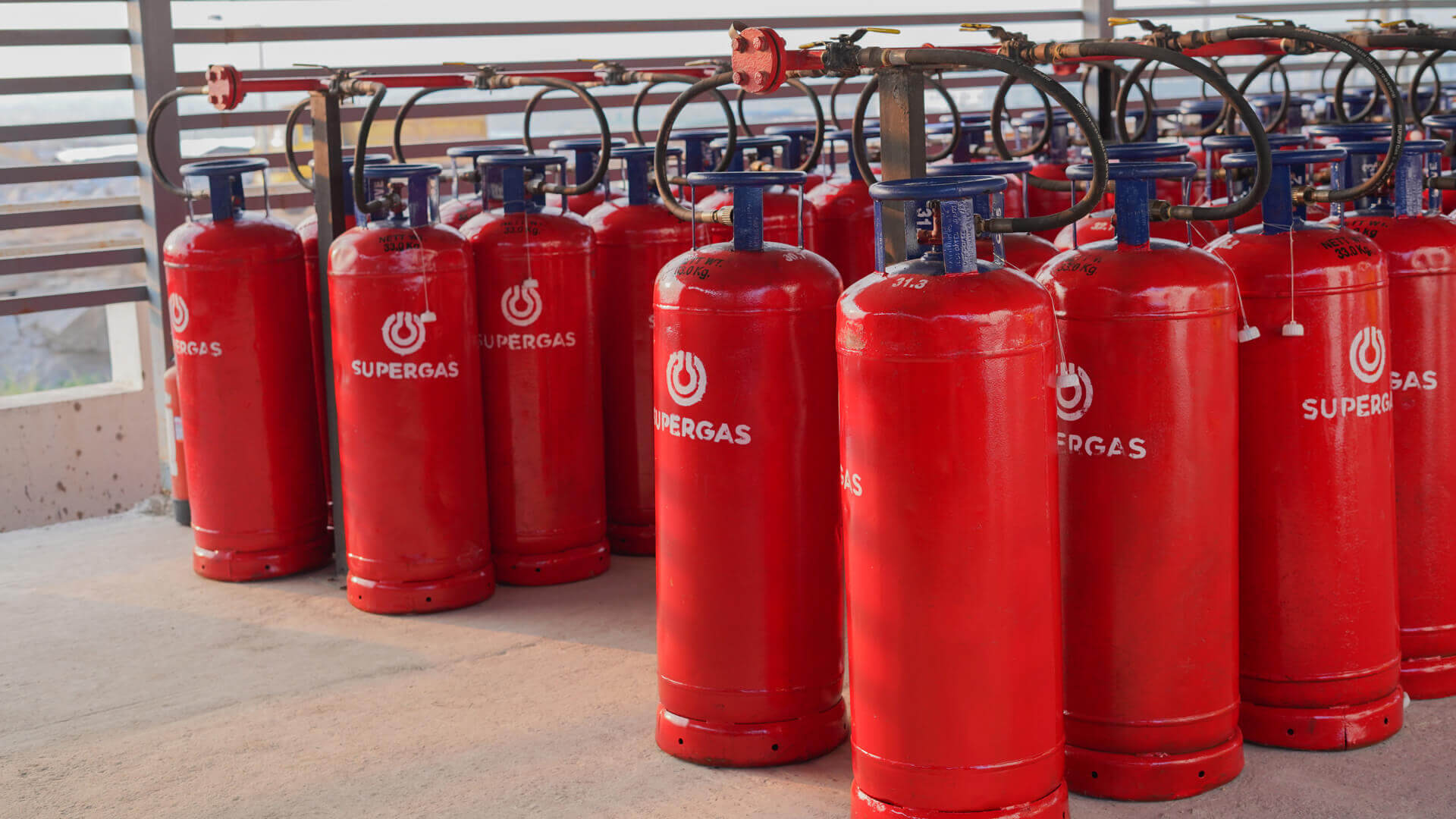
LPG cylinders
At GNEE, we assist our clients in selecting the optimal grade based on their specific vessel design and safety requirements. Our technical team has decades of experience in the steel industry, ensuring you receive the most reliable advice.
How are the welding properties of HP295?
HP295 exhibits excellent welding properties. This is attributed to its low-carbon design (C ≤ 0.20%) and low carbon equivalent; consequently, the heat-affected zone (HAZ) is resistant to hardening, and the material is not prone to cold cracking. High-quality welds can be achieved using standard automatic circumferential welding processes for gas cylinders, without the need for preheating.
Can HP295 steel plates be used to manufacture seamless gas cylinders?
No. HP295 is specifically designed for welded gas cylinders and is intended for processes involving the welded assembly of cylinder heads and shells. Seamless gas cylinders (such as high-pressure oxygen cylinders) are manufactured using deep drawing or spin-forming processes and require the use of different types of steel materials.
Are there any specific heat treatment requirements when manufacturing gas cylinders using HP295?
After welding, the gas cylinders must undergo stress-relief annealing. The recommended process involves heating the material to between 660°C and 690°C, holding it at this temperature for 4 to 10 minutes, and then allowing it to air cool. This process effectively eliminates welding stresses while preserving the material's excellent mechanical properties.
What changes can be expected in future standards regarding HP295?
The GB/T 6653 standard is currently being upgraded from a recommended standard to a mandatory national standard (Project No.: 20261963-Q-339). The new standard will impose stricter requirements on various parameters-such as the yield ratio-to ensure alignment with the mandatory GB 5842 standard for "Steel Cylinders for Liquefied Petroleum Gas," thereby further enhancing the safety of gas cylinders.


