

what is Q690D high-strength low-alloy structural steel?
Q690D is a Chinese national standard (GB) quenched-and-tempered high-strength low-alloy (HSLA) structural steel, with a nominal minimum yield strength of 690 MPa and guaranteed Charpy impact toughness at -20°C.
It is one of the most widely specified grades for heavy load-bearing welded structures in mining, construction machinery and energy infrastructure projects.

Want to cut 30% structural weight and save 20% on welding costs for your heavy equipment? We've got the real Q690D data and practical solutions for you.
Get Technical Data & Quote Now
What Are the Key Performance Advantages of Q690D?


High strength-to-weight ratio: 690MPa yield strength enables 20–30% structural weight reduction compared to Q355/S355 steel, lowering overall fabrication and transportation costs.
Reliable low-temperature toughness: Guaranteed impact performance at -20°C makes it suitable for outdoor equipment in cold climate regions.
Acceptable weldability: Controlled carbon equivalent supports conventional welding methods (SMAW, GMAW, SAW) with appropriate preheating (typically 100–150°C for thick sections).
Good fatigue and wear resistance: Fine-grained microstructure delivers stable performance under dynamic cyclic loads.
For steel plates over 40 mm thick used in load-bearing welded structures, internal lamination defects tend to occur easily. GNEE Steel provides 100% ultrasonic testing to effectively prevent such defects.
Grade Nomenclature & Classification
The Q690D designation follows China's unified steel naming system, with each part carrying clear technical meaning:
Q: Stands for Qufu (yield strength), indicating the grade is classified by its minimum yield strength value.
690: Represents the nominal minimum yield strength of 690 MPa (valid for thickness ≤16mm under GB/T 1591-2008).
D: Marks the quality grade, requiring a minimum Charpy V-notch impact energy of 47 J at a test temperature of -20°C on longitudinal specimens.
The Q690 series includes 5 quality grades differentiated by low-temperature impact performance:
- Q690A: No mandatory low-temperature impact requirement
- Q690B: Impact test at +20°C
- Q690C: Impact test at 0°C
- Q690D: Impact test at -20°C
- Q690E: Impact test at -40°C
For heavy welded structures prone to lamellar tearing, Z-direction through-thickness performance variants are available: Q690D-Z15, Q690D-Z25, and Q690D-Z35, specifying minimum reduction of area values in the thickness direction.

Z-Direction Performance Requirements
| Grade | Min. Reduction of Area (Through-Thickness) |
|---|---|
| Q690D-Z15 | 15% |
| Q690D-Z25 | 25% |
| Q690D-Z35 | 35% |


Chemical composition of Q690D steel plate
| Grade | C | Si | Mn | P | S | Ni |
| Q690D | ≤0.2 | ≤0.8 | ≤1.8 | ≤0.025 | ≤0.015 | ≤2 |
| Cr | Mo | Cu | Nb | V | Ti | B |
| ≤1.5 | ≤0.7 | ≤0.5 | ≤0.06 | ≤0.12 | ≤0.05 | ≤0.005 |
Mechanical properties of Q690D high-strength structural steel plate
| Thickness | Mechanical properties | ||
| ≤50mm | ReH(MPa) | ≥690 | When the yield is not obvious, use Rp0.2 |
| Rm(MPa) | 770-940 | ||
| A(%) | ≥14 | ||
| Impact temperature | -20 | ||
| Akv(J) | ≥47 | Longitudinal | |
| >50-100mm | ReH(MPa) | ≥650 | When the yield is not obvious, use Rp0.2 |
| Rm(MPa) | 760-930 | ||
| A(%) | ≥14 | ||
| Impact temperature | -20 | ||
| Akv(J) | ≥47 | Longitudinal | |
| >100-150mm | ReH(MPa) | ≥630 | When the yield is not obvious, use Rp0.2 |
| Rm(MPa) | 710-900 | ||
| A(%) | ≥14 | ||
| Impact temperature | -20 | ||
| Akv(J) | ≥47 | Longitudinal | |
Q690D Steel Plate Thickness Tolerance
| Nominal Thickness (mm) | Width ≤ 1,500 mm | 1,500 mm < Width ≤ 2,000 mm | 2,000 mm < Width ≤ 2,500 mm | Width > 2,500 mm |
|---|---|---|---|---|
| 6 ≤ t < 8 | ±0.45 | ±0.50 | ±0.55 | ±0.60 |
| 8 ≤ t < 10 | ±0.50 | ±0.55 | ±0.60 | ±0.65 |
| 10 ≤ t < 12 | ±0.55 | ±0.60 | ±0.65 | ±0.70 |
| 12 ≤ t < 15 | ±0.60 | ±0.65 | ±0.70 | ±0.75 |
| 15 ≤ t < 20 | ±0.65 | ±0.70 | ±0.75 | ±0.80 |
| 20 ≤ t < 25 | ±0.70 | ±0.75 | ±0.80 | ±0.85 |
| 25 ≤ t < 30 | ±0.75 | ±0.80 | ±0.85 | ±0.90 |
| 30 ≤ t < 40 | ±0.80 | ±0.85 | ±0.90 | ±0.95 |
| 40 ≤ t < 50 | ±0.90 | ±0.95 | ±1.00 | ±1.05 |
| 50 ≤ t < 60 | ±1.00 | ±1.05 | ±1.10 | ±1.15 |
| 60 ≤ t < 80 | ±1.10 | ±1.15 | ±1.20 | ±1.25 |
| 80 ≤ t < 100 | ±1.20 | ±1.25 | ±1.30 | ±1.35 |
| 100 ≤ t < 120 | ±1.30 | ±1.35 | ±1.40 | ±1.45 |
| 120 ≤ t ≤ 150 | ±1.40 | ±1.45 | ±1.50 | ±1.55 |
Do these mechanical properties exactly fit your project?
Our engineers can review your thickness, welding requirements, and delivery schedule – free of charge – to avoid costly mismatches.
Delivery Conditions of Q690D steel
Q690D is predominantly supplied in quenched and tempered (Q+T) condition to achieve its balanced strength and toughness profile:
Quenching: Heated to 880–930°C and rapidly cooled via water or oil quenching to form a fine martensitic-bainitic matrix.
Tempering: Subsequent tempering at 550–650°C to relieve internal stress, improve ductility and low-temperature toughness, and stabilize mechanical properties.
Q690D hot-rolled steel plate for Mining equipment
Q690D is specified across heavy industry sectors where high load capacity and structural reliability are critical:
- Mining equipment
- Construction machinery
- Port & lifting equipment
- Energy infrastructure
- Heavy structures
- Special vehicles

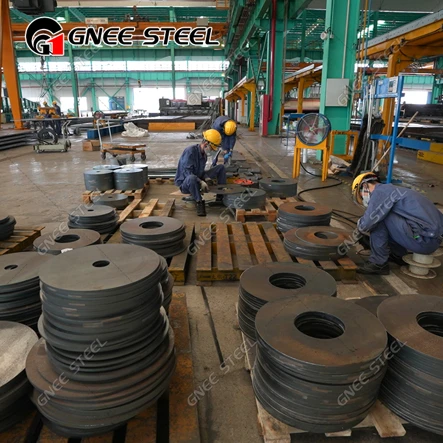
GNEE Steel Q690D Steel Plate Processing and Testing Services
Processing Services
- CNC Flame Cutting
- High-Precision Laser Cutting
- Plasma Cutting
- Edge Milling & Beveling
- Drilling & Hole Machining
- Welding Preparation
- Plate Leveling
- Shot Blasting
- Surface Cleaning & Rust Removal
- Custom Cut-to-Size Plate Production
- Welded Component Fabrication
All processing operations are performed according to customer drawings and technical specifications, ensuring dimensional accuracy and fabrication readiness.



Q690D Steel Plate Testing Services
- Chemical Composition Analysis
- Yield Strength Test
- Tensile Strength Test
- Elongation Test
- Charpy V-Notch Impact Test (-20°C)
- Hardness Test
- Ultrasonic Testing (UT)
- EN 10204 3.1 Mill Test Certificate (MTC)
- Third-Party Inspection (SGS, BV, TÜV)


We keep Q690D in stock from 6mm to 150mm, with cut-to-size and 100% UT inspection available. Drop your requirements – we'll reply with a tailored quote within 24 hours.

FAQ
What is the difference between Q690D and Q690E?
The core difference is low-temperature impact performance. Q690D requires ≥47J impact energy at -20°C, while Q690E requires ≥31J impact energy at -40°C, making it suitable for colder operating environments. Other mechanical and chemical requirements are largely identical.
Is Q690D equivalent to European S690QL?
Q690D is broadly comparable to EN 10025-6 S690QL in strength level and -20°C toughness, but they follow different standard systems with slight differences in chemical composition limits and inspection protocols. They cannot be considered 1:1 direct equivalents without material qualification.
Can Q690D steel be welded?
Yes, Q690D has good weldability under proper procedures. Preheating to 100–150°C is recommended for thick sections, and matching high-strength welding consumables should be used. Post-weld heat treatment may be required for highly restrained structures.
What is the maximum available thickness of Q690D plate?
Standard commercial production covers up to 150mm thickness with guaranteed full-section mechanical properties. Custom heavy plates up to 350mm can be produced via die casting and Q+T treatment, with property verification per specific technical agreements.
What is the carbon equivalent of Q690D?
Per GB/T 1591-2008, the maximum carbon equivalent (CEV) of Q690D is 0.49% across all thickness ranges, which is controlled to ensure acceptable weldability for structural fabrication.


