

Products Description
Atmospheric corrosion-resistant steel, also known as weathering steel, is a low-alloy steel made by adding a certain amount of alloying elements to ordinary steel. The main alloying components are Cu, P, Cr, Ni and other elements.
Atmospheric corrosion-resistant steel (also known as weathering steel) refers to a low-alloy steel with excellent atmospheric corrosion resistance, manufactured by adding a certain amount of alloying elements such as Cu, P, C, or Ni, Mo, Nb, and Ti. In industrial and rural atmospheric environments, weathering steel forms a dense and stable oxide film on its substrate, which blocks the ingress of corrosive media and exhibits excellent atmospheric corrosion resistance. However, the rust film formed on the surface of ordinary carbon steel due to corrosion is loose and microcracked, failing to truly protect the underlying steel.

Corrosion resistance mechanism
From the perspective of the impact of corrosion products on the corrosion process, atmospheric corrosion of steel occurs when oxygen in the air undergoes an electrochemical reaction through the rust layer in the presence of a water film. The rust layer consists of a loose outer rust layer and a dense inner rust layer, and the alloying elements in the steel primarily act through the influence of the inner rust layer. Among the corrosion products of weathering steel, a dense inner rust layer enriched with Cu, P, and Cr can be observed. The high corrosion resistance of weathering steel is related to both the high impedance of the inner rust layer and its dense, fine grain size, as well as the enrichment of Cu and P. The presence of this dense inner rust layer is reflected in the electrochemical behavior of the steel as a retardation of the anodic process. This process of gradually improving its density during the corrosion process precisely explains the characteristic that longer corrosion time leads to stronger corrosion resistance.
Atmospheric corrosion
From a global perspective, the main composition of the atmosphere remains basically unchanged. Experimental measurements show that the composition of air, calculated by volume, is approximately: nitrogen 78%, oxygen 21%, rare gases 0.94%, carbon dioxide 0.03%, and other gases and impurities 0.03% [4]. Due to natural conditions such as location and climate, as well as human environmental pollution, the composition of the atmosphere has become complex and diverse, and some harmful components have a tendency to gradually increase. In particular, global acid rain caused by sulfur dioxide and nitrogen dioxide in the air has exacerbated the corrosion of steel materials, even though there is no naturally occurring sulfur dioxide and nitrogen dioxide. However, most of these basic air pollutants are produced by human activities. Once the sulfur dioxide and nitrogen dioxide pollutants emitted by humans enter the atmosphere, they may be converted into secondary pollutants such as nitric acid and sulfuric acid. These pollutants are easily soluble in water and form acidic water droplets that return to the ground to form acid rain, acid snow, etc.
Different types of impurities in the atmosphere have varying effects on the corrosion rate of steel. Sulfur dioxide in industrial atmospheres and salt particles in marine atmospheres have the greatest impact on steel corrosion rates. In pure rural atmospheres, steel corrosion rates are very low. Atmospheric corrosion of steel is a complex process. Besides man-made environmental pollution, corrosion rates are also related to wind speed and direction, temperature and rainfall, dew cycles, solar radiation, seasonal changes, and even natural dust in the atmosphere. Even under identical external conditions, the corrosion rate on the underside of steel is significantly higher than on the sunny side due to the accumulation of rainwater.
Use of weathering steel
Due to its excellent corrosion resistance, weathering steel is widely used in steel structures such as buildings, vehicles, bridges, and towers. There are three main ways to use weathering steel: exposed, painted, and after rust stabilization treatment.
- 1. Exposed Use:
The most common use of weathering steel is exposed use. Generally, after 3 to 10 years, the rust layer on the surface of the weathering steel gradually stabilizes, corrosion progress slows, and the appearance becomes a beautiful chocolate brown.
Since the rust stabilization process of weathering steel is affected by the chemical composition of the steel, the operating environment, stagnant water and dust accumulation in structural details, and mechanical wear, improper use can disrupt the formation of a stable rust layer and lead to severe corrosion of the weathering steel.
- 2. Painted Use:
In many applications, such as buildings, bridges, and vehicles, weathering steel, like ordinary steel, is often painted. Painted weathering steel exhibits significantly superior corrosion resistance compared to ordinary steel. However, the increased cost and processing steps of painting make it difficult to widely use on large structures.
- 3. Use after Stabilization Treatment
A surface treatment is applied to the component surface at the outset to shorten the formation of the stabilized rust layer on the weathering steel. This not only prevents the yellow rust from dripping during initial use, preventing contamination, but also allows for the formation of a stable rust layer. While exposed use is a unique and economical method for using weathering steel, the rust layer requires considerable time to stabilize in the natural environment. Before a stabilized rust layer forms, early rust dripping and scattering often occur, contaminating the surrounding environment.
Rust layer structure of weathering steel
During the initial use of weathering steel, just like ordinary steel, corrosion occurs. However, the corrosion rate gradually slows, and after a period of time, corrosion almost ceases, thereby protecting the substrate. This phenomenon is called stabilization of the rust layer, and a rust layer in this state is called a stabilized rust layer.
From the perspective of the influence of corrosion products on the corrosion process, atmospheric corrosion of steel occurs through an electrochemical reaction of oxygen in the air through the rust layer in the presence of a water film. The rust layer consists of a loose outer rust layer and a dense inner rust layer. Alloying elements in the steel primarily act through the influence of the inner rust layer.
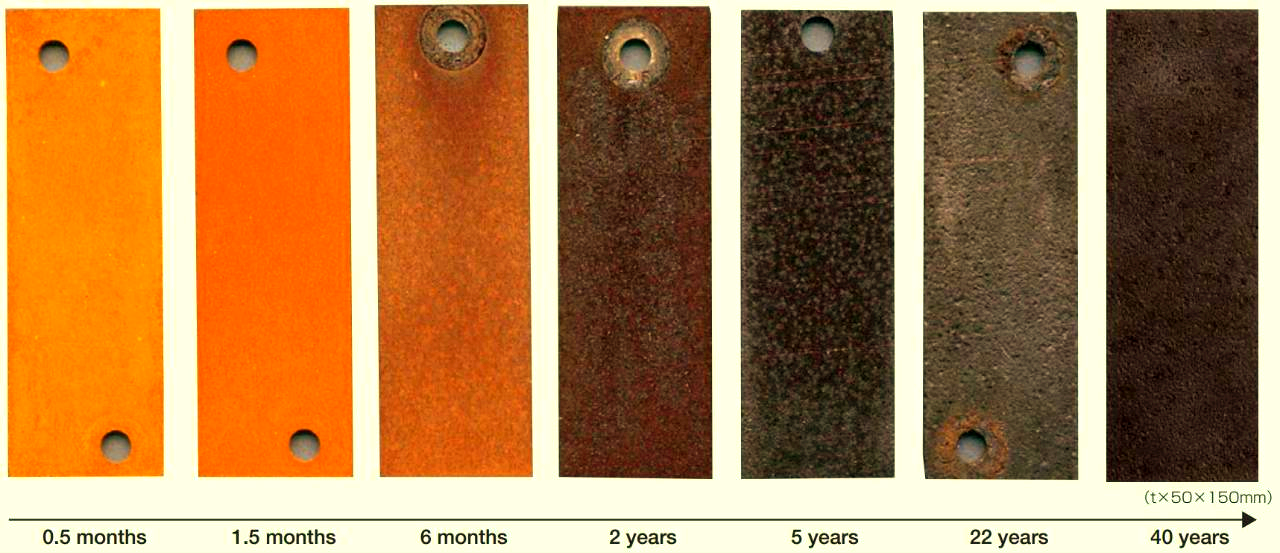
(Surface color change of Atmospheric corrosion resistant steel)


FAQ
Q: What is the ASTM standard for Corten steel?
A: The ASTM specifications include A588, A242, A606-4, A847, A871-65, and A709-50W, with Cor-ten® standing out as the primary trademarked product. These specifications set the standards for weathering steel, ensuring its resilience against the elements and long-lasting corrosion resistance.
Q: Why is Corten steel so expensive?
A: However, given Corten's longevity and lower maintenance needs, it represents a long-term investment. Mild steel is certainly a cost-effective alternative, but if a protective coating, such as powder coating or galvanising, is applied for added longevity, the cost comparison with Corten starts to level out.
Q: What's special about Corten steel?
A: Corten Steel is also known as a 'weathering steel', as the steel forms a protective layer on its surface under the influence of the weather; and it is this protective layer that gives Corten far superior resistance to atmospheric corrosion, compared to other steels.
Q: How long will Corten steel last?
A: Generally, Corten steel will patina or rust within six months of atmospheric exposure. Most weathering steel types need wet/dry weather cycles to develop and oxidize. With the protective rust that provides corrosion resistance, Corten steel can last upwards of a few decades to over 100 years.
Q: Is Corten steel better than stainless steel?
A: Unlike stainless steel, Corten Steel is a distinct type of alloy designed to weather gracefully over time, offering structural strength and an aesthetic quality that sets it apart.
About Gnee
Founded in 2008, Gnee (Tianjin) Supply Chain Group Co., Ltd. specializes in the global trade and processing of Corten steel products.
• We handle all kinds of Corten engineering projects, such as bridges, gardens, hotels, and facade systems.
• Compliant with ASTM, EN, and other international standards; third-party inspection supported.
• Exported to over 200 countries and regions worldwide.
• 8 subsidiaries across China and overseas, ensuring global service coverage.
Application Fields: Architecture, landscaping, gardening, cladding, and urban infrastructure.


