

The fundamental reason why HP345 has been designated as the material of choice for acetylene cylinders lies in the fact that its unique technical characteristics form a perfect safety match with the inherent hazards of acetylene gas.
Acetylene is an extremely unstable, high-pressure, and flammable gas that must be stored in a dissolved state; this imposes rigorous demands on cylinder materials-requirements that far exceed those for standard liquefied petroleum gas cylinders-and HP345 was designed specifically to meet these exacting standards.
HP345 steel plate represents the optimal balance of strength, toughness, weldability, and safetyfor modern acetylene cylinders manufacturing. Its low yield ratio provides a critical safety margin against over-pressurization, while its high strength enables significant lightweighting-reducing material costs and improving transport efficiency.

Acetylene gas cylinder
Specific Safety Requirements for Acetylene Cylinders
Hazardous Characteristics of Acetylene
Acetylene (C₂H₂) possesses the following specific properties:
- Instability under High Pressure: Pure acetylene can undergo explosive self-decomposition at pressures exceeding 0.2 MPa (approximately 2 bar), even without the presence of oxygen.
- Risk of Decomposition Explosion: Vibration, mechanical shock, or localized overheating can all trigger a decomposition reaction, releasing a significant amount of heat.
- Sensitivity to Copper and Silver: Contact between acetylene and copper, silver, or their alloys results in the formation of explosive acetylides (such as copper acetylide), which can be detonated by even the slightest mechanical impact.
Design Principles of Acetylene Cylinders
| Component | Function | Material Requirements |
|---|---|---|
| Porous Filler | Filled with porous materials such as calcium silicate to divide gas-phase space | Cylinder body must withstand internal stress during filler filling and curing |
| Solvent (Acetone) | Dissolves acetylene to reduce storage pressure to a safe level | Material must resist long-term chemical contact with acetone |
| Steel Shell | Provides pressure vessel structure and safety barrier | Must possess high strength, high toughness and excellent welding integrity |
Unlike standard LPG cylinders, the manufacturing of acetylene cylinders involves a filling process utilizing porous packing and solvent impregnation, which imposes more stringent requirements on the cylinder body's resistance to deformation and corrosion.
The Alignment of HP345 Material Properties with Acetylene Cylinder Requirements
HP345 is a high-strength steel for welded cylinders, manufactured in accordance with the GB/T 6653 standard ("Steel Plates and Strips for Welded Gas Cylinders"). This standard is soon to be upgraded to a mandatory national standard to ensure the safety of life and property. The core characteristics of this material align closely with the specific requirements for acetylene gas cylinders.
High Strength-Achieving a Dual Breakthrough in Safety Wall Thickness and Lightweighting
The core strength of HP345 welded cylinder steel is manifested in its exceptional yield strength and tensile strength performance; specifically, its yield strength is no less than 345 MPa. This critical metric provides robust technical support for the thin-wall design of acetylene cylinders. Yield strength represents the critical threshold at which a material resists plastic deformation-simply put, it is the maximum stress value a material can withstand under pressure while maintaining its original shape without undergoing irreversible deformation.
The tensile strength of HP345 welded cylinder steel is maintained within a reasonable range of 510–620 MPa. As the maximum tensile stress a material can withstand, tensile strength directly determines the burst safety margin of an acetylene cylinder, serving as a critical safeguard against extreme pressure surges.
| Performance Indicator | HP345 Spec Value | Significance for Acetylene Cylinders |
|---|---|---|
| Yield Strength | ≥ 345 MPa | Allows for thinner cylinder wall design, reducing weight while ensuring pressure-bearing capacity |
| Tensile Strength | 510–620 MPa | Provides sufficient burst safety margin to resist abnormal pressure shocks |
High Toughness-The Core Safeguard Against Brittle Fracture
HP345 welded cylinder steel demonstrates exceptional toughness, enabling it to effectively withstand the risk of brittle fracture across a wide spectrum of extreme operating conditions. Its elongation is no less than 21% (for thicknesses ≥ 3 mm). Elongation serves as a crucial indicator of a material's plasticity and constitutes a core manifestation of its toughness. A high elongation value signifies that when the bottle body is subjected to excessive internal pressure, it will not fracture instantaneously; instead, it will first undergo visible bulging deformation. This distinct deformation provides operators with a clear warning signal, allowing them sufficient time to evacuate the area, implement emergency response measures, and prevent the incident from escalating.
| Resilience indicators | HP345 performance | The Significance of Acetylene Cylinder Safety |
|---|---|---|
| Toughness Index | HP345 Performance | Safety Significance for Acetylene Cylinders |
| Elongation | ≥21% (thickness ≥3mm) | Ensures the cylinder bulges before rupturing under overpressure, providing escape warning |
| Impact Energy (room temperature) | ≥34 J (KV2) | Resists instantaneous fracture under impact load |
| Yield Ratio | Low (typical value ≤0.80) | Provides sufficient safety warning zone from yielding to fracture |
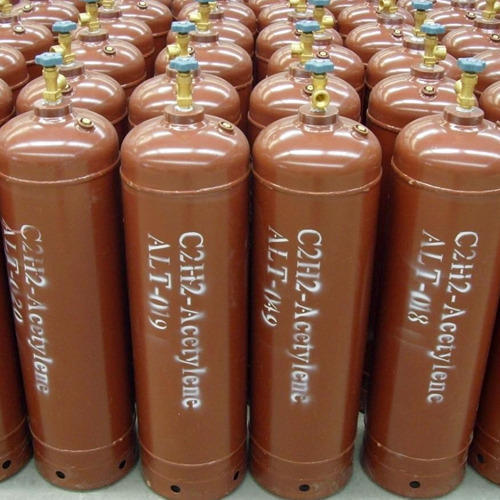
Dissolved Acetylene Gas Cylinder
Strictly Controlled Chemical Composition - Prevents Acetylene-Sensitive Reactions
| Element | HP345 Control Value | Relationship with Acetylene Safety |
|---|---|---|
| Copper (Cu) | Strictly controlled (no addition) | Critical: prevents formation of explosive copper acetylide |
| Phosphorus (P) | ≤ 0.025% | Low phosphorus prevents cold brittleness and ensures low-temperature toughness |
| Sulfur (S) | ≤ 0.015% | Low sulfur prevents welding hot cracking |
| Acid-soluble Aluminum (Als) | ≥ 0.020% | Acts as grain refiner to improve toughness |
Process Advantages of HP345 in Acetylene Cylinder Manufacturing
Excellent formability
With moderate yield strength and low yield ratio, HP345 steel shows good plasticity during deep drawing, spinning and necking, which is conducive to the one‑step forming of seamless steel cylinders and reduces forming defects.
Welding efficiency improvement
Low cold‑cracking sensitivity allows welding with reduced or even without preheating, shortening production cycle and lowering energy consumption.
Stable heat‑affected zone toughnessAfter welding, the HAZ retains high toughness and does not easily become brittle, ensuring the overall safety performance of the cylinder body.
Uniform wall thickness control
Fine‑grained microstructure ensures uniform deformation during forming, making wall thickness distribution more consistent and improving pressure‑bearing reliability.

Compatible with filler filling and curing process
High structural rigidity and toughness enable the steel shell to bear internal stress during porous filler filling and solidification without deformation or cracking.
Weight reduction under the same pressure level
High yield strength (≥345 MPa) allows a thinner cylinder wall design, reducing the overall weight of the acetylene cylinder while meeting pressure standards.
Good chemical compatibility for acetylene service
Strictly controlled copper, sulfur and phosphorus contents avoid explosive compounds and brittleness risks, fully meeting the special safety requirements of dissolved acetylene cylinders.
Why Choose GNEE as Your Supplier?
- 18+ years manufacturing experience
- Full certification support (EN, JIS, GB standards)
- Custom sizes, thickness, and surface treatment
- Fast delivery and global logistics
- Strict quality inspection (chemical + mechanical testing)

Contact now to get the HP345 steel votrt
What is the main function of HP345's toughness?
HP345's toughness resists brittle fracture, especially in low-temperature environments, ensuring the safety and reliability of gas cylinders during use.
What is the ductile-brittle transition temperature (DBTT) of HP345?
The DBTT of HP345 is ≤ -40℃, far lower than that of HP295 (≥ -20℃), making it suitable for cold regions.
What is the impact energy of HP345 at -40℃?
HP345 has a minimum impact energy of ≥20J at -40℃, ensuring stable toughness in severe low-temperature conditions.
How does HP345 achieve superior low-temperature toughness?
Through fine grain structure (controlled by TMCP and Al/Ti nitrides) and high-purity smelting (strict control of P and S), HP345 lowers DBTT and improves impact resistance.
What is the grain size grade of HP345?
HP345 has a grain size grade of ASTM E112 7–8, with an average grain size of 10–18μm, which is finer than HP295 (grade 5–6, 25–35μm).
Does HP345 retain toughness after welding?
Yes. Its high purity and low carbon equivalent ensure the heat-affected zone (HAZ) does not become brittle, retaining impact resistance after welding.


