

16Mo3 is a molybdenum-alloyed pressure vessel steel grade specified in EN 10028-2, widely used for boilers, heat exchangers and process vessels operating at elevated temperatures. When you order 16Mo3 plate, the delivery condition - marked as +N, +N+T, +AR or +TMCP on your mill test certificate - determines its grain structure, toughness, thickness limits and long-term service performance.
Choosing the right condition is not optional: it directly affects whether your vessel passes hydrotesting, survives post-weld heat treatment and meets design life expectations.
This guide compares all four 16Mo3 delivery conditions side by side, explains what each symbol means on an MTC, and helps you specify the correct condition for your project.
What Is 16Mo3 Steel and Why Does Delivery Condition Matter?
16Mo3 is a low-alloy steel with approximately 0.16% carbon and 0.25–0.35% molybdenum, designed for pressure equipment that operates at temperatures from ambient up to roughly 500–550°C. Its molybdenum content provides elevated-temperature strength and resistance to hydrogen attack, which is why it is a standard choice in refineries, chemical plants and power stations.
The same chemical composition can be supplied in several delivery conditions. The delivery condition refers to the final heat treatment or rolling process the plate receives at the mill before shipment. Two plates of identical 16Mo3 chemistry can behave very differently in service depending on whether they are normalized, as-rolled or TMCP-processed.

For buyers, this means you cannot simply ask for "16Mo3 plate" - you must specify the delivery condition in your purchase order. The condition also affects:
- Minimum impact test values and acceptable temperature
- Maximum permissible plate thickness for a given code
- Weld preheat and post-weld heat treatment requirements
- Mill price and lead time
- The content of your EN 10204 3.1 mill test certificate
16Mo3 Delivery Conditions Comparison Table
The table below summarizes the key differences between the four delivery conditions for 16Mo3 plate.
|
Delivery Condition |
Process |
Typical Thickness Range |
Strength Consistency |
Toughness |
Best For |
Relative Cost |
|
+N |
Normalized (reheat + air cool) |
6–100 mm |
High |
Good |
Most pressure vessel and boiler service |
Medium |
|
+N+T |
Normalized then tempered |
Up to 150 mm+ |
Very high |
Excellent |
Heavy sections, critical components, PWHT service |
Higher |
|
+AR |
As hot-rolled, no heat treatment |
Thin sections only |
Lower, directional |
Variable |
Non-critical secondary parts only |
Lowest |
|
+TMCP |
Controlled rolling + accelerated cooling |
6–120 mm |
High |
Good to excellent |
Heavy plates requiring strength and toughness without normalizing |
Medium |
Can't find the row that matches your design?
Upload your pressure design specification (temperature, pressure, thickness) and get a delivery condition recommendation within one business day.
16Mo3 +N Delivery Condition (Normalized)
The +N symbol on a 16Mo3 mill test certificate means the plate is delivered in the normalized condition.

Process and Heat Treatment
Normalizing involves reheating the plate to approximately 910–940°C - above the upper critical temperature Ac3 - and then cooling it freely in still air. Unlike annealing (which cools very slowly in the furnace), normalizing produces a refined, uniform ferrite-pearlite grain structure. The process eliminates the uneven grain flow left by hot rolling and gives the plate consistent mechanical properties from surface to center.
Mechanical Properties and Impact Testing
In the +N condition, 16Mo3 typically delivers:
|
Property |
Typical Value (per EN 10028-2) |
|
Yield strength (ReH) |
275–355 MPa, depending on thickness |
|
Tensile strength (Rm) |
440–590 MPa |
|
Elongation (A) |
≥ 22% |
|
Charpy V-notch impact |
≥ 31 J at 20°C (longitudinal) |
The exact yield strength drops as plate thickness increases, which is why EN 10028-2 defines strength bands by thickness group.
Typical Applications
+N is the most commonly specified delivery condition for 16Mo3. It is the default choice for:
- Boiler drums and steam piping
- Heat exchanger shells and tube sheets
- Pressure vessels in oil refineries and petrochemical plants
- Vessels requiring post-weld heat treatment (PWHT)
Because normalized 16Mo3 has a well-characterized and code-recognized structure, it is the safest specification when your fabricator or inspector has not asked for a different condition.
16Mo3 +N+T Delivery Condition (Normalized and Tempered)
The +N+T condition means the plate is normalized first, then tempered at a subcritical temperature (typically around 600–650°C).
When +N+T Is Required Over +N
The tempering step relieves residual stresses introduced by normalizing and improves toughness and ductility, particularly through the thickness of heavy plates.
Specify +N+T when:
- Your plate thickness exceeds the range where +N alone guarantees through-thickness properties
- The vessel design demands tighter Charpy values at a lower test temperature
- You need improved resistance to through-thickness cracking (lamellar tearing) during fabrication
- The equipment will see cyclic loading or elevated-temperature creep service over many years
In practice, +N+T is most often chosen for heavy sections over approximately 50–60 mm, main boiler components, and critical pressure parts where the cost of a failure outweighs the modest extra mill cost.
16Mo3 +AR Delivery Condition (As-Rolled)
+AR stands for as-rolled. In this condition, the plate is supplied directly after hot rolling with no additional heat treatment at the mill.
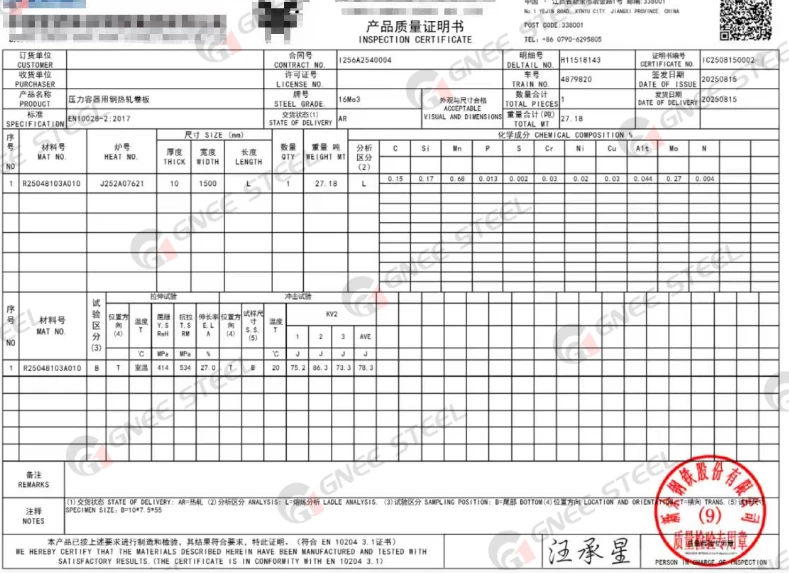
Limitations of As-Rolled Plate
As-rolled 16Mo3 is the lowest-cost option, but it carries important restrictions:
- Limited thickness range. +AR plate is only available and code-accepted for thinner sections. For pressure vessel service under EN 10028-2, the permissible thickness in +AR is generally restricted compared to +N.
- Uneven properties. Without normalizing, the grain structure remains banded and directional. Properties near the surface and at mid-thickness can vary.
- Reduced toughness. Impact values are less consistent, and +AR is generally not accepted for low-temperature or critical service.
- Code restrictions. Many pressure vessel codes and customer specifications prohibit +AR plate for pressure-retaining parts, even when the standard nominally allows it.
+AR 16Mo3 is therefore suitable for non-critical secondary structures, supports, linings and applications where the buyer and inspector have explicitly agreed. It should not be used as a cost-saving substitute for +N on a designed pressure part without the engineering team's written approval.
16Mo3 +TMCP Delivery Condition (Thermo-Mechanical Control Process)
+TMCP means the plate was produced using a thermo-mechanical control process: controlled rolling at carefully finishing temperatures followed by accelerated cooling, all performed without a separate post-rolling normalizing treatment.

Advantages of TMCP for Heavy Plate
TMCP produces a very fine, acicular or ferrite-bainitic microstructure that delivers high strength and good toughness in the as-rolled state, often equivalent or superior to a normalized plate of the same thickness.
The key benefits for pressure vessel buyers are:
- Higher strength-to-thickness ratio. TMCP plate can meet the required yield strength at greater thicknesses than a conventional +N plate.
- Improved toughness. Fine grain refinement raises Charpy values, sometimes allowing service at lower temperatures.
- Shorter lead time and lower mill cost. No separate normalizing furnace cycle is needed.
- PWHT compatibility. Modern TMCP 16Mo3 grades are produced to retain their properties after post-weld heat treatment, which is essential for pressure vessel fabrication.
TMCP is increasingly specified for heavy boiler sections, large pressure vessels and wind tower flanges, where the thickness advantage translates directly into thinner, lighter designs.
Not sure whether +N or +TMCP fits your design?
Send us your drawing and thickness range, and our metallurgy team will recommend the delivery condition that meets your code at the lowest total cost.
How to Choose the Right 16Mo3 Delivery Condition
Once you understand what each delivery condition means, the next step is matching it to your actual service temperature, plate thickness and component type. Our step-by-step buyer's guide walks you through how to choose the right 16Mo3 delivery condition for your project.
Follow this decision path:
- Start with your design code. If the equipment falls under EN 13445, ASME Section VIII or a customer specification, it may mandate +N or +N+T regardless of cost.
- Check thickness. For plates above roughly 50–60 mm, compare +N+T and +TMCP for the best through-thickness properties.
- Check service temperature. For continuous operation above 475°C, +N or +N+T is preferred because long-term creep and oxidation behavior are well documented.
- Check impact requirements. If your Charpy test must pass below 20°C, +N+T or TMCP will give you more margin.
- Never downgrade to +AR on a pressure-retaining component without written engineering approval.

16Mo3 Delivery Conditions Under EN 10028-2
EN 10028-2 is the European standard for flat products made of non-alloy and alloy steels for pressure purposes. It defines the chemical composition, mechanical properties and permitted delivery conditions for 16Mo3.
Key points for buyers:
- The standard specifies which delivery conditions are allowed at each thickness and strength level.
- Each plate must be supplied with an inspection certificate according to EN 10204 - almost always a 3.1 certificate for commercial orders, or a 3.2 certificate when third-party witnessed inspection is required.
- The delivery condition must appear on the MTC exactly as ordered, such as "16Mo3 +N" or "16Mo3 +TMCP".
Get Expert Help on 16Mo3 Plate Selection
Choosing the right delivery condition is a small decision in your purchase order, but it has large consequences for fabrication, inspection and service life. Our team supplies 16Mo3 pressure vessel plate in all four conditions - +N, +N+T, +AR and +TMCP - with full EN 10204 3.1 documentation, mill test certificates and third-party inspection support for export orders.
Whether you are sourcing one plate for a replacement vessel or a multi-tonne order for a new refinery unit, we will confirm the correct delivery condition against your design code before quoting.
Ready to Specify Your 16Mo3 Plate?
- Get mill pricing, lead time and available dimensions within 24 hours.

FAQ
What does +N mean on a 16Mo3 MTC?
It means the plate was normalized: reheated above Ac3 and cooled in still air to produce a uniform, refined grain structure.
Is 16Mo3 +AR acceptable for pressure vessels?
Only for non-critical, non-pressure-retaining parts in thin sections. Most pressure vessel codes require +N, +N+T or +TMCP for pressure parts.
Which is stronger, +N or +TMCP 16Mo3?
TMCP can meet higher yield strengths at heavy thicknesses because of grain refinement. For equivalent thin plates, both meet the EN 10028-2 minimums.
Does TMCP 16Mo3 need post-weld heat treatment?
Yes - if the vessel design requires PWHT, TMCP plate must be ordered from a mill certified to retain its mechanical properties after the specified PWHT cycle.
For quick, direct answers to questions such as whether +AR is acceptable for ASME U-stamp vessels, how to verify the delivery condition on an MTC, or whether 16Mo3 is equivalent to A387 Grade 12, see our 16Mo3 delivery conditions FAQ.


