

What Is ASME SA516 Gr.70 Steel Plate?
ASME SA516 Gr.70 is a carbon steel plate grade specified under the ASME SA-516/SA-516M standard, covering carbon steel plates primarily for pressure vessels and boilers operating at moderate and lower temperature service. The "Gr.70" designation refers to a minimum tensile strength of 70 ksi (485 MPa), making it the highest-strength grade within the SA516 family - which also includes Gr.55, Gr.60, and Gr.65.
SA516 Gr.70 is manufactured in either the as-rolled or normalized condition, with normalized supply being the industry standard for pressure vessel applications. The plate is characterized by excellent weldability, good notch toughness, and reliable performance in service temperatures ranging from -20°C to 350°C.
As the most widely specified pressure vessel steel grade globally, SA516 Gr.70 is accepted by major code bodies including ASME BPVC Section II, EN 10028, and PED 2014/68/EU. It is the default choice for fabricators building pressure vessels, storage tanks, heat exchangers, and boiler components across the oil & gas, petrochemical, and power generation industries.
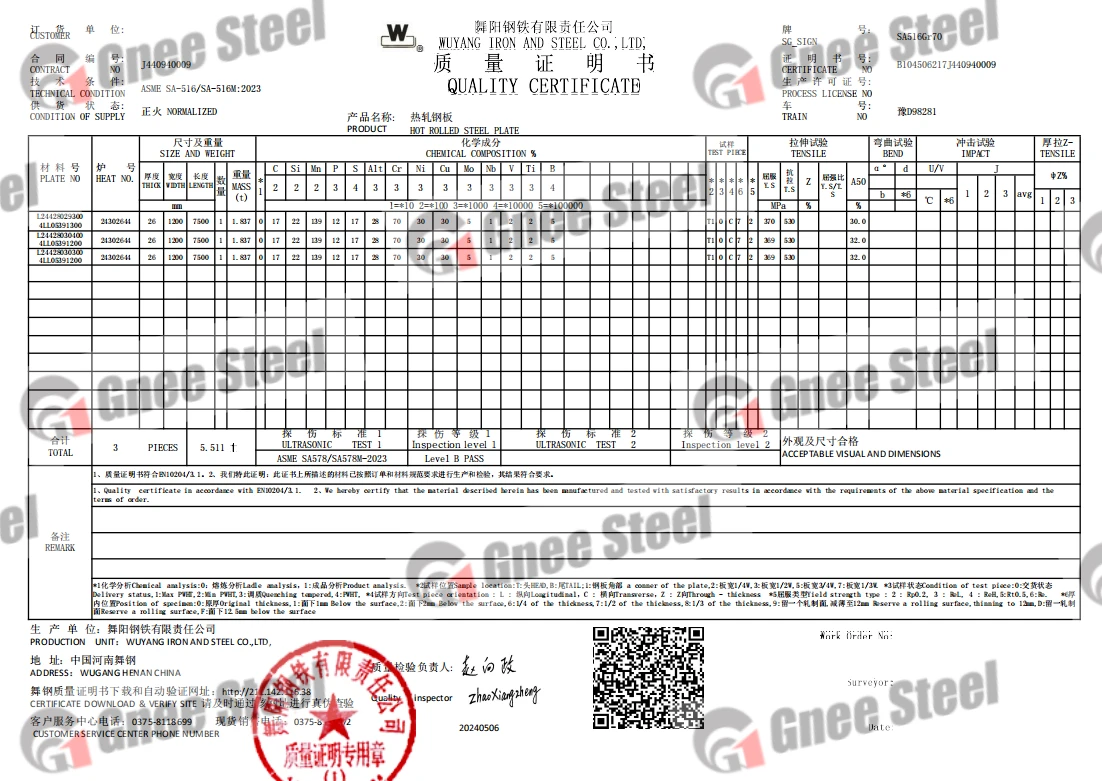
Looking for SA516 Gr.70 plates with full MTC documentation and fast delivery? GNEE Steel supplies factory-direct SA516 Gr.70 pressure vessel plates in thicknesses from 6 mm to 200 mm, with normalized delivery, EN 10204 3.1/3.2 certification, and optional UT/SSC/HIC testing. Contact GNEE Steel for SA516 Gr.70 pricing and stock availability →
ASME SA516 Gr.70 PVQ steel plate Chemical Composition
The chemical composition of SA516 Gr.70 is controlled per ASME SA-516/SA-516M Table 1, with carbon content varying by plate thickness. The carbon-manganese (C-Mn) formulation is designed to balance strength with weldability.
| Element | ≤ 12.5 mm (≤ 0.5 in) | > 12.5 mm (> 0.5 in) |
|---|---|---|
| Carbon (C), max | 0.27 | 0.28 |
| Manganese (Mn) | 0.85–1.20 | 0.85–1.20 |
| Silicon (Si) | 0.15–0.40 | 0.15–0.40 |
| Phosphorus (P), max | 0.025 | 0.025 |
| Sulfur (S), max | 0.025 | 0.025 |
ASME SA516 Gr.70 PVQ plate Mechanical Properties
| Property | ≤ 40 mm (≤ 1.5 in) | > 40–65 mm (> 1.5–2.5 in) | > 65–100 mm (> 2.5–4 in) |
|---|---|---|---|
| Yield Strength, min | 260 MPa (38 ksi) | 260 MPa (38 ksi) | 260 MPa (38 ksi) |
| Tensile Strength | 485–620 MPa (70–90 ksi) | 485–620 MPa (70–90 ksi) | 485–620 MPa (70–90 ksi) |
| Elongation in 8 in (200 mm), min | 17% | 17% | 17% |
| Elongation in 2 in (50 mm), min | 21% | 21% | 21% |
Notes: (1) Yield strength and tensile strength remain constant across all thickness ranges up to 100 mm. (2) Two elongation values are specified - the 200 mm gauge (8 in) is the standard reference; the 50 mm gauge (2 in) applies when the specimen thickness does not permit the 200 mm gauge. (3) Impact testing is not mandatory under the base standard but is required when supplementary requirements S5 (Charpy V-Notch Impact Test) or S7 (Charpy V-Notch Impact Test for Limited Thickness) are specified.
ASME SA516 Gr.70 Equivalent Steel Grades
ASME SA516 Gr.70 has several cross-standard equivalents, though none are exact 1:1 matches. Composition limits, impact testing temperatures, and manufacturing tolerances differ between standards.
| Standard | Grade |
|---|---|
| ASME / ASTM | SA516 Gr.70 / A516 Gr.70 |
| China (GB) | Q345R |
| Europe (EN) | P355GH |
| Japan (JIS) | SBV2 |
| ISO | ISO 9328-2 P355GH |
ASME SA516 Gr.70 Steel Plate Specifications
| Parameter | Available Range |
|---|---|
| Thickness | 6 mm – 200 mm (0.236 in – 7.87 in) |
| Width | 1500 mm – 4000 mm (59 in – 157 in) |
| Length | 3000 mm – 18000 mm (118 in – 708 in) |
| Delivery Condition | As-rolled, Normalized, Normalized + Tempered |
| Thickness Tolerance | EN 10029 Class A / Class B |
| Surface Condition | Hot-rolled, Pickled, Blast + Prime |
| Inspection Certificate | EN 10204 Type 3.1 (mill) / Type 3.2 (third-party) |
| Additional Testing | UT per EN 10160 or ASTM A578, Impact (CVN), Hardness, HIC per NACE TM0284, SSC per NACE TM0177 |
| Marking | Stencil / Stamp, per ASME SA-516 / customer specification |
Key Advantages of ASME SA516 Gr.70 Pressure Vessel Steel Plate
Excellent Low-Temperature Toughness - SA516 Gr.70 provides reliable mechanical properties at temperatures as low as -20°C when impact tested, making it suitable for outdoor storage tanks and process vessels in cold climates. The normalized grain structure contributes to consistent impact energy absorption across the plate.
Superior Weldability - The carbon-manganese composition with controlled carbon content (max 0.27–0.28%) keeps the carbon equivalent value (CEV) typically below 0.43%, enabling excellent weldability without preheat for thinner sections.
ASME Code Compliance - SA516 Gr.70 is listed in ASME BPVC Section II Part A and accepted for Section VIII Division 1 and Division 2 construction, eliminating the need for material substitution approvals on ASME-stamped projects.
Global Availability - As the most widely used pressure vessel plate grade, SA516 Gr.70 is stocked by steel service centers worldwide, offering faster replacement lead times and consistent availability.
Versatile Supplementary Options - The standard allows impact testing (S5, S7), ultrasonic examination (S11), and additional tension testing (S3), enabling the same base grade to serve everything from ambient-temperature storage tanks to low-temperature process vessels.
Typical Applications of ASME SA516 Gr.70 Structural Steel Plate
Pressure Vessels - SA516 Gr.70 is the primary material for ASME Section VIII pressure vessels, including storage tanks, reactors, separators, and accumulators in the oil & gas, petrochemical, and chemical processing industries.
Boilers and Heat Exchangers - The grade is widely used in boiler drums, steam generators, and shell-and-tube heat exchangers where moderate temperatures (up to 350°C) and pressures are encountered.
Storage Tanks - Atmospheric and low-pressure storage tanks for crude oil, refined products, chemicals, and water commonly specify SA516 Gr.70 for shell courses and bottom plates.
LPG and LNG Equipment - For LPG storage spheres and bullet tanks, SA516 Gr.70 is frequently specified with impact testing at -20°C or -40°C, combined with PWHT requirements.
Offshore and Modular Fabrication - Skid-mounted process modules, separator vessels, and produced water treatment packages for offshore platforms often use SA516 Gr.70 as the primary plate material.
ASME SA516 Gr.70 Welding and Fabrication Considerations
Recommended Welding Processes
SMAW with E7018 electrodes, GMAW with ER70S-6 wire, SAW with suitable flux-wire combinations, or FCAW with E71T-1 wire.
Preheat Requirements
Preheat is generally not required for plates under 25 mm thickness with ambient temperature above 10°C. For thicker plates or low ambient temperatures, preheat to 50–100°C is recommended, determined by the WPS qualified per ASME Section IX.
Post-Weld Heat Treatment (PWHT)
PWHT is required when plate thickness exceeds 38 mm (1.5 in), mandated by the design code (ASME Section VIII Division 1), or specified for low-temperature service. Typical PWHT: 600–650°C, hold time per ASME Section VIII requirements.
Fabrication Notes
Cold forming is acceptable for most thicknesses; hot forming (above 900°C) followed by normalizing may be required for severe forming. Oxygen cutting is the standard cutting method; edge preparation by grinding or machining per WPS requirements.
Why Choose GNEE Steel?
Factory-Direct Mill Source
GNEE Steel supplies SA516 Gr.70 directly from the mill, eliminating intermediary markups and ensuring full traceability. Every plate is backed by complete mill test certificates (EN 10204 3.1).
Comprehensive Testing
We offer Charpy V-Notch impact testing, ultrasonic examination per ASTM A578 or EN 10160, and HIC/SSC testing per NACE standards. All testing by ISO 17025-accredited laboratories.
Flexible Supply Options
- 6–200 mm thickness range covering most applications
- Normalized delivery with full mechanical guarantees
- Cut-to-size service with shearing, plasma or laser cutting
- EN 10204 3.2 third-party inspection available
Fast Lead Times - Standard thicknesses (6–50 mm) ship within 15–20 working days. Thicker plates (50–200 mm) within 25–30 working days.
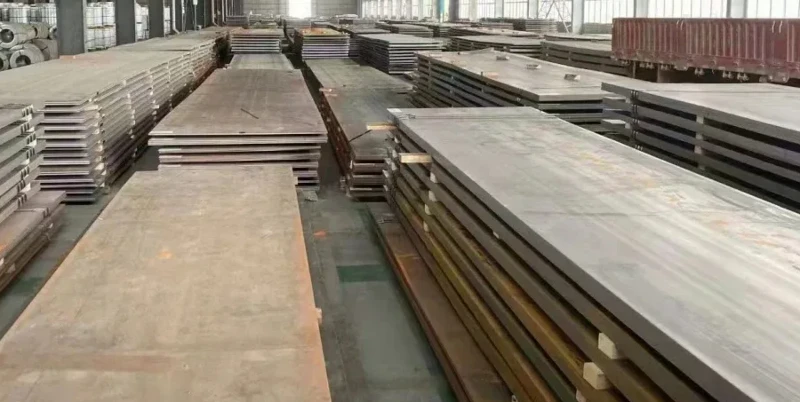

Ready to order SA516 Gr.70 for your next pressure vessel project? Request a quote with your required thickness, quantity, and testing specifications, and our team will respond within 24 hours. Get your SA516 Gr.70 plate quote from GNEE Steel →
FAQ
Q1: What is the difference between SA516 Gr.70 and SA516 Gr.60?
SA516 Gr.70 has a higher minimum tensile strength (485–620 MPa vs 415–550 MPa) and higher yield strength (260 MPa vs 220 MPa) compared to Gr.60. The carbon content limit is also higher for Gr.70 (0.27% vs 0.21% for ≤ 12.5 mm). Gr.70 is preferred for higher design stress applications.
Q2: Can SA516 Gr.70 be used for low-temperature applications?
Yes, but impact testing must be specified per supplementary requirement S5 or S7. Typical low-temperature applications require Charpy V-Notch testing at -20°C or -40°C, with minimum 20 J or 27 J depending on the code.
Q3: What is the difference between SA516 Gr.70 and Q345R?
Key differences: (1) Q345R requires impact testing at 0°C (41 J min) as standard, while SA516 Gr.70 impact testing is by agreement; (2) Q345R has a lower carbon content (0.20% max) and includes aluminum for grain refinement; (3) Q345R is tested to GB 713, not ASME BPVC. They are not direct substitutes without engineering approval.
Q4: Is SA516 Gr.70 suitable for sour service (H2S environment)?
In the as-supplied condition, SA516 Gr.70 is not automatically HIC-resistant. For sour service per NACE MR0175/ISO 15156: hardness control (max 22 HRC), controlled sulfur (≤ 0.002%), and HIC testing per NACE TM0284 are required. GNEE Steel can supply HIC-resistant SA516 Gr.70 upon request.


