

A516 Gr.60 vs Gr.70: Which Pressure Vessel Steel Plate Should You Choose?
ASTM A516 Gr.60 and Gr.70 are carbon steel plate grades specified for welded pressure vessels where strength and notch toughness are important. Both grades are widely used for pressure-retaining equipment, but they are not simply interchangeable alternatives.
The main difference is their specified strength level. A516 Gr.60 has a tensile strength range of 60–80 ksi (415–550 MPa) and a minimum yield strength of 32 ksi (220 MPa), while Gr.70 has a tensile strength range of 70–90 ksi (485–620 MPa) and a minimum yield strength of 38 ksi (260 MPa). Gr.70 therefore provides a higher specified strength level, while Gr.60 may be sufficient when the design does not require the additional strength.
For buyers, the correct choice should not be based on grade number alone. Design pressure, design temperature, required allowable stress, plate thickness, impact-testing requirements, fabrication conditions, and the governing pressure-vessel code should all be considered before specifying A516 Gr.60 or Gr.70.
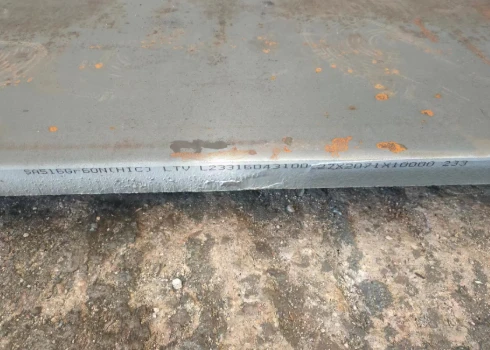
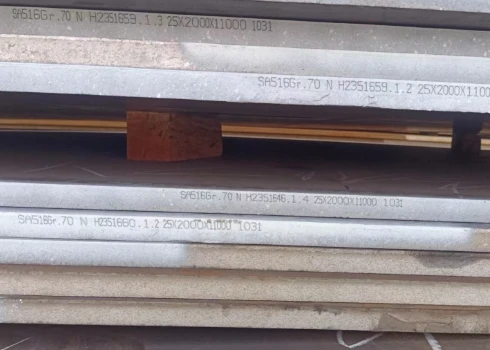
A516 Gr.60 vs Gr.70 High Strength Plate Chemical Composition and Mechanical Properties
| Element | A516 Gr.60 (≤1.5 in / 38 mm) | A516 Gr.70 (≤1.5 in / 38 mm) |
|---|---|---|
| Carbon (C), max | 0.21 | 0.27 |
| Manganese (Mn) | 0.85–1.20 | 0.85–1.20 |
| Silicon (Si) | 0.15–0.40 | 0.15–0.40 |
| Phosphorus (P), max | 0.025 | 0.025 |
| Sulfur (S), max | 0.025 | 0.025 |
| Property | A516 Gr.60 (≤1.5 in / 38 mm) | A516 Gr.70 (≤1.5 in / 38 mm) |
|---|---|---|
| Yield Strength, min | 32 ksi / 220 MPa | 38 ksi / 260 MPa |
| Tensile Strength | 60–80 ksi / 415–550 MPa | 70–90 ksi / 485–620 MPa |
| Elongation in 2 in (50 mm), min | 25% | 21% |
| Elongation in 8 in (200 mm), min | 21% | 17% |
The higher minimum yield and tensile strength of Gr.70 provide a higher strength level than Gr.60. Gr.60, however, has higher specified minimum elongation in the standard tensile requirements shown above.
This difference does not mean that Gr.70 is automatically the better material. If the vessel design already satisfies its required stresses and toughness with Gr.60, selecting Gr.70 may provide no practical engineering benefit. Conversely, where the design requires a higher strength level, Gr.70 may be the more appropriate specification.
A516 Gr.60 vs Gr.70 Structural Steel Plate: Key Performance Differences
A516 Gr.70 has a higher minimum yield strength and higher tensile-strength range than Gr.60. In a pressure-vessel design, this higher strength level may allow a designer to achieve the required design conditions with a more efficient material thickness in some cases.
However, it is not correct to assume a fixed percentage of thickness or weight reduction simply by changing from Gr.60 to Gr.70. Actual vessel thickness depends on the design pressure, temperature, vessel geometry, allowable stress, weld joint efficiency, corrosion allowance, and governing design code.
Therefore, Gr.70 should be selected because the design requires or benefits from its higher strength level-not simply because it is a "higher grade."
A516 Gr.60 vs Gr.70: Where Are They Used?
Typical applications include: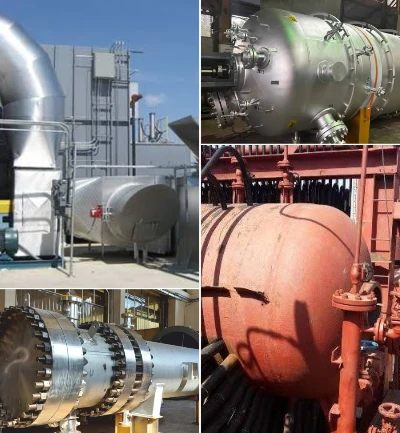
- Storage and process vessels
- Pressure vessels
- Boilers and related pressure-containing equipment
- Heat-exchanger components
- Oil and gas processing equipment
- Chemical and petrochemical pressure equipment
The difference is not simply the equipment type. Grade selection should be based on the required strength level, design temperature, pressure, toughness requirements, fabrication conditions, and project specification.
When A516 Gr.60 may be appropriate
Gr.60 can be considered when its specified mechanical properties satisfy the design requirements and there is no project requirement for the higher strength level of Gr.70.
When A516 Gr.70 may be appropriate
Gr.70 can be considered when the design requires its higher specified yield and tensile strength or when the higher strength level provides a meaningful design advantage.
The final material selection should always be confirmed against the applicable pressure-vessel code and project specification.
A516 Gr.60 vs Gr.70 Welding and Fabrication Considerations
Common filler metals: E7018 / E7016-1 electrodes for SMAW, ER70S-6 for GMAW. PWHT requirements should be determined according to the applicable construction code, material, thickness, welding procedure and project requirements. For sour service applications, additional hardness controls (≤22 HRC per NACE MR0175) and HIC testing per NACE TM0284 may be required.
Normalization requirement: Per ASTM A516/A516M-17 Section S17, plates over 1.5 in (38 mm) in thickness must be supplied in the normalized condition. Customers may also specify normalized delivery for thinner plates when improved toughness is required. For Gr.70 plates in particular, normalized delivery at thicknesses below 1.5 in can provide enhanced Charpy impact performance for low-temperature service applications.
Fabrication considerations for each grade:
- A516 Gr.60: Cold forming is readily achievable due to higher elongation (25% in 2 in). Requires minimal preheat for most thicknesses. Lower residual stress after welding, reducing distortion risk in complex fabrications.
- A516 Gr.70: Requires greater forming force due to higher yield strength. Preheat recommended for thicknesses over 25 mm. Post-weld heat treatment may be required for thicker sections per ASME Section VIII, UCS-56. The higher carbon content necessitates stricter control of welding parameters to avoid hydrogen-induced cracking.
A516 Gr.60 and Gr.70 Specifications
| Parameter | Range / Details |
|---|---|
| Thickness | 6 mm – 150 mm (up to 500 mm subject to mill capability) |
| Width | 1,500 mm – 3,200 mm |
| Length | 6,000 mm – 12,000 mm (or as per customer request) |
| Thickness Tolerance | Per EN 10029 Class A (or ASTM A20/A20M) |
| Surface Condition | As-rolled, shot-blasted, or pickled & oiled |
| Edge Condition | Mill edge or cut edge (plasma / laser / gas cutting) |
| Delivery Condition | As-rolled (≤1.5 in), Normalized (>1.5 in), or N+T |
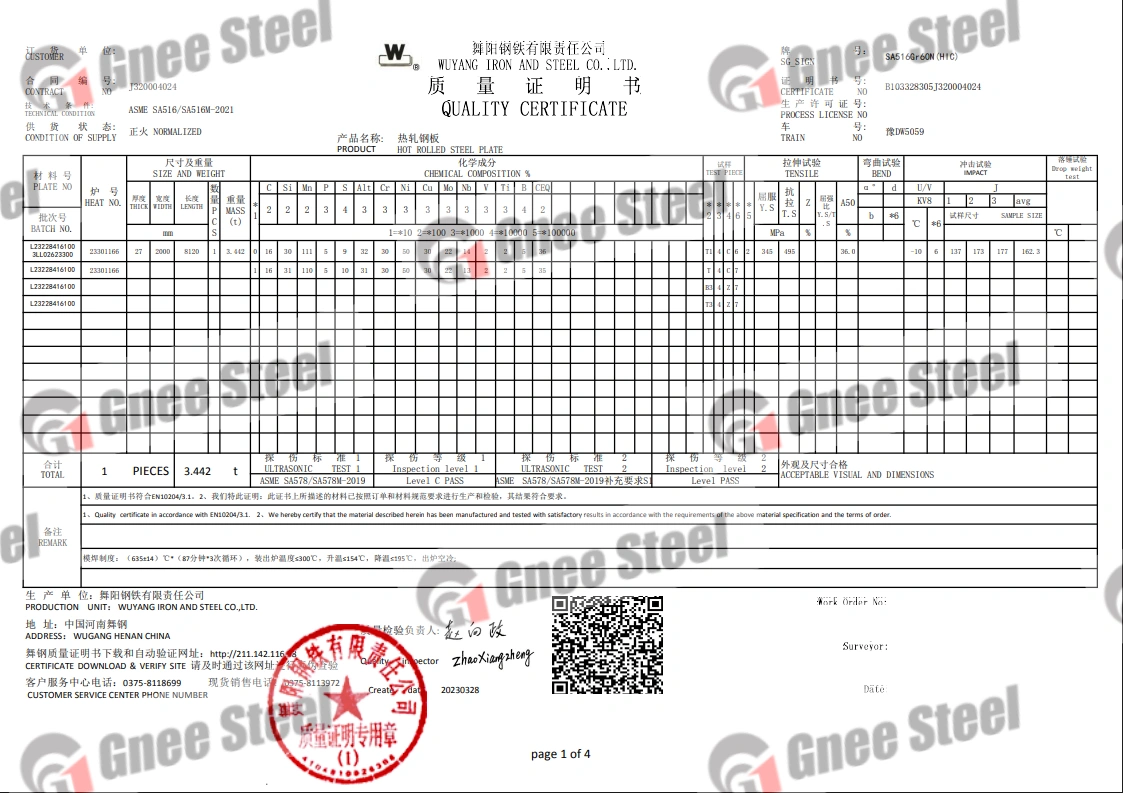
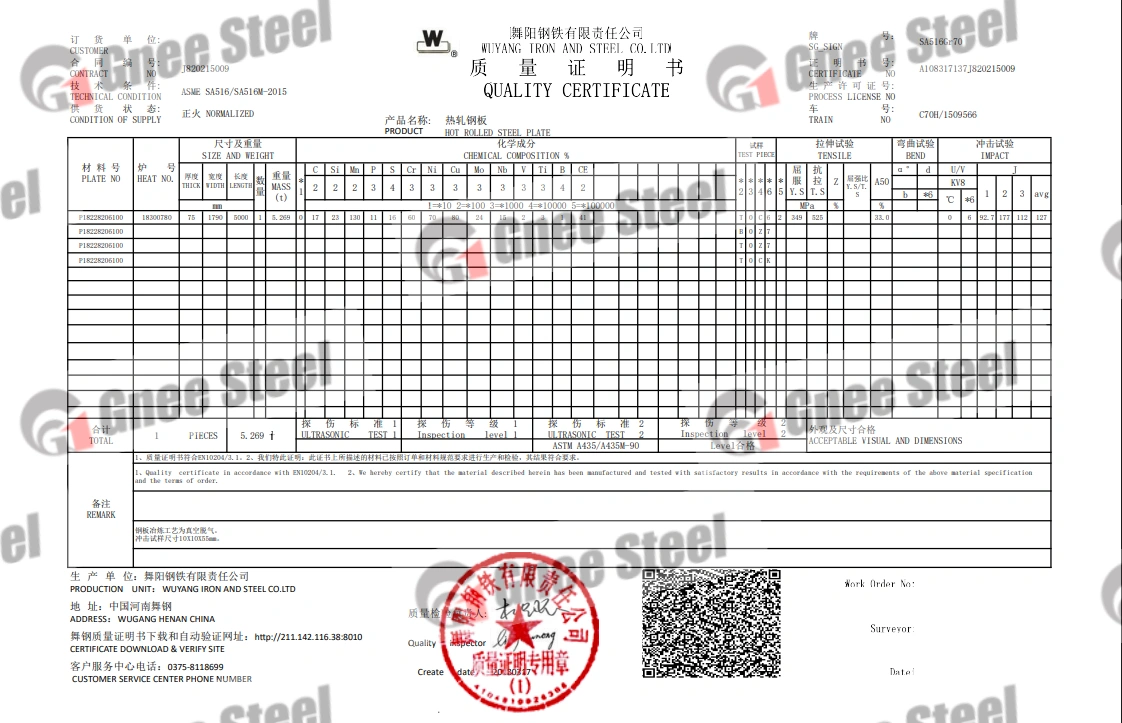
| Certificates | MTC per EN 10204 3.1; 3.2 certification available upon request |
| Supplementary Testing | NACE TM0284 (HIC), NACE TM0177 (SSC), ASTM A578 (UT), Z-direction |
| Marking | Stencil or low-stress stamp per ASTM A6/A6M |
Why Choose GNEE Steel?
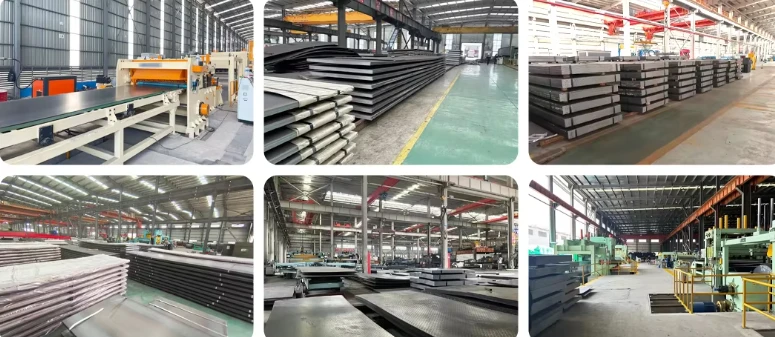
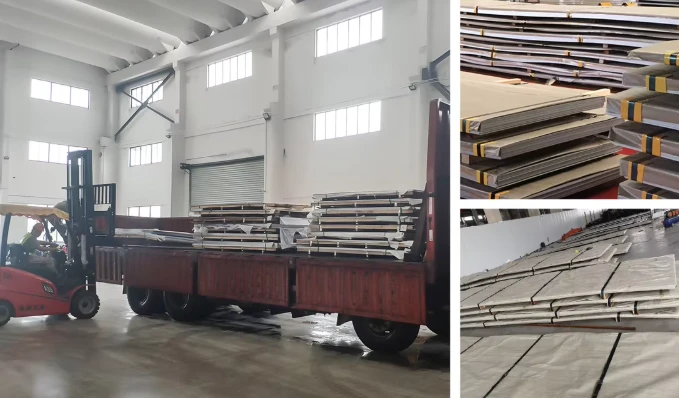
GNEE Steel supply ASTM/ASME pressure vessel steel plates with MTC traceability and support customized dimensions, cutting and third-party inspection according to project requirements.
For A516 Gr.60 or Gr.70 inquiries, buyers can provide grade, thickness, dimensions, heat-treatment condition, impact requirements and inspection requirements for quotation.
Every project has unique parameters. Share your design pressure, temperature, and thickness requirements with our team, and we will recommend the optimal grade with a formal quotation.
Submit your inquiry for A516 Gr.60 or Gr.70 plates
FAQ
Is A516 Gr.70 stronger than A516 Gr.60?
Yes. A516 Gr.70 has a higher specified tensile-strength range and minimum yield strength than Gr.60. Gr.60 has a tensile strength of 60–80 ksi and a minimum yield strength of 32 ksi, while Gr.70 has 70–90 ksi tensile strength and a 38 ksi minimum yield strength.
Can A516 Gr.60 replace Gr.70?
Not automatically. Gr.60 can only replace Gr.70 when the lower strength level still satisfies the applicable design calculations, material requirements, and project specification. Any substitution should be approved by the responsible engineering authority.
Can A516 Gr.70 replace Gr.60?
It should not be assumed that a higher-strength grade is automatically an acceptable substitute. The design code, material specification, toughness requirements, fabrication procedure, and project approval requirements must be checked before substitution.
Which is easier to weld, A516 Gr.60 or Gr.70?
Gr.60 may have a weldability advantage because of its lower specified carbon limit, but weldability depends on more than carbon content. Actual chemistry, carbon equivalent, thickness, hydrogen control, restraint, preheat, heat input, and the qualified welding procedure all need to be considered.
Does A516 Gr.70 always allow a thinner pressure-vessel plate?
No. Its higher strength may provide a thickness or weight advantage in some designs, but there is no universal percentage reduction. Actual thickness must be calculated from the applicable pressure-vessel design code and project design conditions.


