

Quick Overview: A516 Gr.70 vs A515 Gr.70 Pressure Vessel Plate at a Glance
Before diving into technical details, here is a 10-dimension overview of the primary differences:
| Comparison Dimension | A515 Gr.70 (High Temperature) | A516 Gr.70 (Low Temperature) |
|---|---|---|
| Standard | ASTM A515/A515M, ASME SA515 | ASTM A516/A516M, ASME SA516 |
| Temperature Service | Intermediate to high temperature (≤427–538°C / 800–1000°F) | Moderate to lower temperature (down to −46°C / −50°F) |
| Deoxidation Practice | Fully killed, coarse austenitic grain | Fully killed, fine austenitic grain |
| Carbon Content (max) | 0.31–0.35% (higher) | 0.27–0.30% (lower) |
| Notch Toughness | Lower; not suitable for low-temperature applications | Excellent; Charpy V-notch tested down to −46°C |
| Weldability | Good (higher preheat required) | Excellent (lower preheat requirements) |
| Max Thickness (Standard Scope) | Up to 200 mm | Up to 204 mm (8 in.) |
| Heat Treatment | Typically normalized | Normalized mandatory for thickness > 40 mm |
| European Equivalent | DIN 17155 19Mn6, JIS G3103 SB480 | EN 10028-2 P355GH |
| Media Compatibility | Non-corrosive / weakly corrosive (clean water, steam) | Corrosive media (H₂S/CO₂ oil & gas); HIC & NACE MR0175 compliant |
What Is A515 Gr.70 High-Temperature Carbon Steel Plate?
 ASTM A515/A515M Grade 70 is a carbon-silicon, fully killed steel plate specified for welded boilers and other pressure vessels operating in intermediate to high-temperature service environments. The term "killed" indicates that the steel has been fully deoxidized during the steelmaking process through the addition of silicon, manganese, and aluminum, resulting in no gas evolution during solidification and a more uniform composition throughout the plate.
The defining characteristic of A515 Gr.70 is its coarse austenitic grain size practice (typically ASTM grain size 1–5). This intentional grain coarsening enhances resistance to creep deformation and graphitization at elevated temperatures - making it the preferred choice for boiler drums, superheater headers, and steam generators in thermal power plants. Typical applications operate at temperatures up to 427–538°C (800–1000°F).
What Is A516 Gr.70 Low-Temperature Pressure Vessel Steel Plate?
ASTM A516/A516M Grade 70 is a carbon-manganese-silicon pressure vessel quality steel plate designed for moderate and lower-temperature service. Unlike A515, A516 Gr.70 is specifically engineered to deliver superior notch toughness at low operating temperatures, making it the preferred choice for applications where brittle fracture resistance is critical.
The defining characteristic of A516 Gr.70 is its fine austenitic grain size practice (typically ASTM grain size 5 or finer). The finer grain structure dramatically improves low-temperature notch toughness and impact resistance - more grain boundaries act as barriers to crack propagation. A516 Gr.70 can undergo Charpy V-notch testing at temperatures as low as −46°C (−50°F), a capability A515 Gr.70 does not reliably deliver.
Chemical Composition: SA516 Gr.70 vs SA515 Gr.70 Hot Rolled Plate
A515 Gr.70 Chemical Composition (per ASTM A515/A515M)
| Thickness (mm) | C (max) | Mn (max) | Si | P (max) | S (max) |
|---|---|---|---|---|---|
| t ≤ 25 | 0.31 | 1.20 | 0.15–0.40 | 0.025 | 0.025 |
| 25 < t ≤ 50 | 0.33 | 1.20 | 0.15–0.40 | 0.025 | 0.025 |
| 50 < t ≤ 100 | 0.35 | 1.20 | 0.15–0.40 | 0.025 | 0.025 |
| 100 < t ≤ 200 | 0.35 | 1.20 | 0.15–0.40 | 0.025 | 0.025 |
A516 Gr.70 Chemical Composition (per ASTM A516/A516M)
| Thickness (mm) | C (max) | Mn | Si | P (max) | S (max) |
|---|---|---|---|---|---|
| 6.0–12.5 | 0.27 | 0.85–1.20 | 0.13–0.45 | 0.025 | 0.025 |
| 12.5–25 | 0.28 | 0.85–1.20 | 0.13–0.45 | 0.025 | 0.025 |
| 25–50 | 0.28 | 0.85–1.20 | 0.13–0.45 | 0.025 | 0.025 |
| > 50 | 0.30 | 0.85–1.20 | 0.13–0.45 | 0.025 | 0.025 |
Key observation: A515 Gr.70 contains higher carbon content (0.31–0.35%) compared to A516 Gr.70 (0.27–0.30%). Higher carbon contributes to A515's superior high-temperature strength but limits its low-temperature toughness and weldability. A516's lower carbon equivalent enables excellent weldability with reduced hydrogen-induced cracking risk.
Mechanical Properties of A516 Gr.70 and A515 Gr.70 PVQ Carbon Steel Plate
| Property | A515 Gr.70 | A516 Gr.70 |
|---|---|---|
| Tensile Strength | 485–620 MPa (70–90 ksi) | 485–620 MPa (70–90 ksi) |
| Yield Strength (min) | 260 MPa (38 ksi) | 260 MPa (38 ksi) |
| Elongation in 50 mm (min) | 21% | 21% |
| Elongation in 200 mm (min) | 17% | 17% |
| Impact Toughness (Charpy V-notch) | Lower; not reliably tested at sub-zero temperatures | Excellent; tested at −46°C (−50°F), typical avg ≥ 27J (longitudinal, full-size) |
| Hardness (typical) | 130–180 HB (as-rolled) | 140–200 HB (normalized) |
Key observation: While tensile and yield strength ranges are identical, the critical differentiator lies in impact toughness. A516 Gr.70's fine-grain practice allows Charpy V-notch testing at −46°C with guaranteed minimum absorbed energy - a capability A515 Gr.70 cannot reliably deliver due to its coarse grain structure.

A516 Gr.70 and A515 Gr.70 Hot Rolled Pressure Vessel Plate Specification
| Specification | A515 Gr.70 | A516 Gr.70 |
|---|---|---|
| Thickness Range | 5–50 mm (standard scope) | 6–204 mm (up to 8 in.) |
| Width Range | 1,000–3,000 mm | 1,000–3,200 mm |
| Length Range | 3,000–12,000 mm | 3,000–12,000 mm |
| Delivery Condition | As-rolled (AR) or Normalized (N) | As-rolled (AR) or Normalized (N); N mandatory for t > 40 mm |
| Surface Finish | Hot rolled, pickled, or blasted | |
| Edge Type | Milled edge (ME) or flame-cut edge | |
| Weight Tolerance | Per ASTM A20/A20M (General Requirements) | |
| Dimensional Tolerance | Per ASTM A6/A6M (as applicable) | |
| Available Certifications | EN 10204 3.1 MTC; 3.2 optional | |
| Third-Party Inspection | BV, DNV, SGS, Lloyd's Register, TUV | |
| Typical Lead Time | 7–15 days (stock); 25–45 days (mill rolling) | |
| Custom Processing | Oxy-fuel / plasma / laser cutting, beveling, drilling | |
Dimensional Tolerances (per ASTM A6/A6M)
| Nominal Thickness (mm) | Thickness Tolerance (mm) | Width Tolerance (mm) | Length Tolerance (mm) |
|---|---|---|---|
| 5–8 | ±0.40 | +25 / −0 | +50 / −0 |
| 8–15 | ±0.45 | +25 / −0 | +50 / −0 |
| 15–25 | ±0.50 | +25 / −0 | +50 / −0 |
| 25–40 | ±0.60 | +30 / −0 | +50 / −0 |
| 40–60 | ±0.80 | +30 / −0 | +50 / −0 |
| 60–100 | ±1.00 | +35 / −0 | +60 / −0 |
| 100–150 | ±1.30 | +35 / −0 | +60 / −0 |
| 150–204 | ±1.60 | +40 / −0 | +70 / −0 |
Dimensional tolerances are per ASTM A6/A6M for carbon steel plates. Specific tolerance requirements per ASTM A20/A20M may apply. The MTC and governing standard edition shall prevail.
Stock List: A516 Gr.70 PVQ Steel Plate (Selected Items)
| Grade | Thickness (mm) | Width (mm) | Length (mm) | Qty Available (MT) | Condition |
|---|---|---|---|---|---|
| A516 Gr.70 | 8 | 1,500 | 6,000 | 45 | Normalized |
| A516 Gr.70 | 12 | 2,000 | 8,000 | 68 | Normalized |
| A516 Gr.70 | 20 | 2,200 | 8,000 | 92 | Normalized |
| A516 Gr.70 | 30 | 2,400 | 10,000 | 55 | Normalized |
| A516 Gr.70 | 45 | 2,500 | 10,000 | 38 | Normalized |
| A516 Gr.70 | 60 | 2,500 | 12,000 | 28 | Normalized |
| A516 Gr.70N | 80 | 2,600 | 12,000 | 18 | Normalized |
| A516 Gr.70N | 100 | 2,600 | 12,000 | 12 | Normalized |
Stock list is indicative as of September 2026 and subject to availability. Contact our sales team for real-time inventory and custom sizes.

Equivalent Grades for ASTM A516 Gr.70 and A515 Gr.70 Boiler Steel Plate
A515 Gr.70 and A516 Gr.70 have equivalents across multiple international standard systems. Note: cross-system equivalents are approximate references based on similar tensile strength and application. Where no exact 1:1 equivalent exists, direct substitution is not permitted without engineering verification.
| Standard System | A515 Gr.70 Equivalent | A516 Gr.70 Equivalent |
|---|---|---|
| ASTM/ASME (US) | A515/A515M Gr.70, SA515 Gr.70 | A516/A516M Gr.70, SA516 Gr.70 |
| EN (Europe) | EN 10028-2 P265GH (approximate) | EN 10028-2 P355GH |
| DIN (Germany, superseded) | DIN 17155 HII (approximate) | DIN 17155 17Mn4 (approximate) |
| JIS (Japan) | JIS G3103 SB450 | JIS G3103 SB480 (approximate) |
| GB (China) | GB 713-2014 20R (approximate, superseded by Q245R) | GB 713-2014 Q245R / Q345R (approximate) |
| BS (UK, superseded) | BS 1501-161-430A/B | BS 1501-224-490B (approximate) |
Important: Equivalent grades listed above are for reference only. Chemical composition, deoxidation practice, and impact testing requirements differ across standards. Direct substitution without engineering review and code verification is not permitted. Always confirm with your project specification and the governing code edition at the time of ordering.

Key Differences: A516 Gr.70 vs A515 Gr.70 Pressure Vessel Quality Plate Deep Analysis
Difference 1: Temperature Service Range - The Most Critical Factor
The single most significant difference lies in their designed operating temperature ranges:
- A515 Gr.70: Engineered for intermediate and higher-temperature service. Its higher carbon and silicon content, combined with coarse austenitic grain size practice, enhances high-temperature stability, creep resistance, and graphitization resistance. Typical applications operate at temperatures up to 427–538°C (800–1000°F).
- A516 Gr.70: Optimized for moderate and lower-temperature service. The fine austenitic grain size practice provides superior notch toughness and impact resistance at temperatures down to −46°C (−50°F), making it suitable for cryogenic and sub-zero applications.
Bottom line: If your project involves high-temperature steam drums or boilers, choose A515 Gr.70. If your vessel operates in refrigerated or potentially sub-zero environments, A516 Gr.70 is the correct specification.
Difference 2: Grain Size Control - Coarse vs Fine Austenitic Grain
A fundamental metallurgical distinction lies in their grain structure control:
- Coarse Grain Practice (A515 Gr.70): Manufactured to ASTM grain size 1–5. Larger grains mean fewer grain boundaries, which reduces paths for dislocation movement - a critical advantage for high-temperature, long-duration service where creep deformation is the primary concern.
- Fine Grain Practice (A516 Gr.70): Produced to ASTM grain size 5 or finer. More grain boundaries act as barriers to crack propagation, dramatically improving low-temperature notch toughness and impact resistance. This is why A516 Gr.70 excels where brittle fracture risk at lower temperatures must be minimized.
This grain size difference is not merely technical - it has direct consequences for ASME pressure vessel code compliance and material selection.
Difference 3: Carbon Content & Weldability
| Grade | Carbon Content (max %) | Weldability Implication |
|---|---|---|
| A515 Gr.70 | 0.31–0.35 | Higher carbon → reduced weldability, higher preheat requirements, increased hydrogen-induced cracking risk |
| A516 Gr.70 | 0.27–0.30 | Lower carbon equivalent → excellent weldability, lower preheat, reduced HAZ cracking risk |
A516 Gr.70's lower carbon equivalent allows smoother fabrication with less stringent welding procedures. A515 Gr.70's higher carbon contributes to high-temperature strength but requires controlled preheating and interpass temperature management during welding.
Difference 4: Heat Treatment Requirements
- A515 Gr.70: Typically supplied in the normalized condition (heated to 900–950°C / 1,650–1,750°F and air-cooled) to optimize high-temperature properties, refine grain structure, and reduce internal stresses.
- A516 Gr.70: Normalization is mandatory for plates exceeding 40 mm (1.5 in.) in thickness per ASTM A516/A516M. The normalized plate is heated to 900–950°C and air-cooled to refine grain size, enhance low-temperature toughness, and homogenize the microstructure for safety-critical pressure vessel applications.
Difference 5: Media Compatibility & Sour Service Compliance
This is a dimension often overlooked by buyers but critical for oil & gas applications:
| Media Type | A515 Gr.70 | A516 Gr.70 |
|---|---|---|
| Non-corrosive / weakly corrosive (clean water, steam) | Suitable | Suitable |
| Corrosive media (H₂S / CO₂ oil & gas) | Not recommended for sour service | Recommended - HIC-tested and NACE MR0175 / ISO 15156 compliant |
| Low-temperature service (< 0°C) | Not suitable | Suitable - Charpy V-notch tested at −46°C |
Welding & Fabrication Guide for SA516 Gr.70 and SA515 Gr.70 Hot Rolled Steel Plate
Both A515 Gr.70 and A516 Gr.70 are weldable carbon steel plates, but their different carbon contents dictate different welding procedures:
| Welding Parameter | A515 Gr.70 | A516 Gr.70 |
|---|---|---|
| Recommended Welding Process | SMAW, GMAW, SAW | SMAW, GMAW, SAW, FCAW |
| SMAW Electrode | E7018 (low-hydrogen, 70 ksi tensile) | E7018 (low-hydrogen, 70 ksi tensile) |
| GMAW Wire | ER70S-6 | ER70S-6 |
| FCAW Wire | E71T-1C | E71T-1C |
| Preheat Temperature | 149–204°C (300–400°F) for t > 25 mm; higher preheat due to higher carbon | 149–204°C (300–400°F) for t > 38 mm; lower preheat due to lower carbon equivalent |
| Interpass Temperature | Control per WPS; typically 150–250°C | Control per WPS; typically 150–250°C |
| PWHT (Post-Weld Heat Treatment) | Required for thick sections per ASME Section VIII; temperature must not exceed original tempering range | Required for thick sections per ASME Section VIII; temperature must not exceed original tempering range |
| Cold Forming | Good; may require stress relief after severe forming | Excellent; fine-grain structure supports rolling, bending, and shell forming without surface cracking |
Preheating and interpass temperature control must follow the approved Welding Procedure Specification (WPS). The information above is for reference only and does not substitute for project-specific welding procedures.

Typical Applications: Where A515 Gr.70 and A516 Gr.70 Pressure Vessel Plates Excel
A515 Gr.70 - High-Temperature Applications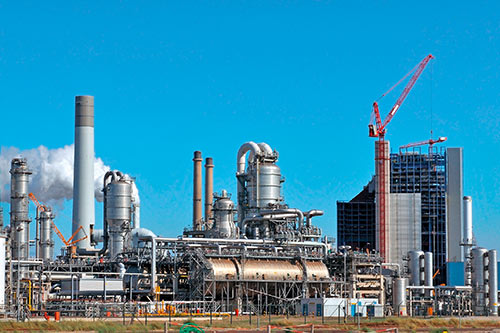
- Power generation: Industrial boilers and steam drums requiring sustained high-temperature performance
- Thermal power plants: Superheater headers and boiler drums
- Refineries: High-temperature heat exchangers and pressure vessels
- Petrochemical: Pressure vessels operating at elevated temperatures
- Creep-critical service: Equipment where long-term high-temperature strength is essential
A516 Gr.70 - Low & Moderate-Temperature Applications
- Oil & gas: Separators, distillation columns, and pressure vessels (including sour service with HIC/NACE compliance)
- Storage tanks: LPG storage tanks requiring low-temperature toughness; API 650 and API 620 storage tanks
- Chemical processing: Low to moderate-temperature pressure vessels
- Cryogenic service: Cryogenic storage vessels (with supplementary Charpy V-notch testing)
- Sour service: Pressure vessels in H₂S-containing environments (with optional HIC and NACE MR0175 compliance)
Selection Guide: A516 Gr.70 or A515 Gr.70 Carbon Steel Plate - High Temp or Low Temp?
Use the following decision rules to quickly determine which grade is right for your project:
4-Step Selection Decision Rules
IF design temperature > 400°C (752°F) and service involves steam, boilers, or creep-critical components → Choose A515 Gr.70 (coarse grain, high-temperature optimized)
IF design temperature < 0°C (32°F) or MDMT requires Charpy V-notch testing → Choose A516 Gr.70 (fine grain, low-temperature optimized)
IF service media contains H₂S / CO₂ (sour service) or requires NACE MR0175 / HIC compliance → Choose A516 Gr.70 (available with HIC testing and sour service certification)
IF required plate thickness > 50 mm → Choose A516 Gr.70 (standard scope covers up to 204 mm; A515 standard scope is limited to 50 mm)
IF application is a standard ambient-temperature pressure vessel with no special low-temperature or sour service requirements → A516 Gr.70 is the industry-preferred choice (better weldability, broader availability, global acceptance)
Why Choose GNEE Steel?
- 18 Years of PVQ Expertise: With 18 years specializing in pressure vessel steel plates, our engineering team has deep expertise in A516 Gr.70 and A515 Gr.70 specifications, testing, and application requirements
- Comprehensive Inventory: 5,000+ tons of PVQ steel plate stock, thickness range 6–200 mm, ready for fast global delivery
- Full Certification: Every plate supplied with EN 10204 3.1 / 3.2 MTC; optional third-party inspection by BV, DNV, SGS, or Lloyd's Register
- Special Testing Capability: HIC (NACE TM0284), SSC (NACE TM0177), NACE MR0175 / ISO 15156 compliance, UT inspection (ASTM A578), Charpy V-notch at −46°C
- Normalized Condition Supply: A516 Gr.70N (normalized) available for critical pressure vessel applications requiring enhanced notch toughness
- Custom Processing: Precision cutting (oxy-fuel, plasma, laser, waterjet), edge preparation, beveling, rolling, and forming to your exact specifications
- Global Export Experience: Serving clients in 60+ countries with reliable logistics and documentation support
- Technical Support: Our engineering team helps evaluate your specifications and recommend the correct grade for your operating conditions


Need A516 Gr.70 or A515 Gr.70 PVQ Steel Plates?
Send us your specifications and get a factory price quote within 24 hours. Custom sizes, full certification, and global delivery available.
Send Inquiry for Factory Price & DatasheetFAQ:
Q: Is A515 Gr.70 always killed steel?
A: Yes. ASTM A515/A515M specifies that the steel shall be fully killed and produced to a coarse austenitic grain size practice. Killed steel ensures no gas evolution during solidification, resulting in uniform composition and properties throughout the plate.
Q: What welding rod should I use for A516 Gr.70?
A: For SMAW, use E7018 (low-hydrogen, 70 ksi tensile). For GMAW, use ER70S-6 solid wire. For FCAW, use E71T-1C flux-cored wire. Preheating at 149–204°C (300–400°F) is required for thickness > 38 mm. Always follow the approved WPS for your specific application.
Q: Which grade is better for sour service (H₂S environments)?
A: A516 Gr.70 is the preferred choice for sour service. It can be supplied HIC-tested per NACE TM0284 and SSC-tested per NACE TM0177, and is compliant with NACE MR0175 / ISO 15156 requirements. A515 Gr.70 is not recommended for sour service due to its higher carbon content and coarse grain structure, which reduce resistance to hydrogen-induced cracking.
Q: Can A516 Gr.70 be used at high temperatures above 400°C?
A: While A516 Gr.70 can withstand moderately elevated temperatures, it is not designed for sustained high-temperature service where creep and graphitization become limiting factors. For continuous operation above approximately 400°C, A515 Gr.70 or alloy steel grades such as SA387 are more appropriate.
Q: What is the hardness of A516 Gr.70?
A: The typical hardness of ASME SA516 Gr.70 ranges from 130–180 HB (as-rolled) to 140–200 HB (normalized). Actual hardness depends on heat treatment condition, chemical composition, and manufacturing process. These are typical values, not guaranteed values - refer to the MTC for actual measured values.


