

Products Description
The short answer is yes - HP295 is widely recognized as the most popular and commonly used steel grade for household LPG (liquefied petroleum gas) cylinders, particularly in markets that follow Chinese GB standards. However, its dominance is not accidental; it results from a specific balance of properties that perfectly aligns with the manufacturing process and service requirements of domestic gas cylinders.
Why HP295 is considered "mainstream"
Dominant use in household LPG cylinders
• HP295 is specifically designed for welded gas cylinders under the GB6653 standard.
• It is widely used for household LPG cylinders (e.g., 15 kg cylinders).
• In some production contexts, household LPG cylinders account for 98–99% of output using this grade.
Are you still unsure which grade is best for your upcoming project? Don't leave your material selection to chance. Contact GNEE today for a detailed technical consultation and a competitive quote on HP295 steel plates. Our team of experts is ready to help you optimize your production and ensure the highest safety standards for your products.
Why HP295 Dominates Household LPG Cylinder Manufacturing
Strength and Formability
Household LPG cylinders (typically 5kg, 10kg, or 15kg capacity) are manufactured through a process that includes deep drawing, punching, and welding. This manufacturing method imposes specific requirements on the steel:
- Deep drawability - The steel must flow plastically without cracking during the one-piece stamping of the cylinder head and bottom
- Weldability - The longitudinal seam weld must be reliable and defect-free
- Sufficient strength - The cylinder must safely contain LPG at working pressures typically up to 2.5-3.0 MPa
HP295 occupies an ideal position in this balance. According to the GB6653 standard, HP295 provides :
| Property | HP295 Value | Why This Matters for LPG Cylinders |
|---|---|---|
| Yield Strength (ReL) | ≥295 MPa | Provides safe pressure containment with reasonable wall thickness (typically 2.5-3.0mm) |
| Tensile Strength (Rm) | ≥440 MPa | Ensures structural integrity under overpressure scenarios |
| Elongation (δ5) | ≥26% | Excellent formability for deep drawing operations |
| Cold Bending (180°) | d=1.5a | Can be bent flat without cracking - critical for head forming |
| Impact Toughness (Akv) | ≥27 J (10×10mm) at room temperature | Prevents brittle fracture during handling and transport |
Optimal Thickness for Economic Production
For a standard YSP-15 type cylinder (15kg LPG capacity), the body uses HP295 steel plate with a thickness of approximately 2.5mm to 3.0mm . This thickness represents an economic optimum:
- Thin enough to keep material costs and cylinder weight manageable
- Thick enough to provide adequate strength and withstand manufacturing tolerances
- Compatible with standard stamping presses and welding equipment
Low Carbon Equivalent for Excellent Weldability
HP295 maintains a carbon content of ≤0.20% and manganese content of ≤1.00% . This composition provides:
- Low carbon equivalent (Ceq) - Reduces cold cracking susceptibility in the welded seam
- Good heat-affected zone (HAZ) toughness - Maintains strength adjacent to the weld
- Compatibility with standard welding processes - Works with common LPG cylinder welding procedures (typically submerged arc welding for the longitudinal seam)
Technical Specifications of HP295 steel
| Element | Requirement (wt%) | Purpose |
|---|---|---|
| Carbon (C) | ≤0.20 | Ensures weldability and formability; prevents embrittlement |
| Silicon (Si) | ≤0.35 | Deoxidizer; contributes to strength |
| Manganese (Mn) | ≤1.00 | Provides solid-solution strengthening; improves toughness |
| Phosphorus (P) | ≤0.025 | Strictly limited to prevent cold shortness |
| Sulfur (S) | ≤0.015 | Strictly limited to prevent hot cracking |
| Acid-soluble Al (Als) | ≥0.015 | Grain refiner; improves toughness and formability |
Modern HP295 production achieves significantly tighter controls than the standard maximums, with many steel mills targeting C: 0.16-0.18%, P: ≤0.020%, and S: ≤0.008%
Microstructural Requirements
HP295 requires a fine-grained, homogeneous microstructure. Quality HP295 exhibits:
- Grain size - ASTM No. 8 or finer (typically 10-12)
- Inclusion rating - ≤1.0 for sulfides and ≤1.5 for oxides (per ASTM E45)
- Microstructure - Ferrite + pearlite, with no Widmanstätten or bainitic structures
At GNEE Steel, we pride ourselves on being more than just a manufacturer; we are a partner in your success. Our high-grade HP295 welded gas cylinders steel is trusted by leading cylinder manufacturers worldwide for its consistency and reliability.
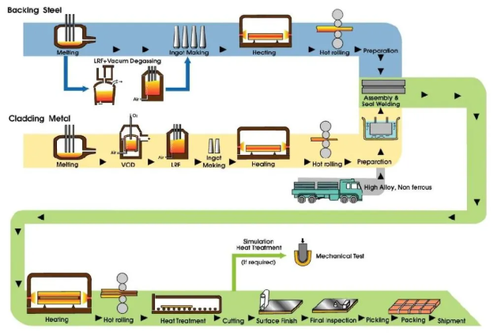
The Manufacturing Process of HP295 steel
Typical Cylinder Manufacturing Flow
- Slitting - Coils are cut to precise widths for blanking
- Blanking - Circular blanks are stamped from the strip
- Deep drawing - The head and bottom are formed in one operation
- Trimming and punching - Edges are trimmed; valve openings are punched
- Roll forming - The cylinder body is rolled from rectangular blanks
- Welding - Longitudinal seam is welded (typically submerged arc welding)
- Assembly welding - Head and bottom are welded to the body
- Heat treatment - Stress relief annealing after welding
- Testing - X-ray inspection, hydrostatic testing, air tightness testing
- Surface finishing - Shot blasting and painting
HP295 vS other common cylinder steels
| Grade | Yield Strength | Elongation | Typical Application |
|---|---|---|---|
| HP245 | ≥245 MPa | ≥28% | Smaller cylinders, lower pressure |
| HP265 | ≥265 MPa | ≥27% | Medium cylinders |
| HP295 | ≥295 MPa | ≥26% | Standard household LPG cylinders |
Conclusion: HP295 dominates in volume production, but not universally across all standards.
HP295 vS Higher Grades (HP325, HP345, HP365)
| Grade | Yield Strength | Elongation | Use Case |
|---|---|---|---|
| HP295 | ≥295 MPa | ≥26% | Household LPG (standard pressure) |
| HP325 | ≥325 MPa | - | Higher pressure LPG |
| HP345 | ≥345 MPa | ≥20% | High-pressure gases, toxic media |
| HP365 | ≥365 MPa | ≥20% | Specialty high-pressure applications |
For standard household LPG cylinders, HP325 or HP345 would be over-specified - they cost more, offer reduced formability (lower elongation), and provide unnecessary strength margin. However, for cylinders requiring higher service pressures or for transport in extreme conditions, HP345 becomes appropriate
Applications Beyond Household LPG Cylinders
| Application | Gas Type | Pressure Range | Key Requirement |
|---|---|---|---|
| Fuel cylinders | Acetylene, oxy-fuel | Up to 250 psi | Impact resistance |
| Oxygen cylinders | Medical oxygen | Up to 3000 psi | Lightweight strength |
| Argon cylinders | Welding shielding gas | Up to 2200 psi | Gas purity |
| CO₂ cylinders | Carbonation | Up to 850 psi | Flavor neutrality |
| Hydrogen cylinders | Clean energy | Up to 200 bar | Embrittlement resistance |
Choose HP295 when:
You produce standard household LPG cylinders (15kg–50kg)
You need cost efficiency + stable forming performance
Your market follows GB / Asian supply chains
Consider alternatives when:
Exporting to EU or ISO-regulated markets
Producing high-pressure or lightweight cylinders

HP295 is one of the most popular steels for household LPG cylinders, especially in large-scale manufacturing markets.
At GNEE, we operate a state-of-the-art manufacturing facility that ensures every batch of steel plate we produce maintains consistent grain structure and superior surface quality. By choosing a direct manufacturer like GNEE, you benefit from factory-direct pricing and rigorous quality control that middleman traders cannot offer.
Is HP295 the only steel used for LPG cylinders?
No, but it is the most common. Alternatives include HP245 (for smaller or lower-pressure cylinders), HP325 (for higher pressure), and international equivalents like SG295. For seamless LPG cylinders (less common in household sizes), chrome-molybdenum steels like 30CrMo or 4130X are used.
Can HP295 cylinders be used for gas mixtures or other gases?
Yes, but with qualification. HP295 cylinders are suitable for LPG, propylene, and similar hydrocarbon gases. For toxic gases (e.g., ammonia, chlorine) or high-purity gases, HP345 or higher grades are typically specified due to stricter cleanliness and toughness requirements.
What is the typical lifespan of an HP295 LPG cylinder?
With proper maintenance and periodic inspection, HP295 LPG cylinders typically have a design life of 15-20 years. Periodic hydrostatic testing (typically every 4-5 years, depending on local regulations) verifies continued safe operation.
How does HP295 perform in cold environments?
HP295 is specified for room-temperature impact testing (27J minimum). For cold regions (e.g., Siberia, northern Canada), HP345 with -20°C or -40°C impact toughness is recommended to prevent brittle fracture.
Why not use HP345 for all cylinders to be safer?
While HP345 is stronger, it has lower elongation (≥20% vs. ≥26% for HP295), making it more difficult to form complex cylinder heads. It also costs more and provides unnecessary strength for standard LPG service. For household LPG, HP295 offers the optimal balance.
Can HP295 be welded to other steel grades?
Yes, but weld procedure qualification is required. When welding HP295 to higher-strength steels, the lower strength governs design, and filler metal selection must account for the lower carbon equivalent of HP295.


