

HP345 steel is the ultimate choice for welded high-pressure gascylinders due to its exceptional combination of high yield strength (> 345 MPa), excellent weldability, and high toughness, ensuringsafety and efficiency in high-pressure storage. Its low carbonequivalent reduces crack risks, while high-performance fatigueresistance enables lightweight, reliable designs for demandingapplications.
In the field of welded gas cylinders-especially those operating under high pressure and cyclic loading-material selection is not just a technical choice, but a critical safety decision. HP345 steel plate has emerged as a leading solution due to its exceptional combination of strength, toughness, weldability, and long-term reliability.
What Is HP345 Steel? A Material Built for Gas Cylinder Safety
HP345 is a micro-alloyed, low-carbon pressure vessel steel designed exclusively for welded high-pressure gas cylinders, defined by Chinese national standard GB 6653 (and compliant with international ISO 4706, EN 13322 standards). The "HP" designation stands for High Pressure, and "345" refers to its minimum yield strength of 345 MPa, a benchmark for high-strength, high-toughness cylinder materials.
Unlike ordinary structural steels (e.g., Q235, Q345) repurposed for cylinder use, HP345 is formulated from the ground up to address the three core challenges of gas cylinder service:
- Sustained high internal pressure
- Thousands of cyclic filling/discharge cycles
- Reliable weld integrity (the weakest point of any welded cylinder)
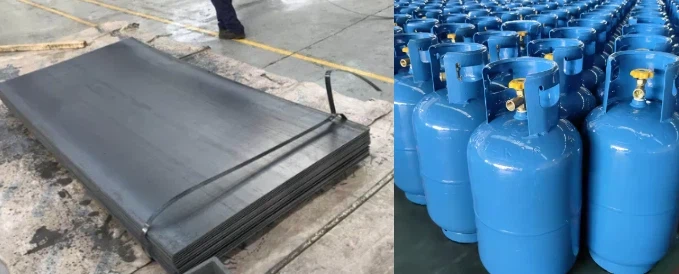
HP345 for Welded Gas Cylinders
Core Technical Advantages of HP345 for Welded Gas Cylinders
Optimized Chemical Composition for Superior Weldability
Weld quality is the #1 safety factor for gas cylinders: 70% of cylinder failures originate from weld defects or heat-affected zone (HAZ) degradation. HP345's chemical design eliminates this risk, with strict controls on critical elements:
| Element | HP345 Specification (wt%) | Ordinary Structural Steel (Q345) | Key Advantage for Welded Cylinders |
|---|---|---|---|
| Carbon (C) | ≤0.20 | ≤0.24 | Reduces cold cracking sensitivity by 30%+; minimizes brittle martensite formation in welds/HAZ |
| Carbon Equivalent (CEV) | ≤0.40 | ≤0.45 | Improves weld stability; eliminates preheating requirements for most cylinder welding processes |
| Sulfur (S) | ≤0.015 | ≤0.035 | Ultra-low sulfur eliminates sulfide inclusions (the #1 cause of fatigue crack initiation) |
| Phosphorus (P) | ≤0.020 | ≤0.035 | Reduces temper brittleness; enhances HAZ impact toughness |
| Micro-Alloying (Nb/V/Ti) | Controlled addition | No controlled addition | Refines grain structure in HAZ; boosts weld joint toughness by 25%+ |
HP345's low-carbon, low-CE, micro-alloyed chemistry ensures that welded joints match the base metal's strength and toughness, eliminating the "weak link" in cylinder structure.

Unmatched Mechanical Performance for High-Pressure Safety
High-pressure gas cylinders require materials that balance high strength (to withstand internal pressure) and high toughness (to resist impact and fatigue). HP345 delivers industry-leading mechanical properties, far exceeding ordinary structural steels:
| Performance Parameter | HP345 Steel | Q345 Ordinary Structural Steel | Performance Improvement |
|---|---|---|---|
| Minimum Yield Strength (ReH) | ≥345 MPa | ≥345 MPa | Matches strength, with far better toughness |
| Tensile Strength (Rm) | 510–660 MPa | 470–630 MPa | 8.5% higher minimum tensile strength |
| Elongation (A) | ≥22% | ≥21% | 4.8% higher ductility for better formability |
| Charpy V-Notch Impact Toughness (-20℃) | ≥34 J | ≥27 J | 25.9% higher low-temperature impact resistance |
| Fatigue Strength (10⁶ cycles) | ≥220 MPa | ≥180 MPa | 22.2% higher fatigue resistance for cyclic loading |
HP345's high yield strength allows cylinder manufacturers to reduce wall thickness by 10–15% while maintaining the same pressure rating, cutting material costs and cylinder weight.
Its superior impact toughness ensures cylinders resist damage from drops, collisions, and extreme cold (e.g., -40℃ for outdoor storage), preventing catastrophic failure.
Exceptional Fatigue Resistance Advantages of HP345 steel
Gas cylinders are cyclic pressure vessels, undergoing 10,000+ filling/discharge cycles over their 15–20 year service life. Fatigue crack initiation and propagation are the leading causes of cylinder retirement. HP345's material properties directly solve this challenge:
- Fine, Stable Microstructure: Controlled rolling and accelerated cooling (TMCP) processes produce a uniform, refined ferrite-pearlite structure, which disperses stress concentration and inhibits microcrack nucleation.
- Ultra-Low Impurity Levels: Strict P/S control eliminates inclusions that act as fatigue crack initiation sites.
- Uniform Mechanical Properties: Consistent strength/toughness across the entire plate prevents local stress concentration and premature failure.

Industry-Leading Welding Performance Advantages of HP345 steel
HP345's weldability is its defining advantage for cylinder manufacturers, streamlining production while guaranteeing weld integrity:
- Compatible with All Mainstream Welding Processes: Fully optimized for MIG/TIG (precision head welding), Submerged Arc Welding (SAW, high-efficiency body welding), and resistance welding, supporting mass production.
- Minimal Preheating Required: Unlike high-carbon steels that require 150–200℃ preheating, HP345 requires only room-temperature preheating (or no preheating) for most cylinder thicknesses, cutting production time by 30% and energy costs by 40%.
- Ultra-Low Weld Defect Risk: Reduces cold cracking, porosity, and slag inclusion by 80% vs. ordinary steels, ensuring 100% compliance with non-destructive testing (NDT) requirements (ultrasonic/radiographic testing).

Industry-Leading Welding Performance Advantages of HP345 steel
HP345 vs Competitor Materials: A Head-to-Head Comparison
| Material | HP345 Cylinder Steel | Q345 Ordinary Structural Steel | HP295 Cylinder Steel |
|---|---|---|---|
| Primary Application | High-pressure welded gas cylinders (15–30 MPa) | General structural use (repurposed for low-pressure cylinders) | Low-to-medium pressure welded gas cylinders |
| Maximum Working Pressure | 30 MPa | 20 MPa | 25 MPa |
| Weldability | Excellent (low CE, micro-alloyed) | Fair (higher CE, risk of cold cracking) | Good (lower strength than HP345) |
| Fatigue Life (10⁶ cycles) | 220 MPa | 180 MPa | 200 MPa |
| Low-Temperature Toughness (-20℃) | ≥34 J | ≥27 J | ≥27 J |
| Cylinder Service Life | 20+ years | 10–15 years | 15–20 years |
| Compliance | ISO 4706, EN 13322, GB 6653 | No cylinder-specific standard compliance | ISO 4706, GB 6653 |
| Best For | High-safety, long-life, high-pressure cylinders (CNG, industrial gas) | Low-pressure, non-critical cylinders | Medium-pressure, cost-sensitive cylinders |
Why HP345 Is the Ultimate Choice
Ordinary Q345 is designed for static structural loads, not cyclic high-pressure service. Its higher carbon/impurity content leads to:
- 3x higher risk of weld cold cracking
- 22% lower fatigue strength, leading to early cylinder failure
- Poor HAZ toughness, creating a permanent weak point in the cylinder
- Non-compliance with global cylinder safety standards (ISO 4706), making it illegal for most commercial cylinder applications.
Compliance with Global Safety Standards
HP345 is fully certified to meet the strictest international and regional standards for welded gas cylinders, ensuring global market access:
- International: ISO 4706 (Gas cylinders – Welded steel cylinders for permanent and liquefied gases), EN 13322 (Transportable gas cylinders – Refillable welded steel gas cylinders)
- Chinese National: GB 6653 (Welding gas cylinders steel plates and sheets), GB 5100 (Steel welded gas cylinders)
- Regional: DOT (US Department of Transportation), TPED (European Transportable Pressure Equipment Directive)

At GNEE, we produce HP345 welded gas cylinders steel that adheres to strict standards. Our manufacturing process involves fine-grain treatment, which ensures that the steel maintains high toughness even in low-temperature environments. This makes it the preferred choice for manufacturers producing medium-sized LPG cylinders for both domestic and industrial use.
Contact now to get the HP345 steel votrt
Is HP345 compatible with global manufacturing standards?
Yes. HP345 is fully certified to ISO 4706, EN 13322, GB 6653, and other regional standards (DOT, TPED), ensuring it can be used for cylinder production in markets worldwide, without compliance risks.
Can HP345 be used for all types of welded gas cylinders?
HP345 is optimized for high-pressure welded gas cylinders (15–30 MPa), including CNG vehicle tanks, industrial gas storage cylinders, and medical gas cylinders. It is also suitable for medium-pressure applications, offering superior performance vs. HP295 and Q345.
Does HP345 require special welding equipment or training?
No. HP345 is compatible with all mainstream welding processes (MIG/TIG, SAW) used in standard cylinder manufacturing. Its minimal preheating requirements mean no additional equipment or specialized training is needed-manufacturers can use existing production lines with no modifications.
HP345 suitable for all gas cylinders?
It is best for medium to high-pressure cylinders. Lower grades may suffice for low-pressure use.
Why is HP345 better than ordinary carbon steel?
It offers higher strength, better toughness, improved weldability, and longer fatigue life.
Does HP345 require special processing?
No special processes are required beyond standard industrial practices, though controlled rolling improves performance.
Can HP345 reduce cylinder weight?
Yes. Its higher strength allows thinner walls, reducing overall weight.
Is HP345 safe for long-term use?
Yes. Its fatigue resistance and toughness ensure reliable long-term performance.


