

P245NB is used for welded gas cylinders (especially LPG) because it is a non-alloyquality steel that offers exceptional weldability, high tensile strength, and excellentdeep-drawing properties for forming It is designed for safety, retaining structuralintegrity after welding and heat treatment.
P245NB is the standard choice for welded gas cylinders because it is specifically engineered to meet the unique manufacturing and safety requirements of these pressurized containers. According to the European standard EN 10120, which defines "Steel sheet and strip for welded gas cylinders," P245NB is designed to offer the ideal combination of strength, formability, and weldability
As an experienced gas cylinder steel manufacturer, GNEE supplies P245NB steel plates with strict quality control, helping global buyers choose the right material for their projects.
Key Properties of P245NB steel
| Property | Performance of P245NB | Why It Matters for Gas Cylinders |
|---|---|---|
| Strength | Minimum Yield Strength: 245 MPa Tensile Strength: 360 - 450 MPa |
Provides the structural integrity to safely contain pressurized gases (e.g., LPG, CNG, industrial gases) without rupturing. |
| Formability | Excellent cold formability | Allows the steel sheet to be deep-drawn or cold-formed into the cylindrical shape of the gas cylinder without cracking. |
| Weldability | Excellent, compatible with standard fusion welding processes | Enables the reliable welding of the cylinder's longitudinal seam and the joining of end caps (domes), ensuring a leak-proof seal. |
| Toughness | Good toughness, especially after normalizing | Critical for safety, as the cylinder must withstand impact and stress during transport, handling, and in various temperature environments. |
| Ductility | Minimum Elongation: 34% (for thickness ≥ 3 mm) | High ductility ensures the steel can deform under pressure instead of fracturing catastrophically, a key safety feature. |
Why P245NB steel Performs
The performance of P245NB is a direct result of its precise chemical composition, which is strictly controlled by the EN 10120 standard -
- Low Carbon (C ≤ 0.16%): This low carbon content is the primary reason for its excellent weldability and formability. It minimizes the risk of cracking in the heat-affected zone during welding and keeps the steel ductile for cold forming.
- Microalloying Elements (Niobium - Nb ≤ 0.05%): The addition of a small amount of niobium is key to achieving the required strength without compromising on formability. Niobium forms fine precipitates that strengthen the steel during the normalizing heat treatment process.
- Controlled Impurities (P ≤ 0.025%, S ≤ 0.015%): Keeping phosphorus and sulfur very low is crucial for maintaining toughness and preventing embrittlement, which is essential for a safety-critical component like a pressure vessel.
| Element | Min | Max |
|---|---|---|
| C (Carbon) | - | 0.16 |
| Si (Silicon) | - | 0.25 |
| Mn (Manganese) | 0.30 | - |
| P (Phosphorus) | - | 0.025 |
| S (Sulfur) | - | 0.015 |
| Al (Aluminum, total) | 0.020 | - |
| N (Nitrogen) | - | 0.009 |
| Nb (Niobium) | - | 0.050 |
| Ti (Titanium) | - | 0.030 |
the Manufacturing Process of P245NB steel
Beyond just the final properties, P245NB is designed for efficient and reliable production. The typical manufacturing process for a welded gas cylinder using this steel is as follows:
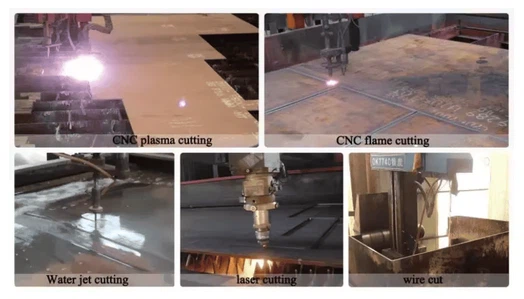
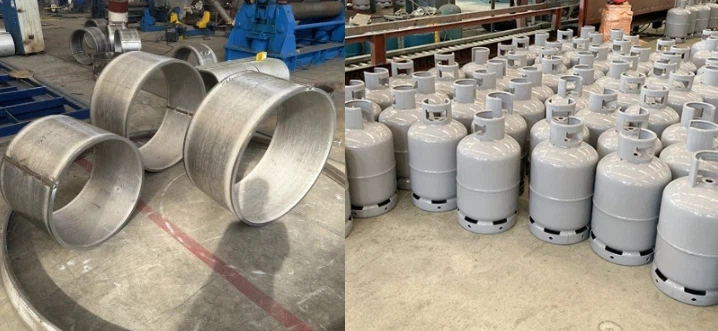
- Forming: The steel sheet is cut, then cold-formed into two half-cylinders or rolled into a tube and fitted with end caps (domes) .
- Welding: The longitudinal and circumferential seams are welded using standard, high-productivity arc welding methods. The steel's composition ensures a strong, consistent weld .
- Normalizing (Post-Weld Heat Treatment): The entire welded cylinder is subjected to a normalizing heat treatment . This process refines the grain structure of both the base metal and the weld zone, ensuring uniform mechanical properties across the entire cylinder, relieving residual stresses from forming and welding, and fully developing the strengthening effect of the niobium.
This integrated approach-selecting a steel grade that is optimized for forming, welding, and final heat treatment-is what makes P245NB the standard and reliable choice for manufacturers of welded gas cylinders worldwide.
Formability for Cylinder Geometry of P245NB steel
P245NB steel exhibits excellent formability that is specifically tailored to the cold-forming processes required for manufacturing gas cylinder geometries, making it a preferred material in the industry. Its unique combination of ductility, toughness, and uniform mechanical properties ensures that it can be precisely shaped into the complex, pressure-resistant structures of gas cylinders-from the cylindrical body to the end caps-without compromising structural integrity or performance.
Superior Deep Drawability: Enabling Seamless Cylinder Shaping
Deep drawability is one of the most critical formability characteristics of P245NB steel for gas cylinder manufacturing, as it directly supports the seamless shaping of core cylinder components-including the cylindrical body, top caps, and bottom caps. Unlike materials with poor drawability that are prone to cracking, tearing, or necking during the deep drawing process, P245NB boasts high elongation (≥26% for thickness < 3 mm and ≥34% for thickness ≥ 3 mm, per EN 10120) and excellent plastic deformation capacity.
During the deep drawing operation, P245NB steel can be stretched and formed into the desired curved and cylindrical shapes without splitting or material failure. This is attributed to its uniform grain structure (achieved through normalized or normalized-rolled delivery state) and low impurity content, which ensure consistent plastic flow across the entire material blank.

Uniform Thickness Retention: Critical for Pressure Containment Reliability
For gas cylinders, maintaining a consistent wall thickness throughout the entire structure is paramount to ensuring safe pressure containment. Uneven thickness can create stress concentrations-thinner areas are more prone to deformation or rupture under internal pressure, while thicker areas may lead to material waste and increased production costs. P245NB steel excels in retaining uniform gauge during the cold-forming process, addressing this critical requirement effectively.
Its balanced mechanical properties, including controlled yield strength (≥245 MPa) and tensile strength (360–450 MPa), allow for uniform deformation during forming operations such as deep drawing, bending, and ironing. The material's low carbon content and microalloying design prevent localized over-stretching or under-stretching, ensuring that the wall thickness of the cylinder body, end caps, and transition zones (where the body connects to the caps) remains consistent within strict manufacturing tolerances.
| Property | Specification (EN 10120) |
|---|---|
| Yield Strength (Rₑₕ) | ≥ 245 MPa |
| Tensile Strength (Rₘ) | 360–450 MPa |
| Elongation | ≥26% (t < 3 mm); ≥34% (t ≥ 3 mm) |
| Delivery State | Normalized or normalized-rolled |
Why Not Other Grades?
- Lower Strength Grades: Lack the required pressure capacity for standard applications.
- Higher Strength Alloys: Offer excessive strength but poorer weldability and formability, increasing production complexity and cost.
- P245NB Position: Strikes the optimal balance for mass production, safety, and performance.
Looking for a reliable supplier of P245NB gas cylinder steel? Contact GNEE today for expert advice, competitive pricing, and fast delivery-let us help you choose the best solution for your project.
Can P245NB be used for LPG cylinders?
Yes, P245NB is very suitable for manufacturing household and commercial LPG (liquefied petroleum gas) cylinders. Its excellent cold formability and weldability can meet the processing requirements of LPG cylinder shells and heads.
Is P245NB suitable for industrial gas cylinders?
Yes, P245NB can be used for industrial gas cylinders, such as oxygen cylinders, nitrogen cylinders, argon cylinders and carbon dioxide cylinders, especially for low-pressure industrial gas storage scenarios.
Can P245NB be used for fire extinguisher shells?
Yes, P245NB is suitable for manufacturing fire extinguisher shells. Its light weight, high strength and good cold formability make it an ideal material for small pressure-bearing fire extinguisher shells.
Is P245NB suitable for low-pressure vessels?
Yes, P245NB is suitable for low-pressure vessels with a design pressure of less than 1.6MPa, such as small air storage tanks, food-grade CO₂ storage tanks and other low-pressure storage equipment.
Can P245NB be used in low-temperature environments?
Yes, P245NB can be used in low-temperature environments. Its impact energy at -20℃ is ≥27J, which has good low-temperature toughness and can be used in cold regions (above -20℃) without brittle fracture.


