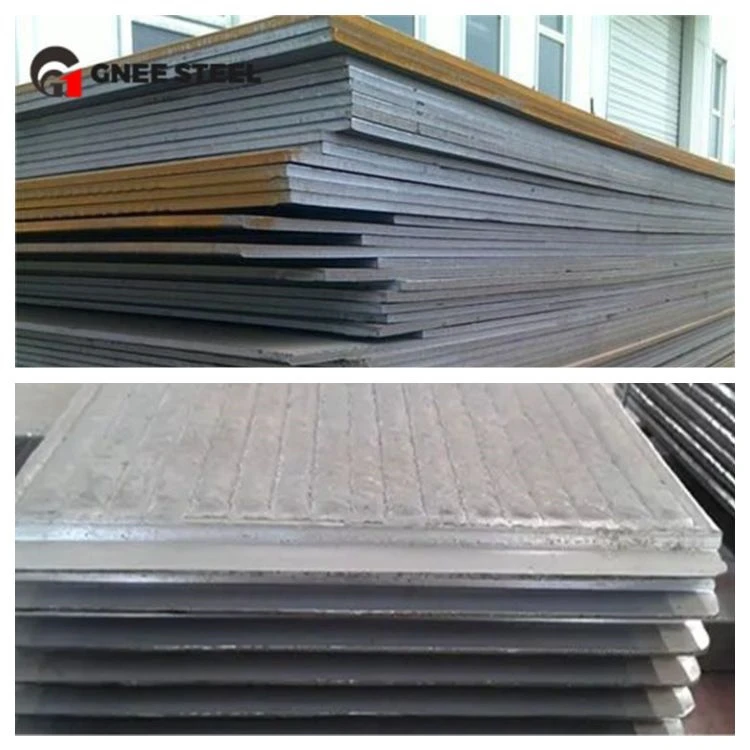
Causes and countermeasures of cracks caused by cold treatment of wear-resistant plate
Many studies have proved that high-speed steel tools and molds can significantly improve their life after ultra-low temperature treatment (-196℃). Some measuring tools, precision machinery parts, in order to ensure high dimensional stability, it is necessary to minimize residual austenite, usually cold treated wear-resistant plate parts at minus 80℃.
The main factors causing cracks in cold treatment process of wear-resistant plate are:
1. After the workpiece quenching, its own temperature is high; Or with too high hot water cleaning, the workpiece has not yet been cold to room temperature and into the low temperature box. At this time, due to the acceleration of the cooling rate, part of the untransformed austenite is further transformed into martensite, the tensile stress increases, and the brittle fracture resistance of the material is reduced at low temperature. When the stress exceeds the brittle fracture resistance of the material, cracks are caused. If there is already a microscopic crack, it may cause the crack to grow or expand into a macroscopic crack.
2. Due to the large size of the workpiece, the complex structure, the cold treatment temperature of the wear-resistant plate is too low (such as -196℃), the medium used for cold treatment is cooled faster and other factors, or the original internal stress is increased, which may form cold treatment cracks.
The characteristics of the cold treatment crack of the wear-resistant plate are the same as the quenching crack, the essence is the quenching crack.
Measures to prevent cold treatment cracks of wear-resistant plates:
1) The quenched workpiece is cooled thoroughly and then loaded into the low-temperature equipment.
2) For the workpiece with complex shape and wide difference in thickness, the thin part should be wrapped with asbestos before the cold treatment of the wear-resistant plate.
3) After cold treatment, tempering and aging are carried out immediately after the temperature of the parts rises to room temperature.
4) For parts with complex shapes, after quenching and cooling to room temperature, pre-tempering can be carried out at 110~130 ° C for 30~40min, and then cryogenic treatment of wear-resistant plates.