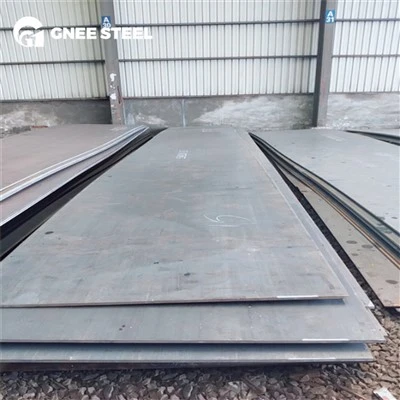
Hey there! As a supplier of JIS Pressure Vessel Plate, I often get asked if these plates can be used in high - temperature environments. Well, let's dive right into it and find out.

Understanding JIS Pressure Vessel Plates
First off, JIS (Japanese Industrial Standards) Pressure Vessel Plates are designed to meet specific requirements for use in pressure vessels. These plates come in different grades, each with its own set of properties. For example, we have JIS G3115 SPV410 Steel Plates For Boiler Pressure Vessel, SPV 235 Pressure Vessel Steel Plate, and SPV460 SPV490 For Pressure Vessel Container.
Factors Affecting Performance in High - Temperature Environments
Material Composition
The chemical composition of JIS Pressure Vessel Plates plays a crucial role in their performance at high temperatures. Elements like carbon, manganese, and chromium can have a significant impact. For instance, a higher carbon content can increase the strength of the plate, but it may also make it more brittle at high temperatures. On the other hand, chromium can improve the plate's resistance to oxidation and corrosion, which is essential in high - temperature settings.
Microstructure
The microstructure of the steel plate also matters. A fine - grained microstructure generally provides better mechanical properties at high temperatures. Heat treatment processes can be used to control the microstructure of the JIS Pressure Vessel Plates. For example, normalizing or quenching and tempering can enhance the plate's strength and toughness, making it more suitable for high - temperature applications.
Performance of Different Grades in High - Temperature Environments
SPV235
SPV235 is a relatively low - strength grade of JIS Pressure Vessel Plate. It has good weldability and is commonly used in general pressure vessel applications. At moderate high temperatures (up to around 350°C), SPV235 can maintain its mechanical properties reasonably well. However, as the temperature rises further, its strength starts to decrease. So, it's not the best choice for extremely high - temperature environments.
SPV410
JIS G3115 SPV410 Steel Plates For Boiler Pressure Vessel have better high - temperature performance compared to SPV235. They are designed for use in boilers and other pressure vessels where higher temperatures are involved. SPV410 can withstand temperatures up to around 400°C without significant loss of strength. It has a good balance of strength, ductility, and resistance to oxidation, making it a popular choice for many high - temperature applications.
SPV460 and SPV490
The SPV460 SPV490 For Pressure Vessel Container grades are higher - strength materials. They are capable of withstanding even higher temperatures compared to SPV410. These grades are often used in more demanding high - temperature applications, such as in power plants and chemical processing industries. They can maintain their mechanical properties at temperatures up to around 450°C, making them suitable for environments where high strength and durability are required.
Challenges in High - Temperature Use
Creep
One of the main challenges when using JIS Pressure Vessel Plates in high - temperature environments is creep. Creep is the slow deformation of a material under a constant load at high temperatures. Over time, this can lead to the failure of the pressure vessel. To mitigate creep, proper material selection and design are essential. Choosing a grade with high creep resistance, such as SPV460 or SPV490, can help reduce the risk of creep failure.
Oxidation and Corrosion
High temperatures can also accelerate oxidation and corrosion of the steel plates. Oxidation can lead to the formation of scale on the surface of the plate, which can reduce its thickness and weaken its structure. Corrosion can also occur due to the presence of moisture or other corrosive substances in the environment. To prevent oxidation and corrosion, protective coatings or surface treatments can be applied to the JIS Pressure Vessel Plates.
Applications in High - Temperature Environments
JIS Pressure Vessel Plates are used in a variety of high - temperature applications. In the power generation industry, they are used in boilers, steam turbines, and other components that operate at high temperatures. In the chemical industry, they are used in reactors, heat exchangers, and storage tanks. These plates are also used in the oil and gas industry for pressure vessels and pipelines that transport high - temperature fluids.

Conclusion
So, can JIS Pressure Vessel Plates be used in high - temperature environments? The answer is yes, but it depends on the specific grade and the temperature range. Different grades of JIS Pressure Vessel Plates have different capabilities when it comes to high - temperature performance. For moderate high - temperature applications, grades like SPV235 and SPV410 can be suitable. For more demanding high - temperature environments, SPV460 and SPV490 are better choices.
If you're in the market for JIS Pressure Vessel Plates for high - temperature applications, I'd love to have a chat with you. We can discuss your specific requirements and find the right grade of plate for your project. Feel free to reach out to me to start the procurement process and let's work together to get the best solution for your needs.
References
- ASME Boiler and Pressure Vessel Code
- JIS G3115 Standard
- Steel Industry Handbook on High - Temperature Materials