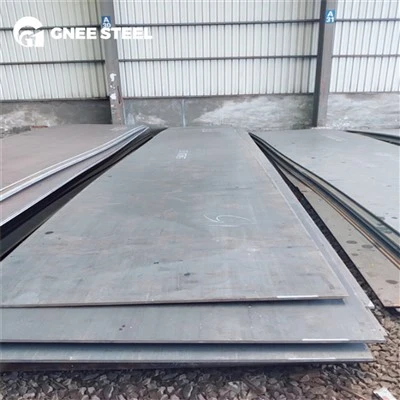
As a reliable supplier of EN Low Alloy Steel Plate, ensuring the flatness of our products during production is of utmost importance. Flatness is a critical quality characteristic that directly impacts the performance and usability of the steel plates in various applications. In this blog, I will share some key strategies and practices that we implement to guarantee the flatness of our EN Low Alloy Steel Plates.
Raw Material Selection
The journey to achieving flat steel plates begins with the careful selection of raw materials. High - quality billets or slabs are the foundation for producing flat steel plates. We source our raw materials from trusted suppliers who adhere to strict quality control standards. The chemical composition of the raw material must be precisely controlled. For example, elements such as carbon, manganese, and silicon can affect the mechanical properties and thermal behavior of the steel during processing. Any deviation in the chemical composition can lead to uneven expansion and contraction, resulting in warping or distortion of the steel plate.
We also conduct thorough inspections of the incoming raw materials. Non - destructive testing methods, such as ultrasonic testing, are used to detect internal defects like cracks or inclusions. Defective raw materials are immediately rejected as they can cause significant problems during the rolling and heat - treatment processes, ultimately affecting the flatness of the final product.
Rolling Process Optimization
The rolling process is a crucial step in determining the flatness of the EN Low Alloy Steel Plate. During rolling, the steel is passed through a series of rolling mills to reduce its thickness and increase its length. To ensure flatness, we optimize several parameters in the rolling process.
Firstly, the roll gap must be accurately set. The roll gap is the distance between the upper and lower rolls in the rolling mill. If the roll gap is not uniform across the width of the steel plate, it can lead to uneven deformation, causing the plate to be bowed or cambered. We use advanced measurement and control systems to precisely adjust the roll gap based on the desired thickness and flatness requirements of the plate.
Secondly, the rolling speed is carefully controlled. A consistent rolling speed helps to ensure uniform deformation of the steel. If the rolling speed is too high, it can cause excessive heat generation, which may lead to thermal stresses and distortion of the plate. On the other hand, a very low rolling speed can be inefficient and may also result in uneven deformation. We conduct extensive research and testing to determine the optimal rolling speed for different grades of EN Low Alloy Steel Plates, such as the S460Q Low Alloy Steel Plate, S275N Low Alloy Steel Plate, and S960Q Low Alloy Steel Plate.
In addition, the number of rolling passes is also a critical factor. Multiple rolling passes are often required to achieve the desired thickness and flatness. Each pass should be carefully planned to ensure that the deformation is gradually and evenly distributed across the plate. We use mathematical models and simulation software to optimize the number and sequence of rolling passes to minimize the risk of flatness defects.
Heat Treatment
Heat treatment is another important process for ensuring the flatness of EN Low Alloy Steel Plates. After rolling, the steel plate may have internal stresses that can cause it to warp or distort over time. Heat treatment is used to relieve these internal stresses and improve the mechanical properties of the steel.
The most common heat - treatment processes for low - alloy steel plates include annealing, normalizing, and quenching and tempering. For annealing, the steel plate is heated to a specific temperature and held for a certain period of time, followed by slow cooling. This process helps to relieve internal stresses and refine the grain structure of the steel, improving its flatness and ductility.
During the heat - treatment process, the heating and cooling rates must be carefully controlled. If the heating rate is too fast, it can cause thermal shock, leading to cracking or warping of the plate. Similarly, an uneven cooling rate can result in uneven stress distribution, causing the plate to become distorted. We use advanced furnaces with precise temperature control systems to ensure uniform heating and cooling of the steel plates.
Straightening
Even with careful control of the rolling and heat - treatment processes, some minor flatness deviations may still occur. Straightening is the final step to correct these deviations and ensure that the EN Low Alloy Steel Plate meets the required flatness standards.
We use mechanical straightening machines to straighten the steel plates. These machines apply a series of bending forces to the plate to correct its shape. The straightening process is based on the principle of plastic deformation. By applying the appropriate amount of force at the right locations, the plate can be bent back into a flat shape.
Before straightening, we measure the flatness of the plate using precision measuring tools, such as laser flatness gauges. Based on the measurement results, the straightening parameters, such as the bending force and the number of passes through the straightening machine, are determined. After straightening, the plate is re - measured to ensure that it meets the specified flatness requirements.
Quality Control and Inspection
Throughout the production process, we implement a strict quality control system to monitor the flatness of the EN Low Alloy Steel Plate. In - process inspections are carried out at various stages, from raw material inspection to the final straightening process.
In addition to the non - destructive testing methods mentioned earlier, we also use visual inspection to detect surface defects and flatness deviations. Trained inspectors visually examine the steel plates for any signs of warping, bowing, or other flatness problems. Any plates that do not meet the quality standards are marked for re - work or rejection.
We also maintain detailed production records for each batch of steel plates. These records include information about the raw materials, rolling parameters, heat - treatment conditions, and straightening processes. By analyzing these records, we can identify any trends or patterns related to flatness problems and take appropriate corrective actions to improve the production process.


Conclusion
Ensuring the flatness of EN Low Alloy Steel Plate during production is a complex and multi - step process that requires careful attention to every detail. From raw material selection to the final quality control, each step plays a crucial role in determining the flatness of the final product.
As a supplier of EN Low Alloy Steel Plate, we are committed to providing our customers with high - quality products that meet the strictest flatness standards. Our state - of - the - art production facilities, advanced technology, and experienced team of professionals enable us to produce flat and defect - free steel plates for a wide range of applications.
If you are in the market for high - quality EN Low Alloy Steel Plates, including S460Q Low Alloy Steel Plate, S275N Low Alloy Steel Plate, and S960Q Low Alloy Steel Plate, please feel free to contact us for procurement and negotiation. We are confident that our products will meet your requirements and exceed your expectations.
References
- ASM Handbook, Volume 6: Welding, Brazing, and Soldering. ASM International.
- "Flatness Control in Cold Rolling of Steel Strips" by X. Liu, Y. Wang, and Z. Guo. Journal of Materials Processing Technology.
- "Heat Treatment Principles and Techniques for Low - Alloy Steels" by R. D. Pehlke. ASM International.