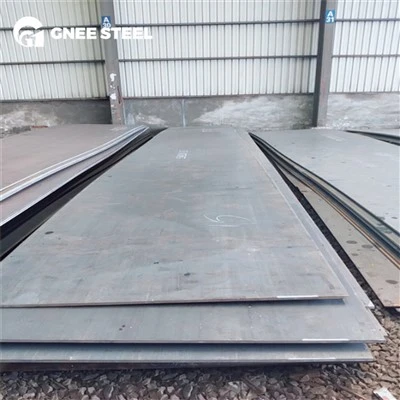
Hey there! As a supplier of low alloy steel plates, I've seen firsthand how important it is to have properly straightened plates for various applications. In this blog, I'm gonna share some of the straightening methods for low alloy steel plates that we use and recommend.
First off, let's understand why straightening is necessary. Low alloy steel plates can get distorted during the manufacturing process, transportation, or even due to improper storage. These distortions can lead to problems when the plates are used in construction, machinery, or other applications. So, straightening them is crucial to ensure they meet the required specifications and perform as expected.

Mechanical Straightening
One of the most common methods is mechanical straightening. This involves using machines to apply force to the steel plate to correct its shape. There are different types of mechanical straightening equipment, such as roller straighteners and press straighteners.
Roller Straighteners
Roller straighteners work by passing the steel plate through a series of rollers. These rollers apply pressure at different points along the plate, gradually bending it back into a flat shape. It's a relatively fast and efficient method, and it can handle plates of various thicknesses. We often use roller straighteners for large - scale production because they can straighten multiple plates in a short period. For instance, when we're dealing with a bulk order of Q420B Low Alloy Steel Plate, roller straighteners are our go - to machines. They ensure that each plate has a uniform flatness, which is essential for applications like building structures.
Press Straighteners
Press straighteners, on the other hand, use a hydraulic or mechanical press to apply force to specific areas of the plate. This method is more precise and is suitable for correcting local distortions or for plates that require a very high degree of straightness. For example, if a small section of an ASME SA709 Grade100 Hsla Structural Steel Plate is bent due to handling during transportation, a press straightener can be used to fix that specific area without affecting the rest of the plate.
Thermal Straightening
Another method is thermal straightening. This method uses heat to change the internal stress distribution of the steel plate, which in turn helps to straighten it.
Flame Straightening
Flame straightening is a well - known thermal straightening technique. In this process, a torch is used to heat specific areas of the steel plate. As the heated area expands and then contracts during cooling, it creates a change in the internal stress, which can correct the distortion. However, it requires a high level of skill because overheating can damage the mechanical properties of the low alloy steel. We usually reserve flame straightening for cases where mechanical straightening isn't enough, like when dealing with complex or severe distortions in JIS SMA400AP BP CP Low Alloy Structural Steel Plate.
Stress - Relieving Heat Treatment
Stress - relieving heat treatment can also be considered as a form of straightening in a way. When low alloy steel plates are subjected to stress - relieving heat treatment, the internal stresses that cause distortion are reduced. The plate is heated to a specific temperature and then held at that temperature for a certain period before being slowly cooled. This process helps to relax the internal structure of the steel, which can make the plate flatter. It's a more time - consuming method compared to mechanical or thermal straightening, but it's very effective for ensuring long - term stability of the plate's shape.
Factors to Consider
When choosing a straightening method, there are several factors to take into account.
Plate Thickness
Thicker plates may require more force and different techniques compared to thinner ones. For example, very thick low alloy steel plates might be better suited for press straightening or a combination of mechanical and thermal methods, while thinner plates can often be straightened using roller straighteners.
Degree of Distortion
If the distortion is minor, a simple mechanical straightening process might be enough. But for severe distortions, a combination of methods or more advanced techniques like flame straightening may be necessary.
Mechanical Properties of the Steel
Different low alloy steels have different mechanical properties, such as yield strength and hardness. These properties can affect the straightening process. For instance, a steel with high yield strength may require more force to straighten, and the straightening process needs to be carefully controlled to avoid cracking or other damage.
Quality Control
After straightening, it's crucial to conduct quality control checks. We use various measuring tools, such as straightedges, laser scanners, and calipers, to ensure that the plates meet the required flatness and dimensional tolerances. Any plates that don't meet the standards are either re - straightened or rejected.
In conclusion, there are several effective straightening methods for low alloy steel plates, each with its own advantages and suitable applications. As a supplier, we're committed to providing high - quality, properly straightened low alloy steel plates to our customers. Whether you need Q420B Low Alloy Steel Plate, ASME SA709 Grade100 Hsla Structural Steel Plate, or JIS SMA400AP BP CP Low Alloy Structural Steel Plate, we've got the expertise and the right straightening methods to meet your needs. If you're in the market for low alloy steel plates, don't hesitate to reach out to us for a quote and to discuss your specific requirements. We're here to help you get the best - quality products for your projects.
References
- "Steel Plate Manufacturing and Processing Handbook"
- Industry standards and guidelines for low alloy steel plate manufacturing and straightening