

Hey there! As a supplier of GB Low Alloy Steel Plate, I often get asked about the pre - heating requirement for welding these plates. So, I thought I'd write this blog to share some insights on this topic.
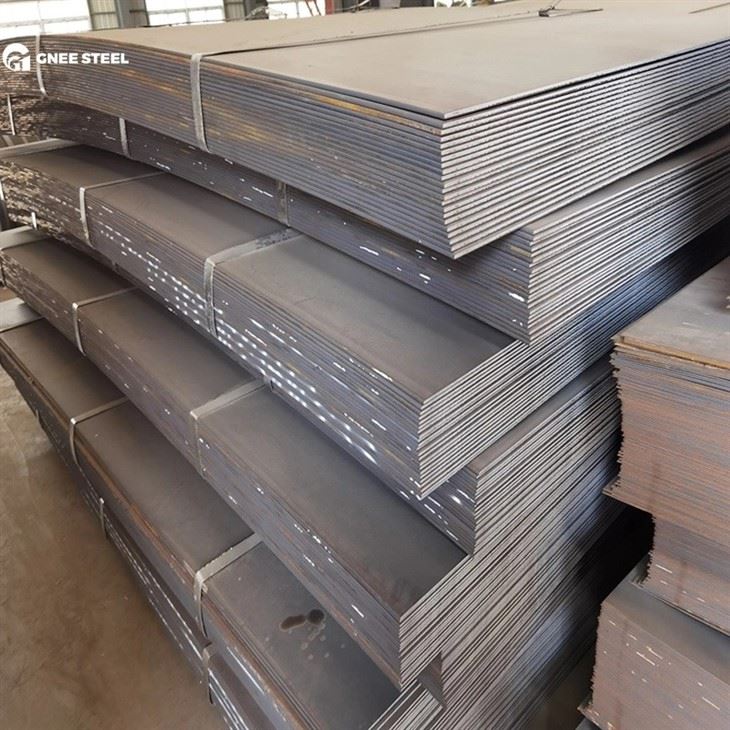
First off, let's understand what GB Low Alloy Steel Plate is. GB refers to the Chinese national standards, and low - alloy steel plates are steel plates that contain a small amount of alloying elements. These alloying elements can improve the strength, toughness, and corrosion resistance of the steel. We offer a variety of GB Low Alloy Steel Plates, like the Q390C Low Alloy Steel Plate, Q500F Low Alloy Steel Plate, and Q390D Low Alloy Steel Plate.
Now, why is pre - heating necessary for welding GB Low Alloy Steel Plate? Well, welding is a process that involves heating and cooling the steel. When you weld low - alloy steel, the rapid heating and cooling can cause some issues. For example, it can lead to the formation of hard and brittle microstructures, which can reduce the toughness of the weld and make it more prone to cracking. Pre - heating helps to slow down the cooling rate after welding, which can prevent the formation of these undesirable microstructures.

There are several factors that determine the pre - heating requirement for welding GB Low Alloy Steel Plate.
Chemical Composition
The chemical composition of the steel is a major factor. Different alloying elements have different effects on the hardenability of the steel. For instance, elements like carbon, manganese, chromium, and molybdenum can increase the hardenability of the steel. If the steel has a high content of these elements, it will be more likely to form hard and brittle microstructures during welding. So, steels with higher alloy content usually require higher pre - heating temperatures.
Plate Thickness
Thicker plates generally require higher pre - heating temperatures. This is because thicker plates have a larger heat sink. When you weld a thick plate, the heat from the welding process is dissipated more quickly into the surrounding metal. Pre - heating helps to compensate for this heat loss and maintain a more uniform temperature distribution in the plate during welding. For example, a thin GB Low Alloy Steel Plate may only need a pre - heating temperature of around 50 - 100°C, while a very thick plate could require pre - heating up to 200 - 300°C or even higher.
Welding Process
The type of welding process you use also affects the pre - heating requirement. Some welding processes, like shielded metal arc welding (SMAW) and gas tungsten arc welding (GTAW), produce less heat input compared to processes like submerged arc welding (SAW). Processes with lower heat input may require higher pre - heating temperatures to ensure proper fusion and prevent cracking.
Ambient Temperature
The temperature of the surrounding environment matters too. If you're welding in a cold environment, the steel will cool down more rapidly during and after welding. So, in cold conditions, you may need to increase the pre - heating temperature to offset the effect of the cold ambient temperature.
How to Determine the Pre - heating Temperature?
There are a few ways to figure out the right pre - heating temperature for welding GB Low Alloy Steel Plate.
One way is to refer to the welding procedure specification (WPS). A WPS is a document that provides detailed instructions on how to perform a specific welding job. It usually includes information on the pre - heating temperature, welding parameters, and post - weld heat treatment. Many steel manufacturers provide recommended WPSs for their products.
Another method is to use a carbon equivalent formula. The carbon equivalent is a value that takes into account the combined effect of different alloying elements on the hardenability of the steel. One commonly used carbon equivalent formula is the IIW formula:
$CE = C+\frac{Mn}{6}+\frac{Cr + Mo+V}{5}+\frac{Ni + Cu}{15}$
Based on the calculated carbon equivalent value, you can estimate the pre - heating requirement. Generally, if the carbon equivalent is high, a higher pre - heating temperature is needed.
Pre - heating Methods
There are several methods for pre - heating GB Low Alloy Steel Plate.
Electrical Resistance Heating
This method uses electrical current to generate heat in the steel. It's a very precise method and can be easily controlled. You can use electrical heating pads or coils to heat the plate. Electrical resistance heating is suitable for both small and large - scale welding jobs.
Gas Flame Heating
Gas flame heating is a simple and widely used method. You can use oxy - acetylene or propane torches to heat the plate. However, it requires some skill to ensure uniform heating. If not done properly, it can lead to uneven temperature distribution in the plate.
Induction Heating
Induction heating uses electromagnetic induction to heat the steel. It's a fast and efficient method, especially for large plates. The heat is generated directly in the steel, which allows for quick and uniform heating.
Monitoring the Pre - heating Temperature
It's crucial to monitor the pre - heating temperature to ensure that it meets the requirements. You can use temperature - measuring devices like thermocouples or infrared thermometers. Thermocouples are more accurate and can be placed directly on the surface of the plate to measure the temperature. Infrared thermometers are non - contact devices that can measure the surface temperature from a distance.
Post - weld Considerations
After pre - heating and welding, it's also important to take some post - weld measures. For example, post - weld heat treatment (PWHT) can be used to relieve residual stresses in the weld and improve the mechanical properties of the welded joint. PWHT usually involves heating the welded joint to a specific temperature and holding it there for a certain period of time, followed by slow cooling.
In conclusion, the pre - heating requirement for welding GB Low Alloy Steel Plate depends on multiple factors, including the chemical composition, plate thickness, welding process, and ambient temperature. By understanding these factors and using the right methods to determine and apply the pre - heating temperature, you can ensure high - quality welds and avoid issues like cracking and reduced toughness.
If you're in the market for GB Low Alloy Steel Plate or have any questions about the pre - heating requirements for welding, don't hesitate to reach out. We're here to help you with all your steel needs and provide you with the best solutions for your welding projects.
References
- AWS D1.1/D1.1M:2020, Structural Welding Code - Steel
- Welding Handbook, Volume 2: Welding Processes, American Welding Society


