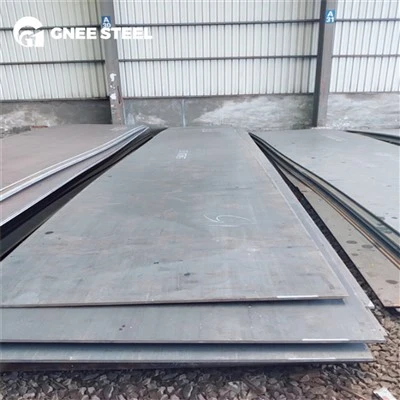
Hey there! As a supplier of ASTM Alloy Steel Plate, I've been getting a bunch of questions about the aging properties of these plates. So, I thought I'd write this blog to share what I know and help you understand more about it.

First off, let's talk about what aging means in the context of ASTM Alloy Steel Plate. Aging is a process that occurs over time and can change the properties of the steel. This can include things like its strength, hardness, and ductility. There are two main types of aging: natural aging and artificial aging.
Natural aging happens at room temperature over a long period. When ASTM Alloy Steel Plate is exposed to normal environmental conditions, certain internal changes take place. For example, the precipitation of fine particles within the steel's microstructure can occur. These particles can act as barriers to the movement of dislocations (defects in the crystal structure of the steel), which in turn can increase the strength and hardness of the plate.
Artificial aging, on the other hand, is a process where the steel plate is heated to a specific temperature for a set period. This accelerates the precipitation process and can lead to more significant changes in the steel's properties in a shorter time. By controlling the temperature and time during artificial aging, we can tailor the properties of the ASTM Alloy Steel Plate to meet specific requirements.
Now, let's look at how these aging processes affect the different properties of ASTM Alloy Steel Plate.

Strength and Hardness
One of the most noticeable effects of aging is the increase in strength and hardness. As mentioned earlier, the precipitation of particles during aging restricts the movement of dislocations in the steel. This means that it becomes more difficult for the steel to deform under stress, resulting in higher strength and hardness. For applications where high strength is required, such as in the construction of bridges or heavy machinery, the aging process can be a great advantage. For instance, ASTM 8620 Rolled Steel Plate can benefit from aging to enhance its load - bearing capacity.

Ductility
However, an increase in strength and hardness often comes at the expense of ductility. Ductility is the ability of the steel to deform plastically before fracturing. As the steel becomes harder during aging, it becomes less ductile. This can be a concern in applications where the steel needs to undergo significant deformation without breaking, like in the manufacturing of automotive parts. So, when choosing an ASTM Alloy Steel Plate and considering the aging process, it's important to strike a balance between strength and ductility.
Corrosion Resistance
Aging can also have an impact on the corrosion resistance of ASTM Alloy Steel Plate. In some cases, the precipitation of particles during aging can create micro - galvanic cells within the steel. These cells can accelerate the corrosion process, reducing the plate's resistance to rust and other forms of corrosion. On the other hand, proper aging can also improve corrosion resistance in certain alloys. For example, some alloying elements can form protective oxide layers on the surface of the steel during aging, which can prevent further corrosion. The ASTM 15CrMo Alloy Plate Heat - Resistant Steel Plate may require careful aging to maintain its corrosion resistance, especially in high - temperature and corrosive environments.
Impact Toughness
Impact toughness is another important property that can be affected by aging. Impact toughness measures the ability of the steel to absorb energy during impact loading without fracturing. Aging can reduce the impact toughness of ASTM Alloy Steel Plate, especially if the aging process leads to excessive precipitation and embrittlement. This is a critical consideration in applications where the steel may be subjected to sudden impacts, such as in the mining or aerospace industries.
So, how do we control the aging properties of ASTM Alloy Steel Plate? Well, it all starts with the alloy composition. Different alloying elements have different effects on the aging process. For example, elements like copper, nickel, and magnesium can promote precipitation during aging, while others like chromium and molybdenum can improve corrosion resistance and high - temperature stability.
The heat treatment process also plays a crucial role. The initial heat treatment, such as quenching and tempering, can set the stage for the aging process. By controlling the heating and cooling rates during these processes, we can control the microstructure of the steel and how it responds to aging.
The aging temperature and time are also key factors. Higher aging temperatures generally lead to faster precipitation, but they can also cause over - aging, which can result in a decrease in properties. So, it's important to find the right combination of temperature and time for each specific alloy and application.
As a supplier, I've seen firsthand how important it is to understand the aging properties of ASTM Alloy Steel Plate. Whether you're in the construction, automotive, or manufacturing industry, getting the right steel with the appropriate aging properties can make a big difference in the performance and longevity of your products.
If you're interested in ASTM 20CrMo Structural Sheet or any other ASTM Alloy Steel Plate, and you want to know more about how we can tailor the aging properties to meet your specific needs, don't hesitate to reach out. We're here to help you make the best choice for your project. Contact us to start a conversation about your procurement needs and let's work together to find the perfect solution.
References
- ASM Handbook Volume 4: Heat Treating. ASM International.
- Metals Handbook Desk Edition, 3rd Edition. ASM International.